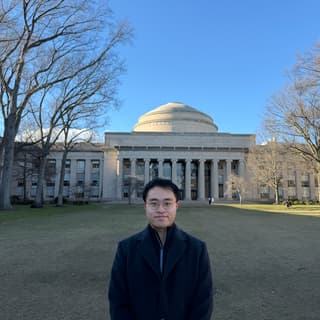
Tianhao Luo

Studied at Harvard Medical School
Available tomorrow
Starting at 6:00 PM UTC
Questions? Start chatting with this coach before you get started.
Education
Harvard Medical School
PhD, Biomedical AI
2025 - 2030
At Harvard Medical School, I’m pursuing a PhD in Biomedical Informatics focused on AI and computational biology. My experience has been shaped by rigorous research training, interdisciplinary collaboration, and mentorship from leaders across medicine and science. Harvard has helped me grow as both a researcher and mentor, and it’s given me valuable insight into succeeding in highly competitive academic environments.
The Wharton School (UPenn)
Bachelor's Degree, Statistics
2021 - 2025
At Wharton during undergrad, I built a strong foundation in business, entrepreneurship, and strategic thinking that complemented my training in statistics, mathematics, and computational biology at Penn. The experience sharpened my ability to connect rigorous analysis with real-world impact and continues to shape how I approach innovation in AI, healthcare, and startups.

University of Pennsylvania
Bachelor's Degree, Mathematics, Computational Biology
2021 - 2025
My time at the University of Pennsylvania was shaped by a rare mix of academic depth, research intensity, leadership, and creative exploration. As a dual-degree student across the College of Arts and Sciences and Wharton, I studied statistics, pure mathematics, and computational biology while also building a strong foundation in business, entrepreneurship, and strategic thinking. That combination shaped how I approach problems today: with both analytical rigor and a focus on real-world impact. At Penn, I immersed myself in research at the intersection of computation and biology. I worked on questions spanning genomics, single-cell biology, and translational medicine, and I learned how to move from abstract quantitative ideas to meaningful biomedical applications. Research taught me how to think independently, ask sharper questions, and stay resilient through ambiguity. It also gave me the chance to contribute to projects with real scientific and clinical relevance, which deepened my commitment to using data and AI to improve healthcare. Leadership was another defining part of my Penn experience. I took on teaching roles in statistics, including serving as a TA and later Head TA for Bayesian Statistics, where I discovered how much I enjoy mentoring others and making difficult material more accessible. Outside the classroom, I also built and supported mission-driven initiatives, from entrepreneurship to education, which strengthened my ability to lead teams, communicate clearly, and turn ideas into action. What made Penn especially meaningful, though, was that my life there was never only academic. I remained deeply connected to the things I love outside of work, including violin, running, and classical music. Those interests kept me grounded and reminded me that growth is not just about achievement, but also about discipline, balance, and joy. Looking back, Penn was where I learned how to be both rigorous and expansive: a researcher, builder, mentor, and person with interests far beyond any single path.