Leland+ for Executive Coaching





Popular on Leland+
Free
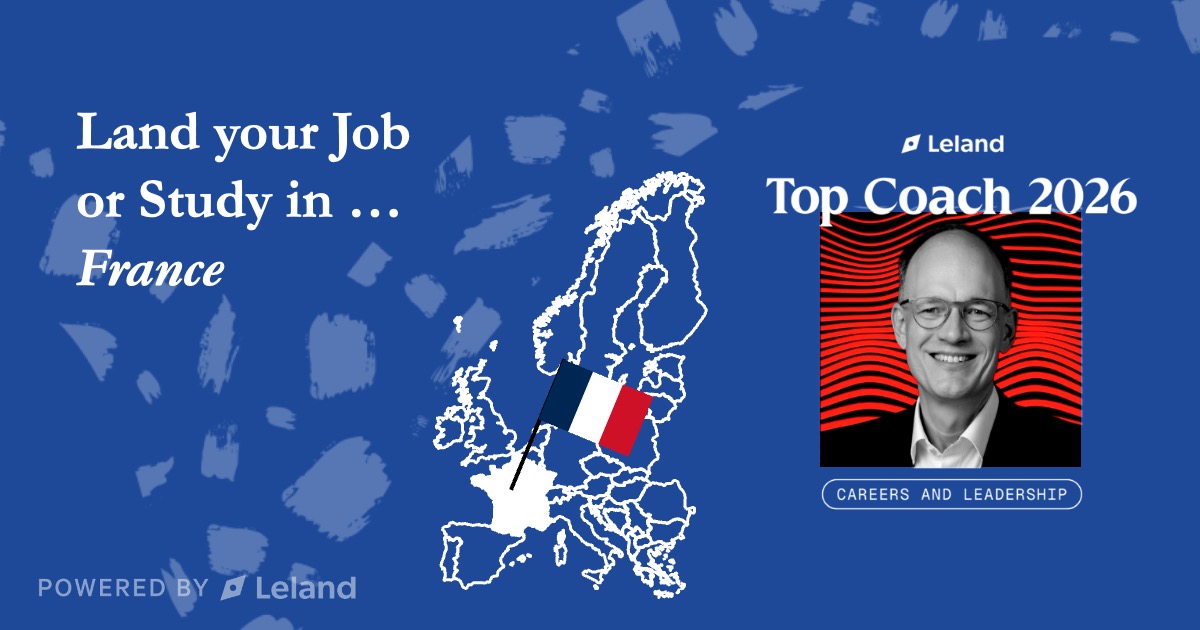
Land Your Job or Study in ... France
France is not just Paris, luxury brands, and Grandes Écoles. It is Europe's second largest economy, home to 5,500 companies operating in the US alone, and one of the world's top destinations for AI investment. For non-EU graduates and young to mid-career professionals who take it seriously, France offers a career path that is both internationally prestigious and genuinely accessible. The question everyone asks first is the language. It is a fair question and this session answers it honestly: where English is enough, where French matters, and at what point in a career it becomes a real differentiator. We cover the study path and the direct job path side by side: visa options, grandes écoles versus public universities, living costs in Paris and beyond, workplace culture, and what makes a French employer say yes to an international candidate. Two real cases show how people with no European background made it work. France rewards those who understand the culture before they apply. This Thursday, we get into the details. New episodes in this series cover a different European country every Thursday.

The Year-End Review Playbook
Most professionals approach the year-end review passively and leave the outcome to chance. This guide covers the full process high performers use: building a documented case throughout the year, writing a self-assessment for the calibration room (not just your manager’s inbox), preparing your manager to advocate for you in the room you’re not in, and using the review conversation to set the terms for next year. Includes before/after self-assessment examples and exact language for the conversations most people avoid.
Free
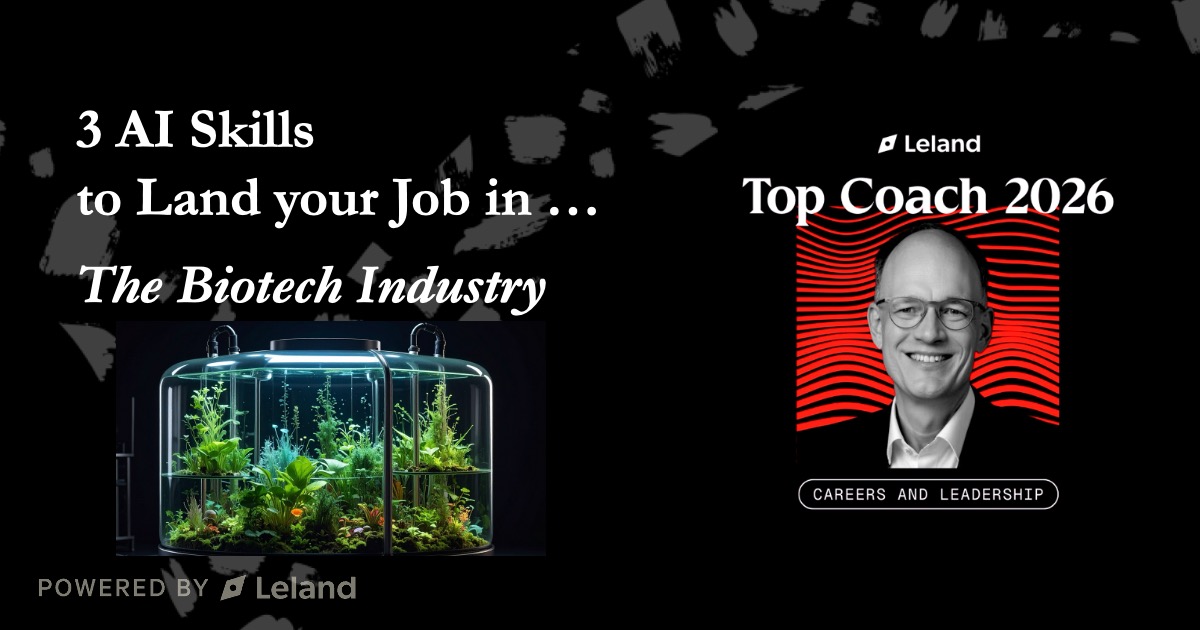
3 AI Skills to Land your Job in ... the Biotech Industry
Some people assume biotech is purely science: pipettes, gene sequences, clinical trials. In practice, the industry runs on physical infrastructure as demanding as any in manufacturing. A diagnostic device that detects a cancer marker with enough reliability to inform a treatment decision. A surgical instrument precise enough to operate where a millimeter is the margin between success and failure. A monitoring system that tracks a patient's vital signs continuously, without interruption, for weeks. These are tangible products in the most consequential sense: the stakes attached to their performance are measured in human outcomes. I spent more than 10 years working with the biotech industry as a supplier, managing it as a strategic key account across multiple market segments. I understand what biotech and medtech companies require from their partners and their people; I also know which skills are shifting fast right now because of AI. This Tuesday session covers the biotech industry: one of the most regulated, most innovation-driven, and most purposeful sectors in the global economy. We will discuss three specific AI skills that are changing what hiring managers expect, and how you can demonstrate them before you walk into an interview. If you want a career where the tangible product you help bring to market can directly improve someone's life, this session is for you.
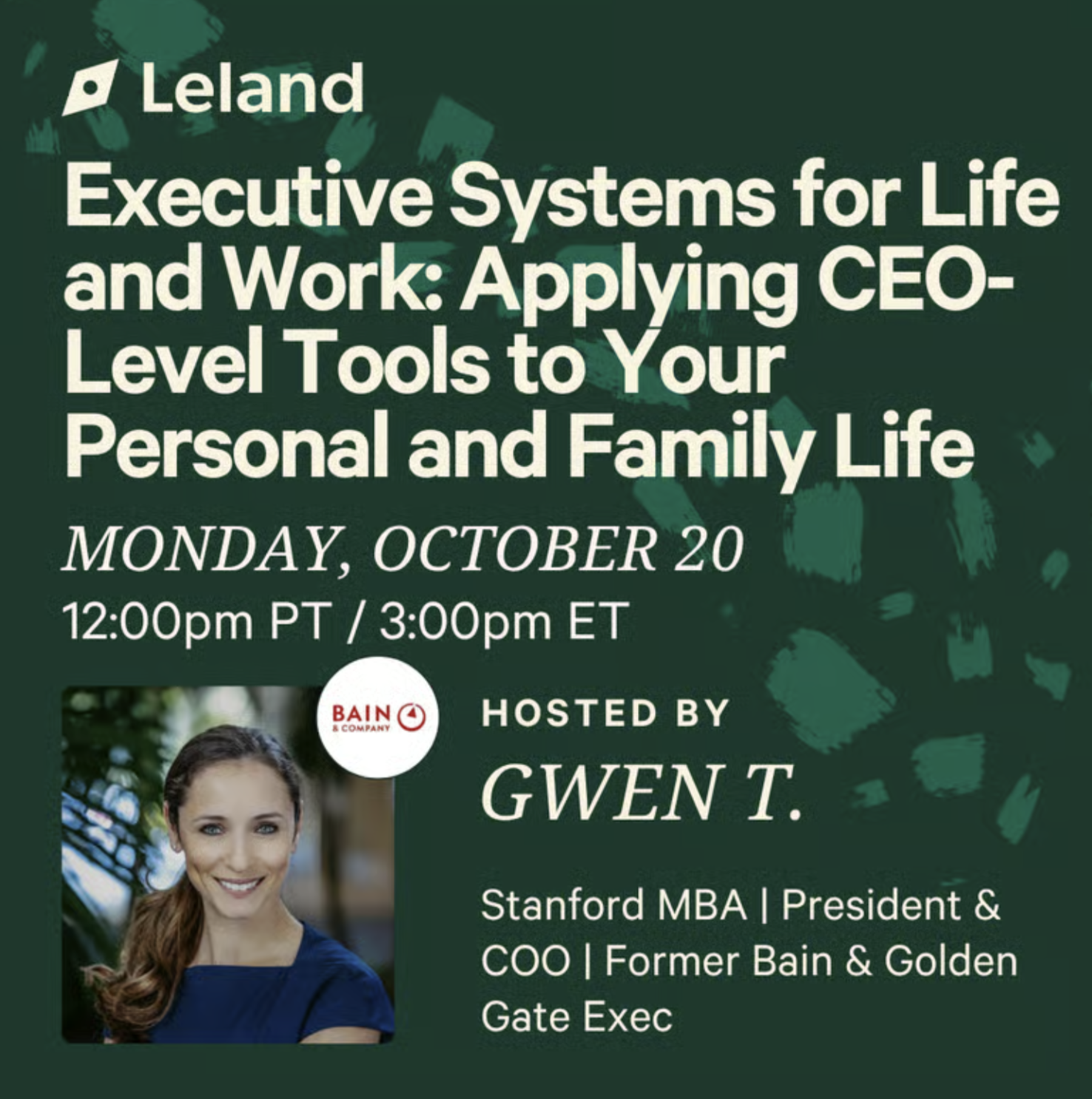
Executive Systems for Life and Work: Applying CEO-Level Tools to Your Personal and Family Life
The best leaders don’t just run great companies—they run their lives with the same level of clarity, structure, and purpose. In this session, expert Leland coach Gwen T. will share how to apply executive-level systems and frameworks to your personal and family life to create more alignment, efficiency, and peace of mind. You’ll walk away with practical, easy-to-implement strategies to operate your life like a high-performing organization—without losing sight of what matters most.


Your First 90 Days: How to Build Credibility and Momentum in Any New Role for Leaders
Starting a new leadership role can be both exciting and daunting. In this session, Matt T., former McKinsey consultant and executive coach to Fortune 500 leaders, will share his proven Onboarding Accelerator Framework—designed to help new leaders build credibility, drive alignment, and accelerate impact in their first 90 days. Whether you’re stepping into a new company or expanding your leadership scope, you’ll walk away with practical strategies to establish momentum and set yourself up for long-term success.

Free

The Unwritten Rules of Getting Promoted
This pdf offers 3 rules of getting promoted that most often get missed when people find themselves stuck in their careers. It also offers some powerful questions you can ask your boss to help you understand what might be going on when you are feeling stuck in your career.
Free
Land Your Job or Study in ... Denmark
Denmark does not make much noise. It does not need to. Novo Nordisk alone accounts for roughly 4% of the entire Danish GDP. Vestas leads the world in wind energy. Danfoss sets the standard in industrial automation. These are not household names to most non-EU professionals, and that is precisely the point: the competition for roles here is lower than the quality of the companies would suggest. The labour market is tight and the skills shortage is real, which works in your favour. English is the default language in most professional environments. The workforce is genuinely multicultural, and Danish workplace culture is notably flat: titles matter less than contribution. This session covers both paths in: studying at world-class institutions like Copenhagen Business School and the Technical University of Denmark, and entering the job market directly. We go through visa options, the Danish approach to work-life integration, living costs, and what international candidates consistently get wrong in their applications. Two real cases show what a successful move to Denmark actually looks like. Denmark is smaller than its neighbours and more selective. This Thursday, we show you exactly how to qualify. New episodes in this series cover a different European country every Thursday.
Free
Land your Job or Study in ... Switzerland
Switzerland is not part of the EU. It does not have the largest job market in Europe. And it is, by most measures, one of the most expensive countries in the world to live in. None of that stops it from being one of the most attractive destinations on the continent for ambitious non-EU graduates and young professionals: it simply requires knowing what you are walking into. The country hosts the European or global headquarters of Nestlé, Novartis, Roche, ABB, UBS, Credit Suisse's successor operations, and dozens of precision engineering and medtech companies that most people outside Europe have never heard of. Salaries are the highest in Europe by a significant margin, which is the other side of the cost equation. ETH Zurich consistently ranks among the world's top ten universities. English is widely used in professional environments, particularly in Zurich and Geneva. This session covers the study path and the direct job path side by side: how the permit system works for non-EU nationals, what living in Zurich or Geneva actually costs, language realities across the four linguistic regions, and how to position yourself in a market that rewards precision, reliability, and depth over volume. Two real cases show how international candidates made it work. Switzerland is selective. It rewards those who come prepared. In this session, we lay out exactly what that means in practice. New episodes in this series cover a different European country every Thursday.
Free
3 AI Skills to Land Your Job in ... The Green Energy Industry
Some people assume green energy is about policy, subsidies, and political will. In practice, the industry runs on physical hardware as demanding as any in heavy manufacturing. A wind turbine nacelle housing a gearbox that must perform reliably at 100 meters altitude in North Sea conditions for 25 years. A solar panel assembly sealed well enough to withstand thermal cycling, humidity, and UV exposure across decades of outdoor installation. A battery cell precise enough in its chemistry and construction to store grid-scale energy without degradation. These are tangible products; the energy transition does not happen without them. I spent more than 10 years selling to the green energy industry, working across its supply chain at the component and system level. Beyond that, I have coached candidates on Leland preparing for roles in this sector, several of whom have since been successfully hired. I understand what green energy companies require from their people; I also know which skills are shifting fast right now because of AI. This Tuesday session covers the green energy industry: one of the fastest-growing, most capital-intensive, and most consequential sectors in the global economy. We will discuss three specific AI skills that are changing what hiring managers expect, and how you can demonstrate them before you walk into an interview. If you want a career where the tangible product you help bring to market contributes to something larger than a balance sheet, this session is for you.
Free

Land your Job or Study in ... Germany
Germany is not just beer, efficiency, and engineering heritage. It is one of the most accessible countries in the world right now for ambitious non-EU graduates and young professionals who want to build something serious. Over 600,000 skilled positions go unfilled every year. The government rewrote its immigration law in 2023 specifically to bring international talent in. Public universities charge close to nothing. Tech companies, global pharma, and the entire renewable energy sector are actively hiring people with your profile. This session cuts through the noise. We cover the study path and the direct job path, side by side: visa options, living costs, language reality, workplace culture, and what a competitive application actually looks like. Two real cases show how people with no German, applying from abroad, made it work. Germany rewards preparation and specificity. This Thursday, we provide both. New episodes in this series cover a different European country every Thursday.
Free
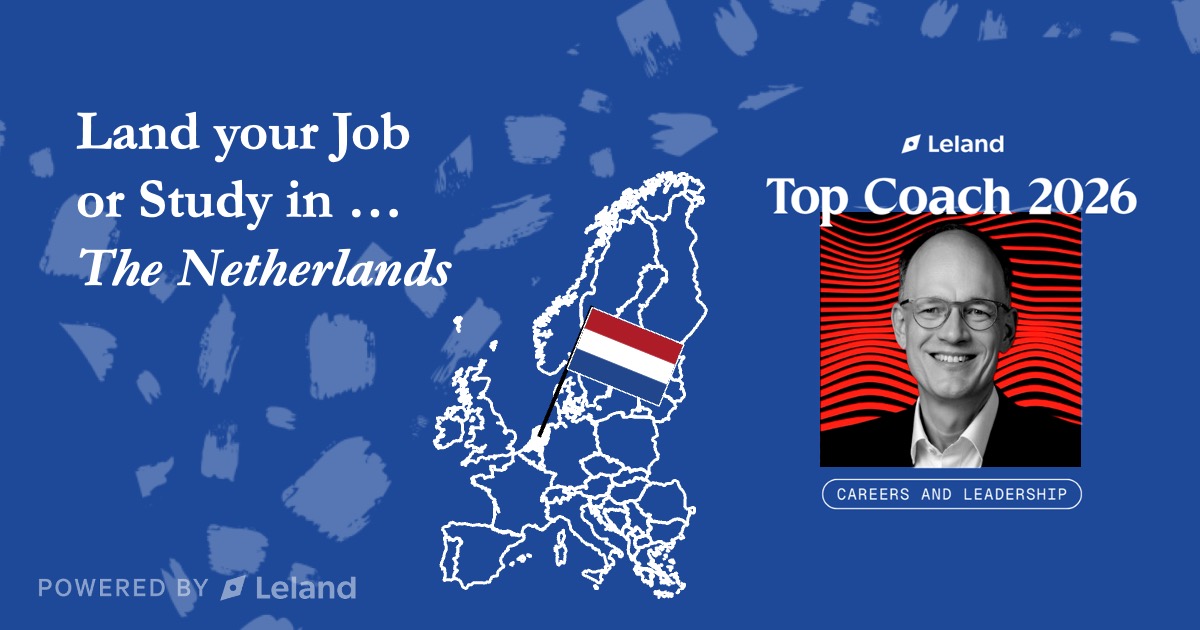
Land Your Job or Study in ... The Netherlands
The Netherlands punches well above its weight. A country of 18 million people hosts the European headquarters of companies like ASML, Shell, Philips, Booking.com, Heineken, and IKEA. Rotterdam is home to the largest port in Europe. Amsterdam ranks among the continent's top financial and tech hubs. For a non-EU professional, this combination of scale, innovation, and openness is rare. The language barrier that slows people down in other European countries simply does not exist here. The Dutch are among the most proficient English speakers in the world outside of native-speaking countries. Most professional environments operate entirely in English. That removes one of the biggest obstacles non-EU candidates face elsewhere. This session covers the study path and the direct job path side by side: visa options, living costs in Amsterdam and beyond, the multicultural workplace culture that makes integration genuinely easier, and how to position yourself in a market that spans logistics, tech, finance, agriculture, and life sciences. Two real cases show how international candidates turned Dutch openness into a concrete career move. The Netherlands is one of the most welcoming labour markets in Europe. This Thursday, we show you how to use that to your advantage. New episodes in this series cover a different European country every Thursday.

The Executive Leap: A Playbook for First Time Executives
Are you ready to transition from a functional role to a business leader? Join me, Kim, for an insightful session on becoming a first-time executive. With over 20 years of experience in leadership and coaching, I specialize in empowering high-potential leaders to excel in their careers. As the Founder of Surko Coaching, I've partnered with executives to enhance their executive presence, mental resilience, and strategic decision-making, leading to significant career advancements and organizational influence. During this event, we'll cover essential topics like leadership development, communication skills, decision-making, and strategic planning. My background includes senior roles at Flowcode and Bluecore, where I successfully led cross-functional teams and drove substantial growth. As an ICF Accredited Coach and Certified Professional Coach, I leverage tools like the Energy Leadership Index to help clients overcome self-limiting beliefs and achieve sustainable success. Don't miss this opportunity to unlock your full potential and achieve your professional goals. Space is limited, so RSVP now to secure your spot!
Free

3 AI Skills to Land your Job in ... The Automation Industry
Some people assume automation is about software: algorithms, digital twins, remote monitoring dashboards. In practice, the industry is deeply physical. A robotic arm on a production line that welds the same joint ten thousand times a day with sub-millimeter repeatability. A programmable logic controller that keeps a bottling plant running in sequence, every second, without deviation. A motion control system precise enough to place a component on a circuit board at speeds a human hand could never match. These are tangible products; the factory floor does not forgive imprecision. I spent more than 10 years working with the automation industry as a supplier, with companies like Siemens, Schneider Electric, and Kuka among my key accounts. I understand what automation companies require from their partners and their people; I also know which skills are shifting fast right now because of AI. This Tuesday session covers the automation industry: one of the most technically rigorous, capital-intensive, and rapidly evolving sectors in industrial manufacturing. We will discuss three specific AI skills that are changing what hiring managers expect, and how you can demonstrate them before you walk into an interview. If you want a career where the tangible product you sell or develop keeps the modern world running, this session is for you.

Why You’re Still Doing Too Much: Rethinking Delegation as a Leader
Even the most effective leaders struggle with letting go—but true leadership isn’t about doing it all yourself. In this workshop, Stefanie M.—a certified leadership and strengths-based coach with 17+ years of experience as a market executive and team leader in global finance—will help you rethink your approach to delegation and team empowerment. Drawing on her background in corporate banking, private equity, and venture capital, Stefanie will share actionable strategies for identifying what to delegate, developing trust, and building systems that elevate both performance and well-being. Whether you manage a team or lead at the executive level, this session will help you create more space for strategic thinking, growth, and balance—without sacrificing results.