Leland+ for GRE






Popular on Leland+

Start Now MBA Week March 2026
![Read any passage in 1 minute (AND get all the questions right!) [6/22/2026] (Recording)](https://customer-14xsjmjbqk93tdwp.cloudflarestream.com/979a915dfd18d5e3e6a2867c81d53dac/thumbnails/thumbnail.jpg)
Read any passage in 1 minute (AND get all the questions right!) [6/22/2026] (Recording)
Learn the technique for reading passages very fast while eliminating rereading and actually increasing your comprehension. You'll save a ton of time, the passages won't sap your energy and you'll avoid the dreaded, "my eyes just glazed over and I have no idea what I just read" syndrome. And the questions will be a lot easier to answer, too! This workshop will be hosted by Bruce H - Wharton MBA and professional GMAT/GRE tutor. Bruce has helped over 300 students achieve their target test scores, and developed the rigorous GMAT curriculum at UCLA!
![Mixtures and Weighted Averages with the Number Line Trick [8/20/2026] (Recording)](https://customer-14xsjmjbqk93tdwp.cloudflarestream.com/a554aaacb6f06a50dbeb0d43fcf9c0c3/thumbnails/thumbnail.jpg)
Mixtures and Weighted Averages with the Number Line Trick [8/20/2026] (Recording)
Come join this session to learn a very clearcut method for deciphering the most. complicated Mixture problems. I'll show you all the different variations of Mixture problems and how to tackle each type.

![Advanced Quant Questions: Overlapping Sets [7/16/2026] (Recording)](https://customer-14xsjmjbqk93tdwp.cloudflarestream.com/e87686964206244e54d6c7214deb93fc/thumbnails/thumbnail.jpg)
Advanced Quant Questions: Overlapping Sets [7/16/2026] (Recording)
The overlapping set formula you were taught is just wrong. It doesn’t work. Learn the formula that does work and unlock even the hardest questions quickly and easily. This session is for GRE test takers who want to master one of the trickiest quant topics with more speed and confidence. You’ll learn a more reliable framework, avoid common setup mistakes, and solve difficult overlapping sets questions more efficiently. Join live to hear from a GRE expert who specializes in helping students score 325+. The speaker will break down the patterns behind the toughest overlapping sets questions and share practical strategies you can immediately apply in your own prep. Expect high-impact techniques designed to help you pick up points on even the most challenging quant problems.
![Numbers You Should Test in Quantitative Comparisons [8/27/2026] (Recording)](https://customer-14xsjmjbqk93tdwp.cloudflarestream.com/fe00b47f7877ab51cf8986df8d06fe72/thumbnails/thumbnail.jpg)
Numbers You Should Test in Quantitative Comparisons [8/27/2026] (Recording)
Quantitative Comparison questions can look deceptively simple, but the fastest way to solve them is often knowing which values to test and when. This session is for GRE test takers who want to solve Quantitative Comparisons faster, avoid unnecessary calculations, and recognize the patterns that make these questions easier. You'll learn which numbers are most useful to test, how to choose them strategically, and how to quickly determine whether a relationship always holds. Join live to hear from a GRE expert who scored a perfect 340. The speaker will walk through practical examples and share the testing strategies that top scorers use to eliminate answer choices and solve tricky comparisons more efficiently. Expect techniques you can immediately apply to your GRE prep.

![Write On! Top Tips for LSAT & Other Academic Essays [9/1/2026] (Recording)](https://customer-14xsjmjbqk93tdwp.cloudflarestream.com/2f311dea6e3e811696ac463a09df4a2a/thumbnails/thumbnail.jpg)
Write On! Top Tips for LSAT & Other Academic Essays [9/1/2026] (Recording)
Professional writer, editor and writing coach Karin McKie will share quick tips to generate dynamic personal statements for college or graduate school applications like the LSAT plus any type of academic or business writing.
![“RAOUR” Annotation: The Easy New Way to Read and Understand All Types of Texts [8/29/2026] (Recording)](https://customer-14xsjmjbqk93tdwp.cloudflarestream.com/5d04adad09d98bce634fa476f268cead/thumbnails/thumbnail.jpg)
“RAOUR” Annotation: The Easy New Way to Read and Understand All Types of Texts [8/29/2026] (Recording)
“ROUR” Annotation: The Easy New Way to Read and Understand All Types of Texts Educator Karin McKie has created a quick and easy way to annotate and understand dense texts for school or work, developed over decades of tutoring thousands of diverse learners. Mastery of these simple techniques increases standardized test prep scores like the LSAT, GRE, SAT, ACT and more.
![Write On! Top Tips for LSAT & Other Academic Essays [8/11/2026] (Recording)](https://customer-14xsjmjbqk93tdwp.cloudflarestream.com/0c501c0083bff148cc7dcd34da0c1eb9/thumbnails/thumbnail.jpg)
Write On! Top Tips for LSAT & Other Academic Essays [8/11/2026] (Recording)
Professional writer, editor and writing coach Karin McKie will share quick tips to generate dynamic personal statements for college or graduate school applications like the LSAT plus any type of academic or business writing.
![3 GRE Secrets to Raise Your Score TODAY! [6/2/2026] (Recording)](https://customer-14xsjmjbqk93tdwp.cloudflarestream.com/2552055a252283d294a0c8b6779bea2c/thumbnails/thumbnail.jpg)
3 GRE Secrets to Raise Your Score TODAY! [6/2/2026] (Recording)
GIVEAWAY DURING THE EVENT: Join for the chance to win a free seat in Leland's GRE Bootcamp! Many GRE students spend hours studying without improving because they focus on the wrong habits and strategies. This session is for test takers who want practical, high-impact adjustments they can apply immediately to start raising their score. You’ll learn three proven GRE strategies that improve accuracy and efficiency, how high scorers approach difficult questions under pressure, and the common mistakes that quietly cost students points across the exam. Join live to see how an experienced GRE instructor teaches these techniques and the patterns they see across students who improve quickly. You’ll also have the chance to ask questions in real time and get actionable guidance you can apply to your studying right away.
![GRE Geometry & Algebra: The Top Tips High Scorers Use [5/22/2026] (Recording)](https://customer-14xsjmjbqk93tdwp.cloudflarestream.com/52d43be2dacfcc30aa122be51be0b5c7/thumbnails/thumbnail.jpg)
GRE Geometry & Algebra: The Top Tips High Scorers Use [5/22/2026] (Recording)
Geometry and algebra questions make up a major portion of the GRE Quant section, but high scorers approach them with specific strategies that go far beyond memorizing formulas. This session is for students who want to improve both accuracy and speed on two of the most heavily tested GRE topics. You’ll learn the shortcuts and patterns top scorers rely on, how to recognize common trap setups, and the foundational concepts that make difficult problems more manageable under time pressure. Join live to see how an experienced GRE instructor breaks down these question types and the patterns they see across high-performing test takers. You’ll also have the chance to ask questions in real time and get practical guidance on how to apply these strategies effectively during your own preparation.

![How To Prep Independently For the GRE [5/18/2026] (Recording)](https://customer-14xsjmjbqk93tdwp.cloudflarestream.com/96f1e65deffe708eaf5bcea0991f9144/thumbnails/thumbnail.jpg)
How To Prep Independently For the GRE [5/18/2026] (Recording)
Preparing for the GRE on your own can feel overwhelming without a clear plan or feedback loop. This session is for test takers who want a structured, effective approach to independent prep. You’ll learn how to build a study plan that fits your timeline, choose the right materials, and track your progress in a way that leads to consistent improvement. Join live to ask questions about your current approach and get guidance on how to refine it. The speaker is a GRE expert with 18+ years of test prep experience and has helped many students succeed through self-study. They’ll share the patterns they see across high scorers and the strategies typically covered in focused 1:1 prep sessions.

![Starting Your GRE Journey: An Introduction to the GRE General Test [5/14/2026] (Recording)](https://customer-14xsjmjbqk93tdwp.cloudflarestream.com/cbe5a63a3bd823dc5bd2feb5a6263ec1/thumbnails/thumbnail.jpg)
Starting Your GRE Journey: An Introduction to the GRE General Test [5/14/2026] (Recording)
Starting your GRE prep can feel overwhelming when you’re not sure what the test actually involves or how to begin. This session is for anyone looking for a clear introduction to the GRE General Test and how to approach it effectively. You’ll learn how the exam is structured, what each section tests, and how to build a study plan that sets you up for steady improvement. Join live to ask questions about your starting point and get guidance on how to approach your prep with more confidence. The speaker is an experienced GRE coach who regularly helps students navigate the early stages of preparation. They’ll share the patterns they see across successful test takers and the foundational strategies typically covered in 1:1 prep sessions.
![How to Solve GRE Math Questions in Half the Time [5/5/2026] (Recording)](https://customer-14xsjmjbqk93tdwp.cloudflarestream.com/9b5371c69c2dc34fbb3eadd420808bc9/thumbnails/thumbnail.jpg)
How to Solve GRE Math Questions in Half the Time [5/5/2026] (Recording)
In this session, you'll learn how to identify question types faster and apply targeted shortcuts that cut time without sacrificing accuracy. The focus will be on three high-frequency GRE math areas where most test-takers lose unnecessary time: quantitative comparison traps, data interpretation setups, and plugging-in strategies for algebra problems. Attending live means you can describe the specific question types giving you trouble and get a direct answer calibrated to where you are in your prep, not a general response. The coach works with GRE students regularly and will be sharing the patterns that consistently separate efficient scorers from those who run out of time.

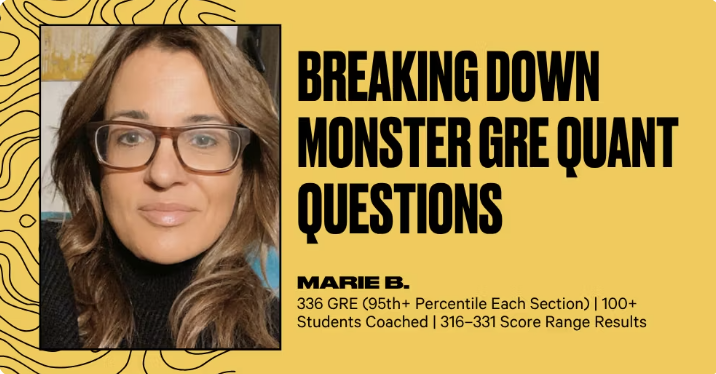
Breaking Down Monster GRE Quant Questions
In this session, you will work through a difficult GRE Quantitative Reasoning problem step by step and leave knowing how to apply that same approach to similar questions on your own. We will focus on identifying what the question is actually testing beneath the surface, breaking down the logic before touching the math, and recognizing the structural patterns that appear repeatedly across hard quant problems.

Strategic Approach to GRE Verbal Reasoning
GRE Verbal Reasoning can feel unpredictable, especially when strong readers still struggle with timing and tricky answer choices. This session is for test takers who want a more strategic and repeatable approach to the verbal section. You’ll learn how to break down question types, eliminate misleading options with confidence, and improve both accuracy and pacing under timed conditions.
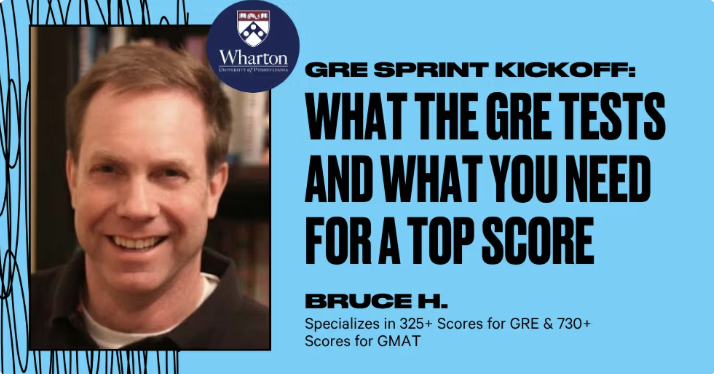
GRE Sprint Kickoff: What the GRE Tests and What You Need for a Top Score
After this session, you will know exactly which GRE skills separate high scorers from the rest and which study habits waste time. We will break down what the Verbal and Quant sections are actually measuring, why most test-takers misread the test's logic, and how to build a study plan around the patterns that consistently produce top scores.
![How to Prepare for the GRE With Just Two Weeks vs. Two Months [4/30/2026] (Recording)](https://customer-14xsjmjbqk93tdwp.cloudflarestream.com/a844a4b3593130f8471310d04b3e02b6/thumbnails/thumbnail.jpg)
How to Prepare for the GRE With Just Two Weeks vs. Two Months [4/30/2026] (Recording)
In this session, you'll learn how to build a realistic GRE study plan based on how much time you actually have. Whether you're working with two weeks or two months, you'll walk away knowing which question types to prioritize first, how to allocate your hours across Verbal and Quant, and when to cut your losses on a concept and move on. Attending live means you can describe your specific timeline and score goals and get a direct answer about what your plan should look like, not a generic framework. The coach works with GRE students regularly and will share the patterns she sees in how successful test-takers adjust their approach when time is short, which is the kind of thinking that does not show up in a study guide.

![My Top 5 Tips for GRE Quant Questions [4/29/2026] (Recording)](https://customer-14xsjmjbqk93tdwp.cloudflarestream.com/23931f9c389da28dff9e94220355b59c/thumbnails/thumbnail.jpg)
My Top 5 Tips for GRE Quant Questions [4/29/2026] (Recording)
GRE quant questions often reward strategy as much as math ability, yet many test takers rely on slow or inconsistent approaches. This session is for anyone looking to improve their performance on the quantitative section with clearer, more efficient methods. You’ll learn five high-impact strategies to simplify complex problems, avoid common traps, and approach questions with greater speed and confidence. Join live to ask questions about specific problem types and see how an experienced GRE expert applies these strategies in real time. The speaker regularly works with students to improve quant performance and will share the patterns they see across high scorers. Expect practical techniques and insights similar to what’s covered in focused 1:1 prep sessions.
How to Answer the GRE Quant Questions in Half the Time
GRE quant questions are designed to reward efficiency, but many test takers get stuck using slow or overly complex approaches. This session is for candidates who want practical ways to solve problems faster without sacrificing accuracy. You’ll learn how to recognize common question patterns, apply time-saving shortcuts, and avoid the traps that tend to eat up valuable minutes on test day.

GRE Text Completion: How to Use Context Clues Effectively
Many GRE test-takers struggle with Text Completion not because of vocabulary gaps, but because they miss the contextual signals that reveal the correct answers. Understanding how to leverage context clues can turn these questions from guesswork into strategy. In GRE Text Completion: How to Use Context Clues Effectively, you’ll learn how to analyze sentences and identify the hints that point directly to the right choice. Audra Z. regularly works 1:1 with GRE students and will share the same strategies used in coaching sessions to help candidates improve accuracy and confidence. Who This Is For - GRE test-takers aiming to boost their Verbal scores - Students who find questions tricky or time-consuming - Candidates wanting a structured approach to decoding sentence meaning - Test-takers who want to move beyond memorizing vocabulary What You’ll Walk Away With - A framework for identifying context clues in complex sentences - How to predict the correct answer before looking at choices - Patterns I see across students who consistently select the right options - The common mistakes I correct in 1:1 sessions - Practical exercises to apply these strategies immediately