Leland+ for MBA







Popular on Leland+
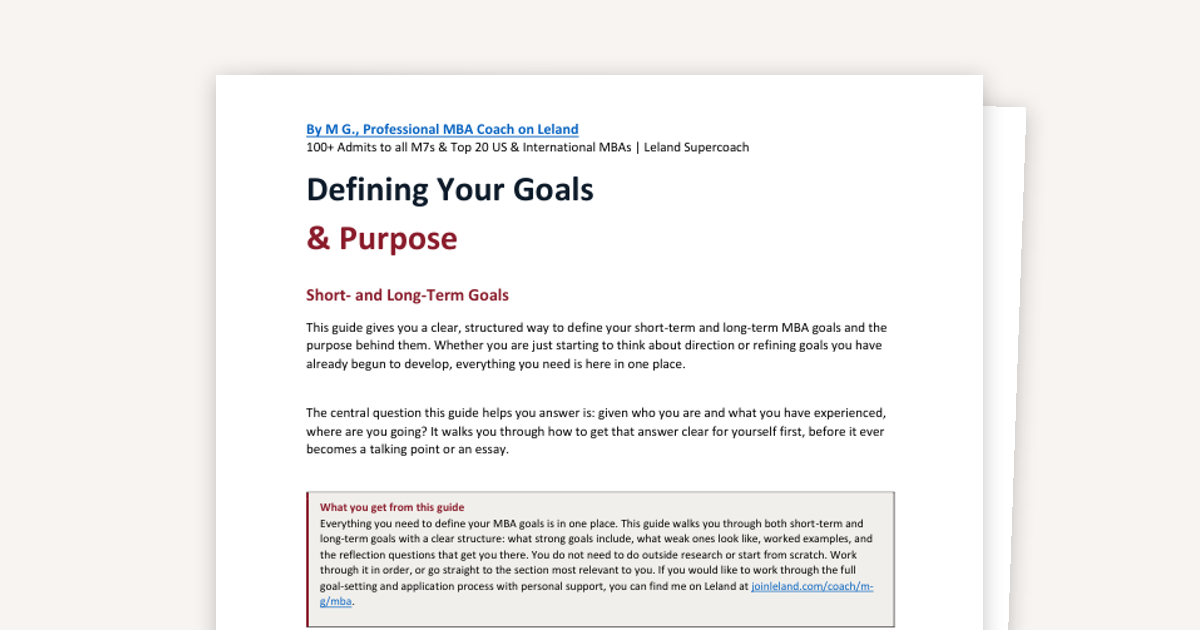
MBA Goals & Purpose Guide: Define Your Short- and Long-Term Goals
Most MBA applicants know they need goals. Few know how to make them specific, grounded, and genuinely their own. This guide gives you a clear framework for defining your short-term and long-term post-MBA goals, along with the purpose behind them. Inside you will find what strong goals include, what weak ones look like, worked examples you can learn from, and the reflection questions that help you get there. Everything is in one place and structured so you can work through it in order or go straight to what you need. Whether you are just starting to think about direction or refining goals you have already begun to develop, this guide will help you arrive at goals you can defend confidently in essays, interviews, and school conversations.
![Your Guide to the Columbia MBA Interview [5/7/2026] (Recording)](https://customer-14xsjmjbqk93tdwp.cloudflarestream.com/e0203c1d1d313b4711ae5b5154a77b04/thumbnails/thumbnail.jpg)
Your Guide to the Columbia MBA Interview [5/7/2026] (Recording)
Strong candidates still get tripped up in the Columbia MBA interview because they underestimate how much clarity and fit matter in a short conversation. This session is for applicants who want a clearer understanding of how to navigate Columbia’s interview process with confidence. You’ll learn how to structure your answers, communicate your goals and fit for the program, and handle the types of questions that commonly come up. Join live to ask questions about your own interview preparation and get guidance tailored to your background. The speaker is an expert in the Columbia MBA interview process and regularly works with candidates preparing for this stage. They’ll share the patterns they see across successful applicants and the kinds of feedback typically given in 1:1 interview prep.

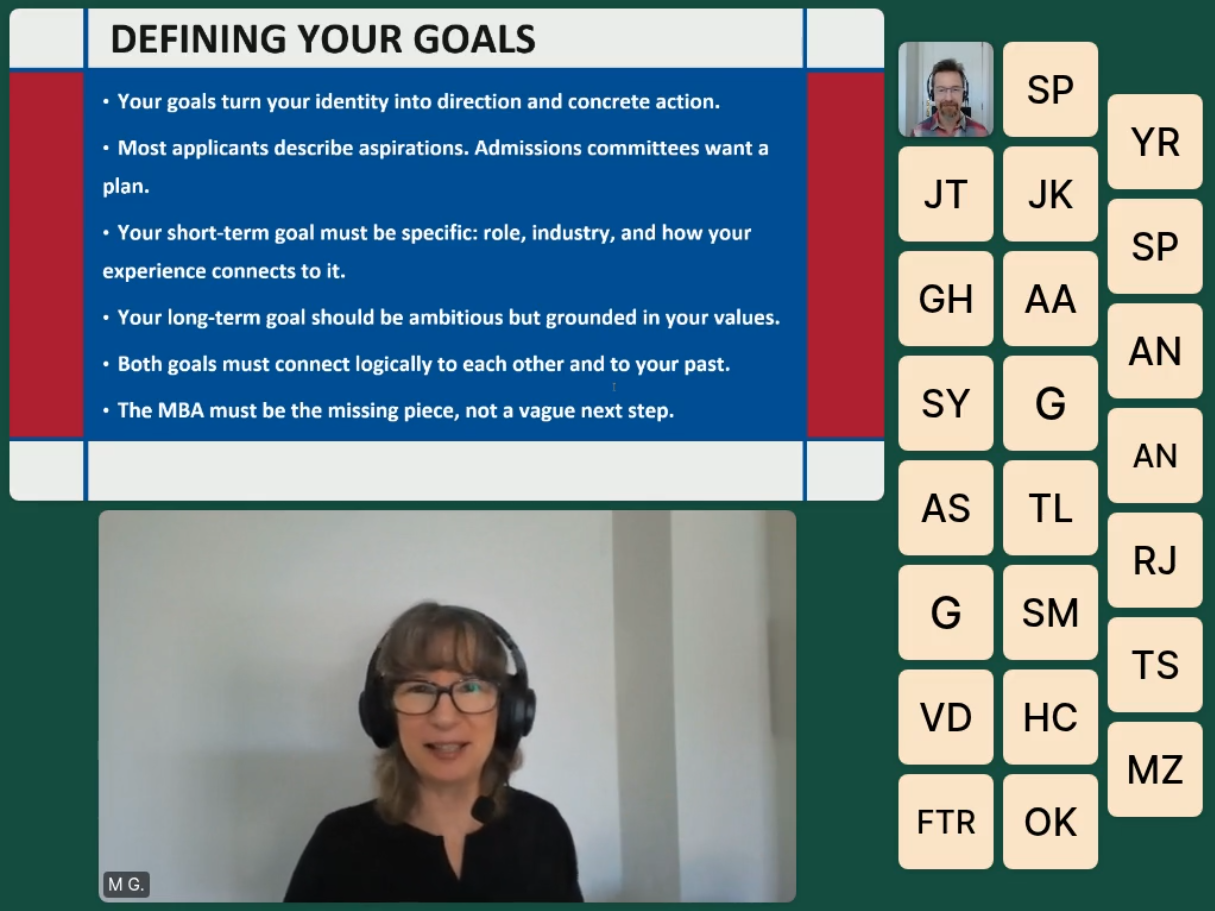
8 Steps to a Complete MBA App: 4) Short & Long-Term Goals & Purpose
Applying to business school can feel overwhelming! You have dozens of moving pieces: essays, short answers, video content, resume, recommendations, outreach, research, and more. This workshop is the fourth of a structured 8-part MBA Identity Mapping series designed to take you from fragmented tasks to a clear plan of action. In this session, you will clarify your short- and long-term goals and build a credible, purpose-driven career narrative. These sessions walk you step by step through building one fully aligned MBA application. In every workshop, you will be assigned tasks to complete over the next two weeks, keeping you organized and accountable. By the end, you will have strong, authentic essays and a cohesive narrative that runs consistently through your resume, goals, recommendations, school strategy, and interviews. You are absolutely welcome to attend individual sessions if you only need focused help on a specific component(s) of your MBA application. Event 4 shapes your identity into a credible, purpose-driven career plan: • Define clear short-term and long-term career goals. • Connect your past experiences and core values to your future direction. • Articulate your broader purpose and the impact you want to have. • Stress-test the realism and logic of your plan. • Ensure your goals align with your strengths and readiness for an MBA. This is the phase where your identity turns into direction. Instead of listing ambitions, you construct a thoughtful, believable path that admissions committees can understand and support. The MBA Identity Mapping process has guided 100+ applicants into every M7 program, all other top 20 U.S. programs, and leading international programs including INSEAD, London Business School, IESE, Esade, Oxford, Cambridge, NUS, and more. Clients consistently describe it as transformative because it replaces scattered effort with forward momentum and strategic clarity. If you are ready to move from abstract aspirations to a grounded, compelling career plan, this is your next step.
![What to Know About the Kellogg Interview [5/5/2026] (Recording)](https://customer-14xsjmjbqk93tdwp.cloudflarestream.com/bbd1aaf8fc2c1e0f7f96382f06b68f38/thumbnails/thumbnail.jpg)
What to Know About the Kellogg Interview [5/5/2026] (Recording)
The Kellogg interview is a critical part of your application and evaluates far more than your resume. This session is for applicants preparing for Kellogg who want to understand how to stand out in a behavioral, resume-driven interview format. You’ll learn how to structure your answers, highlight leadership and collaboration effectively, and prepare for the specific questions and traits Kellogg interviewers focus on. Join live to hear how an experienced MBA admissions coach prepares candidates for the Kellogg interview and the patterns they see across successful applicants. You’ll also have the chance to ask questions about your own preparation and get real-time guidance typically shared in 1:1 coaching sessions.

![What Top Candidates do Well in the Booth MBA Interview [5/5/2026] (Recording)](https://customer-14xsjmjbqk93tdwp.cloudflarestream.com/69d6a5905270a100702f551fa3ef294e/thumbnails/thumbnail.jpg)
What Top Candidates do Well in the Booth MBA Interview [5/5/2026] (Recording)
After this session, you will know how to structure your responses to stand out in the Booth MBA deferred enrollment interview. We will cover the behavioral frameworks that successful candidates use to demonstrate self-awareness, how to articulate long-term goals convincingly at an early career stage, and the specific signals Booth interviewers look for when evaluating fit with the school's entrepreneurial culture. Attending live means you can ask how to handle the parts of your background that feel like liabilities, and hear real-time guidance shaped around your actual situation rather than a generic script. The coach works with deferred MBA candidates regularly and is sharing the patterns that consistently show up in strong Booth interview performances.

![How to Solve GRE Math Questions in Half the Time [5/5/2026] (Recording)](https://customer-14xsjmjbqk93tdwp.cloudflarestream.com/9b5371c69c2dc34fbb3eadd420808bc9/thumbnails/thumbnail.jpg)
How to Solve GRE Math Questions in Half the Time [5/5/2026] (Recording)
In this session, you'll learn how to identify question types faster and apply targeted shortcuts that cut time without sacrificing accuracy. The focus will be on three high-frequency GRE math areas where most test-takers lose unnecessary time: quantitative comparison traps, data interpretation setups, and plugging-in strategies for algebra problems. Attending live means you can describe the specific question types giving you trouble and get a direct answer calibrated to where you are in your prep, not a general response. The coach works with GRE students regularly and will be sharing the patterns that consistently separate efficient scorers from those who run out of time.

![What Top MBA Candidates Do Differently [5/4/2026] (Recording)](https://customer-14xsjmjbqk93tdwp.cloudflarestream.com/243d1881d34983c5d35a65e085c7ea9e/thumbnails/thumbnail.jpg)
What Top MBA Candidates Do Differently [5/4/2026] (Recording)
Top MBA candidates don’t just have strong profiles—they make intentional decisions about how they position their experiences, goals, and story. This session is for applicants who want to understand what actually differentiates successful candidates across top programs. You’ll learn how to frame your impact, articulate clear and credible goals, and avoid the common mistakes that weaken otherwise competitive applications. Join live to hear perspectives from a panel of experienced MBA coaches who work closely with applicants and evaluate what stands out. The discussion will follow a curated set of high-impact questions, offering structured insights and examples typically shared in 1:1 coaching sessions.


How to Build a Winning MBA Application
Many MBA applicants have strong profiles but struggle to bring all the pieces together into a cohesive, competitive application. This session is designed for candidates who want to understand how admissions committees evaluate applicants across essays, resumes, recommendations, and interviews. You’ll learn how to define clear career goals, build a compelling narrative, and position your experiences in a way that demonstrates leadership, impact, and fit with your target programs.

![Acing the MIT Sloan Interview [4/30/2026] (Recording)](https://customer-14xsjmjbqk93tdwp.cloudflarestream.com/a15583e34e82a041d687f9db99a011bb/thumbnails/thumbnail.jpg)
Acing the MIT Sloan Interview [4/30/2026] (Recording)
After this session, you will know how to approach MIT Sloan's distinctive interview format with a clear strategy. We'll cover how to structure your responses to behavioral questions, how to articulate your post-MBA goals in a way that aligns with what Sloan evaluators are listening for, and how to prepare for the conversational style that catches many deferred MBA candidates off guard. Attending live gives you the chance to ask about your specific background, your goals, or a response you're unsure about, and to hear how those answers land in real time. The coach works with deferred MBA applicants through this process regularly, and this session reflects the patterns they see across candidates who interview well.


8 Steps to a Complete MBA App: 3) Core Values, Superpowers & LOR Strategy
Applying to business school can feel overwhelming! You have dozens of moving pieces: essays, short answers, video content, resume, recommendations, outreach, research, and more. This workshop is the third of a structured 8-part MBA Identity Mapping series designed to take you from fragmented tasks to a clear plan of action. In this session, you will identify your core values and defining strengths and begin aligning your Letters of Recommendation with your overall narrative. These sessions walk you step by step through building one fully aligned MBA application. In every workshop, you will be assigned tasks to complete over the next two weeks, keeping you organized and accountable. By the end, you will have strong, authentic essays and a cohesive narrative that runs consistently through your resume, goals, recommendations, school strategy, and interviews. You are absolutely welcome to attend individual sessions if you only need focused help on a specific component(s) of your MBA application. Event 3 clarifies your defining characteristic and begins the recommendation process: • Identify 3–5 core values and superpowers that consistently appear across your key stories. • Define what each strength truly means in your life and how it shows up in action. • Ensure your positioning reflects who you actually are, not who you think admissions wants you to be. • Learn how to select recommenders and ensure strong narrative alignment. This is the phase where your stories become identity. Instead of a collection of experiences, you now articulate the defining qualities that connect your past, present, and future. The MBA Identity Mapping process has guided 100+ applicants into every M7 program, all other top 20 U.S. programs, and leading international programs including INSEAD, London Business School, IESE, Esade, Oxford, Cambridge, NUS, and more. Clients consistently describe it as transformative because it replaces scattered effort with forward momentum and strategic clarity. If you are ready to clarify what truly defines you and ensure your recommendations reinforce your positioning, this is your next step.
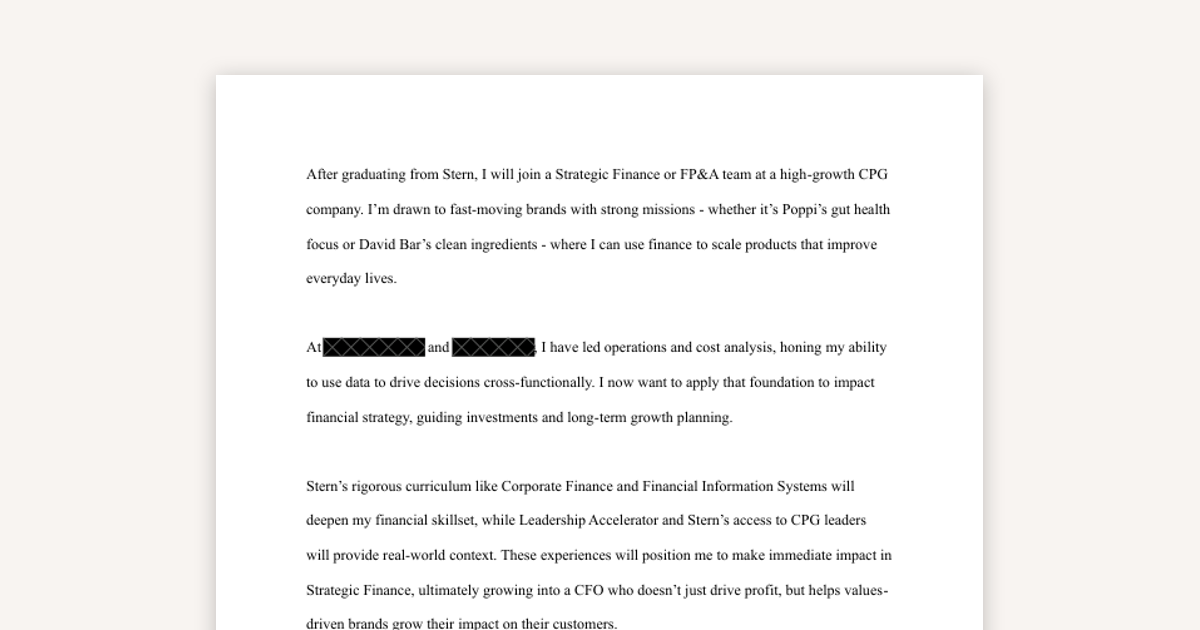
NYU Stern Short Answer Example (Accepted with Full Ride)
NYU Stern Short Answer examples of a female from a CPG start-up accepted into the class of 2028.

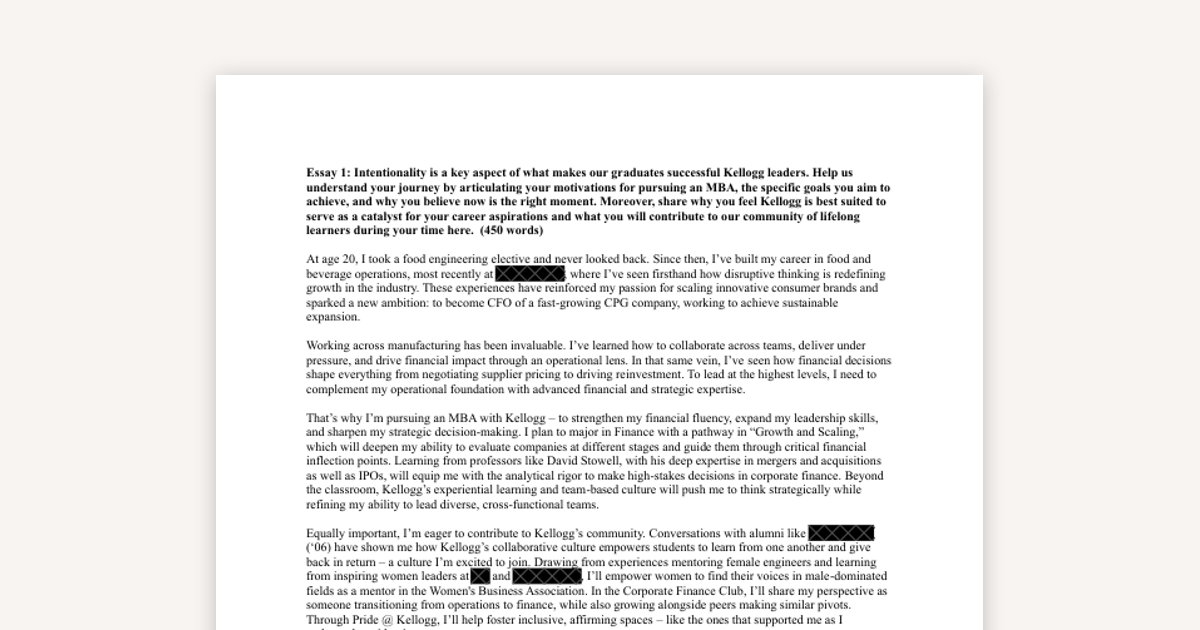
Accepted Kellogg Essay 1 Example
Kellogg Essay 1 example of a female from a CPG start-up accepted into the class of 2028.
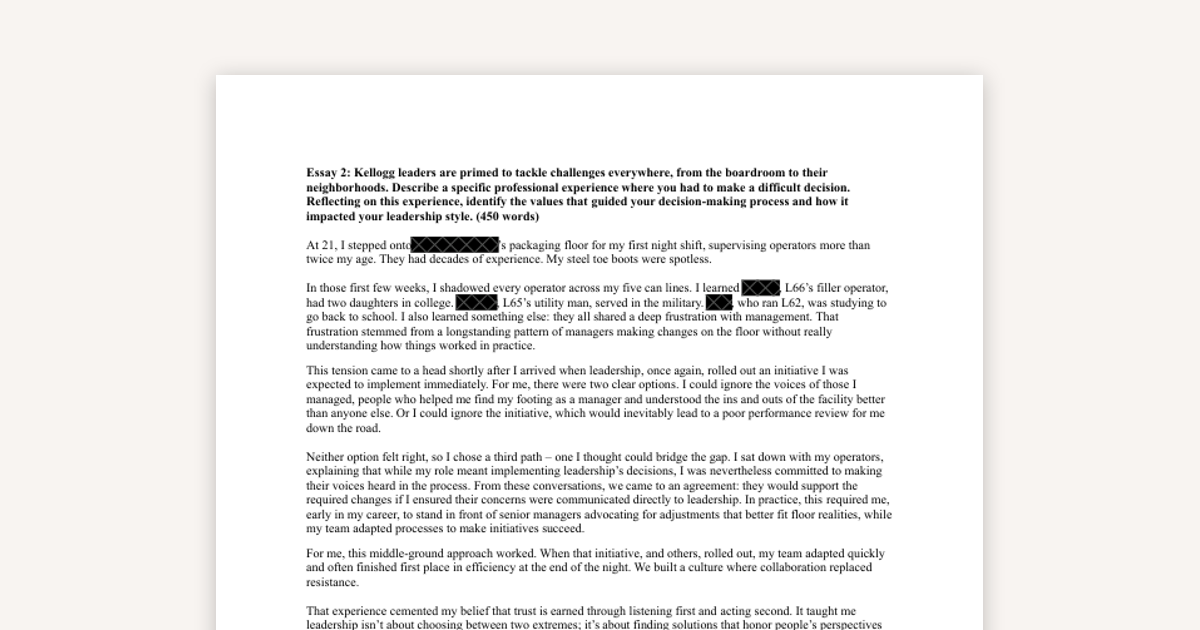
Accepted Kellogg Essay 2 Example
Kellogg Essay 2 example of a female from a CPG start-up accepted into the class of 2028.

NYU Stern Essay 1 Example (Accepted with Full Ride)
NYU Stern Essay 1 example of a female from a CPG start-up accepted into the class of 2028.
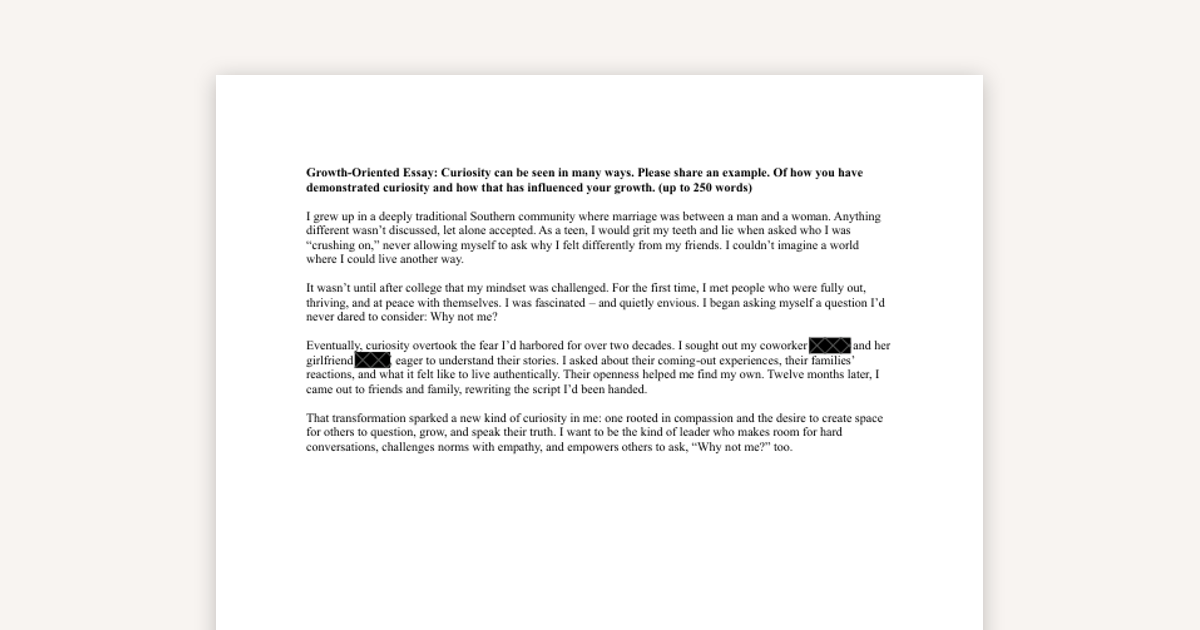
Accepted Harvard Essay 3 Example
Harvard Essay 3 example of a female from a CPG start-up accepted into the class of 2028.
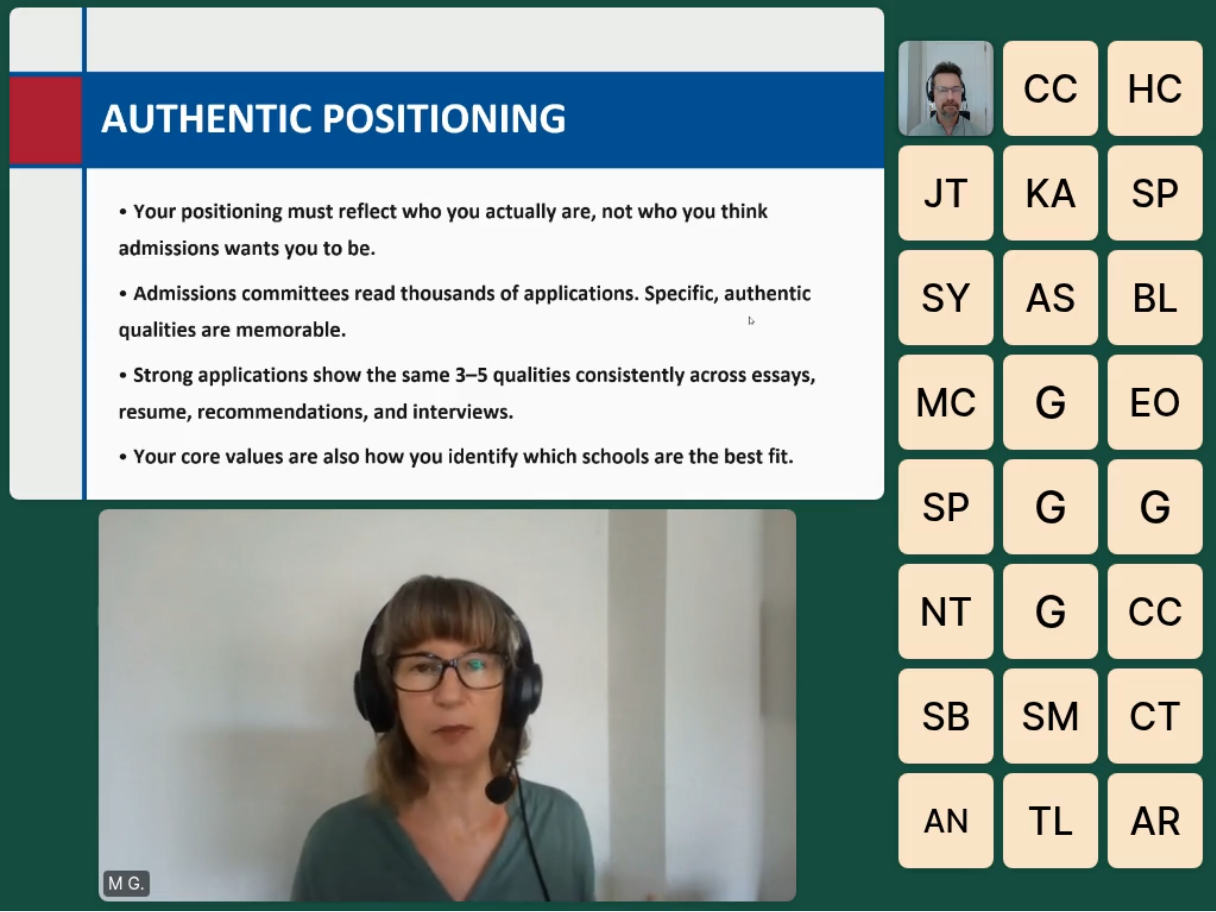
8 Steps to an MBA App: 3) Core Values, Superpowers & LOR Strategy
Applying to business school can feel overwhelming! You have dozens of moving pieces: essays, short answers, video content, resume, recommendations, outreach, research, and more. This workshop is the third of a structured 8-part MBA Identity Mapping series designed to take you from fragmented tasks to a clear plan of action. In this session, you will identify your core values and defining strengths and begin aligning your Letters of Recommendation with your overall narrative. These sessions walk you step by step through building one fully aligned MBA application. In every workshop, you will be assigned tasks to complete over the next two weeks, keeping you organized and accountable. By the end, you will have strong, authentic essays and a cohesive narrative that runs consistently through your resume, goals, recommendations, school strategy, and interviews. You are absolutely welcome to watch individual sessions if you only need focused help on a specific component(s) of your MBA application. Event 3 clarifies your defining characteristic and begins the recommendation process: • Identify 3–5 core values and superpowers that consistently appear across your key stories. • Define what each strength truly means in your life and how it shows up in action. • Ensure your positioning reflects who you actually are, not who you think admissions wants you to be. • Learn how to select recommenders and ensure strong narrative alignment. This is the phase where your stories become identity. Instead of a collection of experiences, you now articulate the defining qualities that connect your past, present, and future. The MBA Identity Mapping process has guided 100+ applicants into every M7 program, all other top 20 U.S. programs, and leading international programs including INSEAD, London Business School, IESE, Esade, Oxford, Cambridge, NUS, and more. Clients consistently describe it as transformative because it replaces scattered effort with forward momentum and strategic clarity. If you are ready to clarify what truly defines you and ensure your recommendations reinforce your positioning, this is your next step.
How to Stand Out in the Standford GSB Interview
The Stanford GSB interview is known for being highly personal and introspective, and many candidates struggle to strike the right balance between authenticity and structure. This session is for applicants preparing for Stanford who want to approach the interview with more clarity and confidence. You’ll learn how to answer behavioral questions with depth, communicate self-awareness and values, and align your responses with what Stanford is truly evaluating.

Free
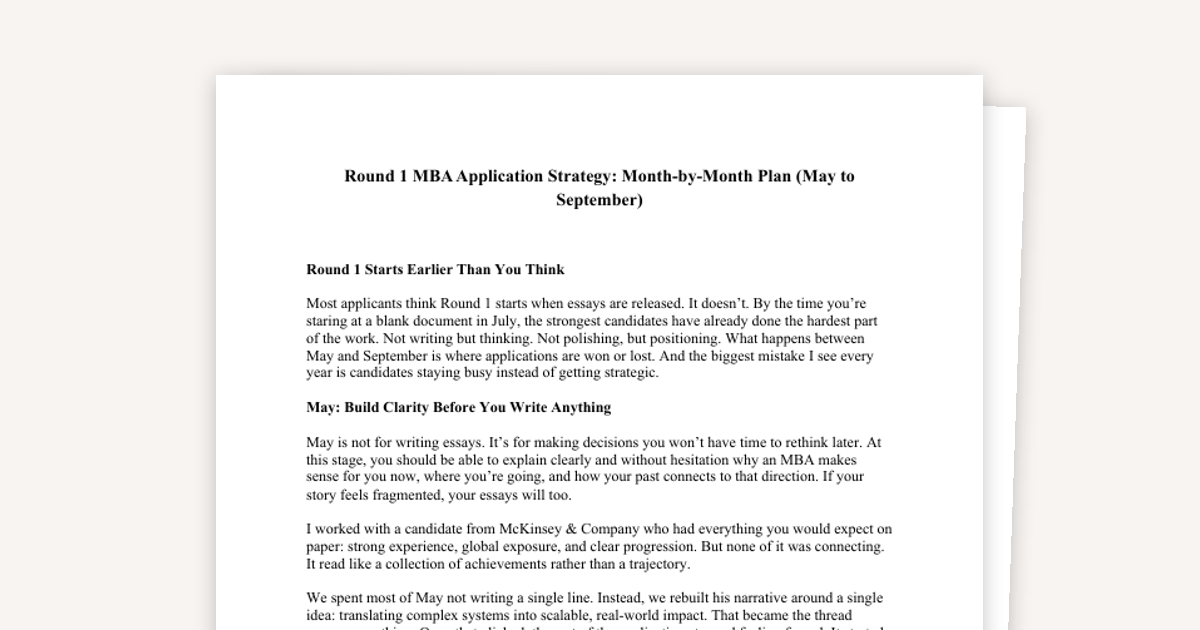
Round 1 MBA Application Strategy: Month-by-Month Plan
Most applicants think Round 1 starts when essays are released. It doesn’t. By the time you’re staring at a blank document in July, the strongest candidates have already done the hardest part of the work. Not writing but thinking. Not polishing, but positioning. What happens between May and September is where applications are won or lost. And the biggest mistake I see every year is candidates staying busy instead of getting strategic.
How to Build a Strong MBA Application from Start to Finish
Starting an MBA application can feel overwhelming when there are so many moving pieces and no clear roadmap. This session is for applicants who want to understand how to approach the process from start to finish with a thoughtful, structured strategy. You’ll learn how to evaluate your profile, build a strong school list, and develop a cohesive narrative across essays, recommendations, and interviews.

Your MBA Edge: Turning a Non-Traditional Path into a Winning App
Join this live conversation with a Korean INSEAD admit from a niche industry (gaming) and their admissions coach, Caolan. We’ll unpack how to build an authentic, coherent MBA story without over‑fixating on scores, even as a reapplicant or non‑traditional candidate. You’ll see how they framed transferable skills, targeted schools with different cultures, and prepared for interviews. - Learn how to craft a compelling and authentic application story that stands out, even with diverse career paths or perceived weaknesses like a lower GPA. - Understand why storytelling, strategic discussions, and a holistic approach can be more critical than perfect quantitative metrics (GMAT/GPA) for top MBA admissions. - Discover strategies to reframe your niche industry experience as a competitive advantage, turning perceived disadvantages into strengths. - Gain insights into researching and articulating school-specific fit, moving beyond generic website information to truly customize your application. - Be inspired by a reapplicant's journey to INSEAD, demonstrating that with the right approach and guidance, success is achievable for a wide range of profiles. - Learn what to look for in a consultant, including the importance of genuine care, industry understanding, and time investment. An engaging, interview-style conversation between Caolan Hunter and Gitak Kwak, followed by an open Q&A session, designed to empower aspiring MBA candidates, particularly those from non-traditional backgrounds or facing unique application challenges, by offering practical insights and an inspiring success story. Who it’s for: - Korean and international MBA hopefuls - Reapplicants or candidates from niche / non‑traditional industries - Applicants worried about stats (GPA/GMAT) or “imperfect” profiles