Leland+ for MBA






Popular on Leland+

Deferred MBA Deep Dive: What You Need to Know Now
In this panel, join admissions experts Justin K., Kelsey K., and Siri G. who will break down everything you need to know about deferred MBA programs so that you have a concrete strategy going into application season. You’ll learn how these programs work, what top schools are looking for in college seniors and early-career applicants, and how to start building a strong application now. Check out their profiles here: Justin K. - Former BCG consultant and MIT Sloan MBA student with a strong record helping candidates land MBB offers and top MBA admits Kelsey K. - Former M7 Admissions Director and Columbia Business School Admissions Committee member with a 93% client acceptance rate and $180K average scholarship awards Siri G. - Accepted to deferred MBA programs at Harvard and Wharton from a non-target school through authentic, story-driven applications


MBA Interview Series: Chicago Booth
Jumpstart your Chicago Booth MBA interview prep with up-to-date insights and stage-specific strategies. As application deadlines approach, join expert coach Tim F. who will help you understand what’s expected, how to prepare, and how to stand out. You’ll learn about the format of the Chicago Booth interview, key evaluation criteria, and how to craft strong stories using frameworks, while balancing polish and authenticity. By the end of this session, you’ll have a clear action plan for your interviews—what to practice, how to outline your answers, and how to present your best self when your invitation arrives.

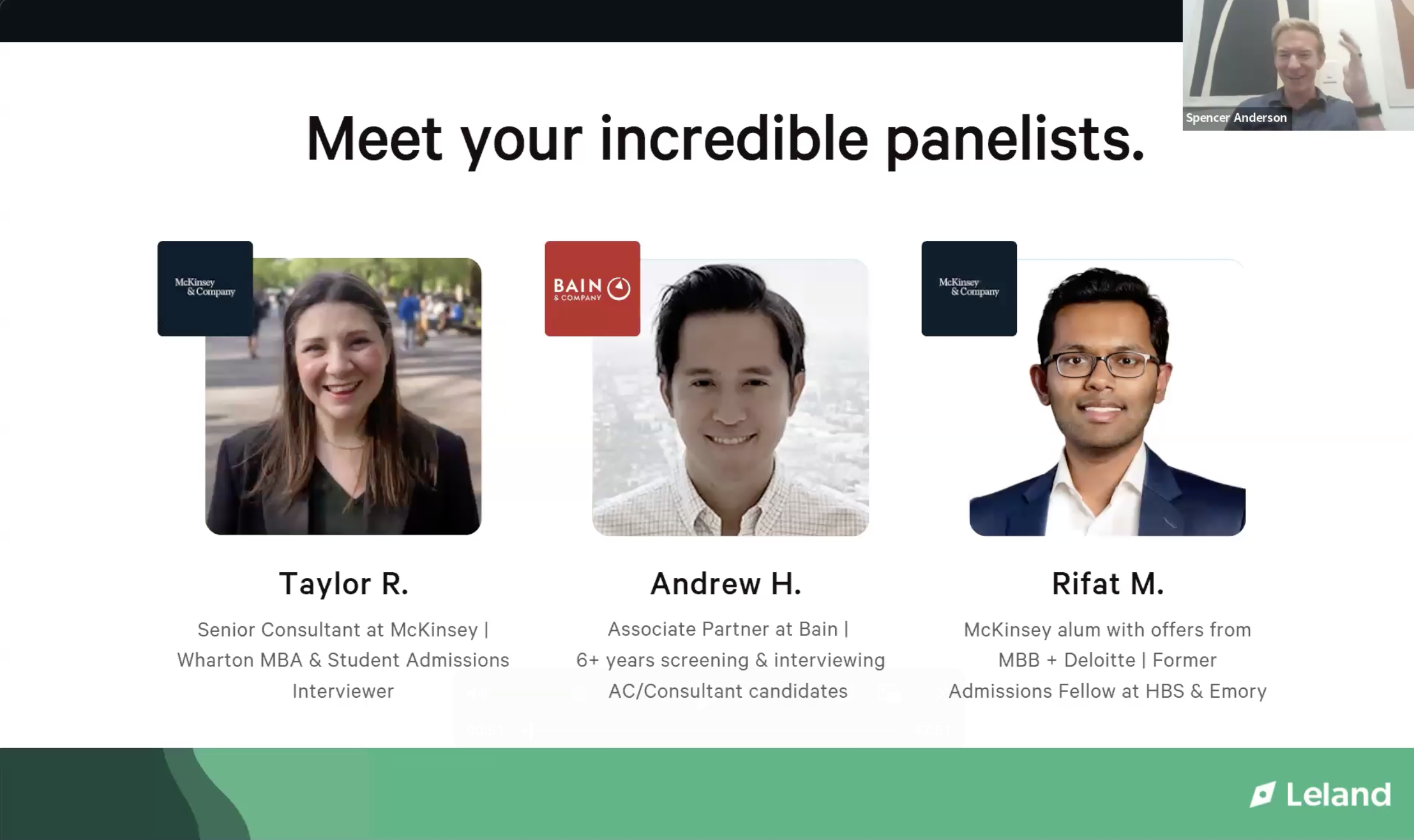
MBA to Consulting Panel
Still planning to break into consulting before graduation? You're not alone, and it's not too late. This panel is designed for MBA students who are exploring full-time roles in consulting, whether you’re re-recruiting, pivoting, or looking to refine your strategy. Hear from Taylor R., Andrew H., and Rifat M., all of whom successfully landed consulting offers later in the MBA journey as they share practical advice on networking, storytelling, case prep, and how to stand out in a competitive recruiting cycle. If you're hoping to make the jump into MBB or other top firms, this session will help you make the most of the months ahead.



MIT Sloan: Application Breakdown
A deep dive into the MIT Sloan MBA application.

MIT Sloan: Example Cover Letter
An example of a cover letter for the MIT Sloan MBA application.

MIT Sloan: Example Video Essay
An example of a video essay for the MIT Sloan MBA application.

Three Tricky GRE Quant Questions
An overview of 3 tricky quant questions for the GRE.
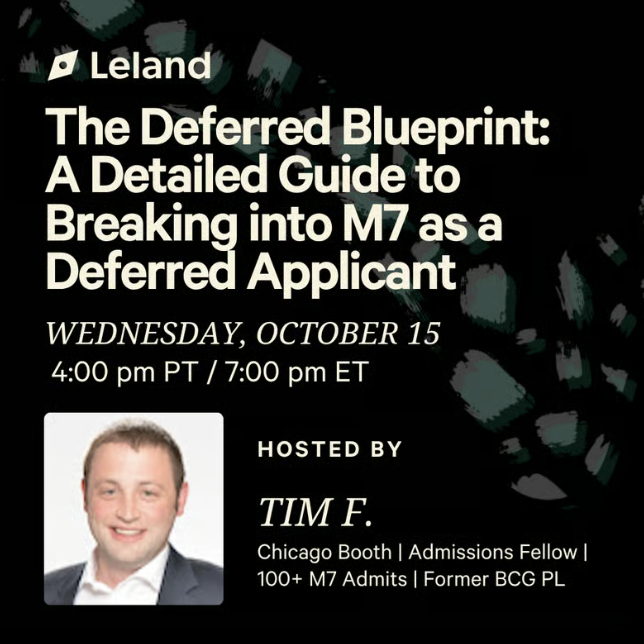
The Deferred Blueprint: A Detailed Guide to Breaking into M7 as a Deferred Applicant
Applying to deferred MBA programs can feel like a black box—especially when it comes to the ultra-competitive M7 schools. In this session, expert coach Tim F. will break down exactly what it takes to stand out as a deferred applicant. By the end, you’ll have a step-by-step blueprint for building a competitive application and putting yourself on the fast track to an M7 admit.

MIT Sloan: School Overview and Brand
An overview of MIT Sloan and its unique brand.
MIT Sloan: Overview and Application Breakdown
An overview of MIT Sloan and its application components.

15 Challenging GMAT Questions
An overview of 15 challenging GMAT questions and walkthroughs.

Permutations and Combinations for GMAT and GRE
An overview of permutations and combinations for the GMAT and GRE.
Waitlist Action Planner Template
• Weekly layout (Weeks 1–6) • Sections for: school engagement, updates, achievements, outreach, mindset goals • Columns for tracking actions, deadlines, and communications sent • Example of a completed plan for inspiration • Summary section for final reflection

Waitlist Self-Audit Worksheet
• Section 1: Application summary (GMAT/GRE, GPA, goals, recommenders) • Section 2: Strengths (what resonated or differentiates you) • Section 3: Gaps (academic, professional, narrative, or fit-related) • Section 4: Actionable improvements — list 2–3 moves in next 4–6 weeks • Section 5: Reflection prompt — “What new evidence can I show to close these gaps?”

If You’re Admitted vs. If You’re Not – Next Steps and Growth Opportunities
• What to do immediately if admitted off the waitlist (next steps checklist) • If not admitted: reframing and reapplication mindset • How to carry lessons forward to strengthen next cycle applications • Managing timelines (deposits, deferrals, reapp deadlines) • Closing encouragement: progress > perfection
Overview of the Waitlist Process
• Visual timeline from decision release → movement → final outcomes • Key decision points: R2 admit shifts, summer yield management • Typical volume of waitlisted candidates and admit conversion rates • School-specific examples (generalized, not data-heavy) • Summary: What you can and can’t control at each stage
Waitlist 101 Guide
• Mindset shift: from “waiting” to “strategic repositioning” • Common emotional pitfalls (panic, over-updating, disengagement) • How to maintain professionalism and perspective • Setting intentions for the next 4–8 weeks • Quick self-checklist: “Am I reacting or responding?”

Identify Your Missing Piece
• Walk through a real or hypothetical example of identifying gaps • How to differentiate between “substance gaps” and “communication gaps” • Example of turning a weakness (e.g., low quant score) into an update plan • Framework recap: Story – Strength – Fit • Call to action: complete your self-audit and select 1–2 improvement priorities
Top 10 Ways to Strengthen Your Profile While Waitlisted
• Examples of high-impact updates: promotions, certifications, quant coursework, new leadership roles • How to frame achievements for the admissions committee • How to show ongoing engagement with the school (events, conversations, visits) • Building credibility through thoughtful updates, not volume • Quick-reference chart: “Update ideas by category (Academic / Professional / Personal / Fit)"
Waitlist Update Letter Builder
• Section 1: Greeting and opening tone • Section 2: New accomplishments or progress since submission • Section 3: Refined clarity on short- and long-term goals • Section 4: Reaffirmed school fit (specific to program culture and resources) • Section 5: Closing statement (gratitude + enthusiasm without pressure) • Example language snippets for each section