Leland+ Content Library
Select a category













































Popular on Leland+

Three Types of AI Memory
There are three types of AI memory: in-context memory, file-based memory, and retrieved memory. This reference card outlines examples of each and tips for how to prioritize how you save and transfer data to AI Agents.
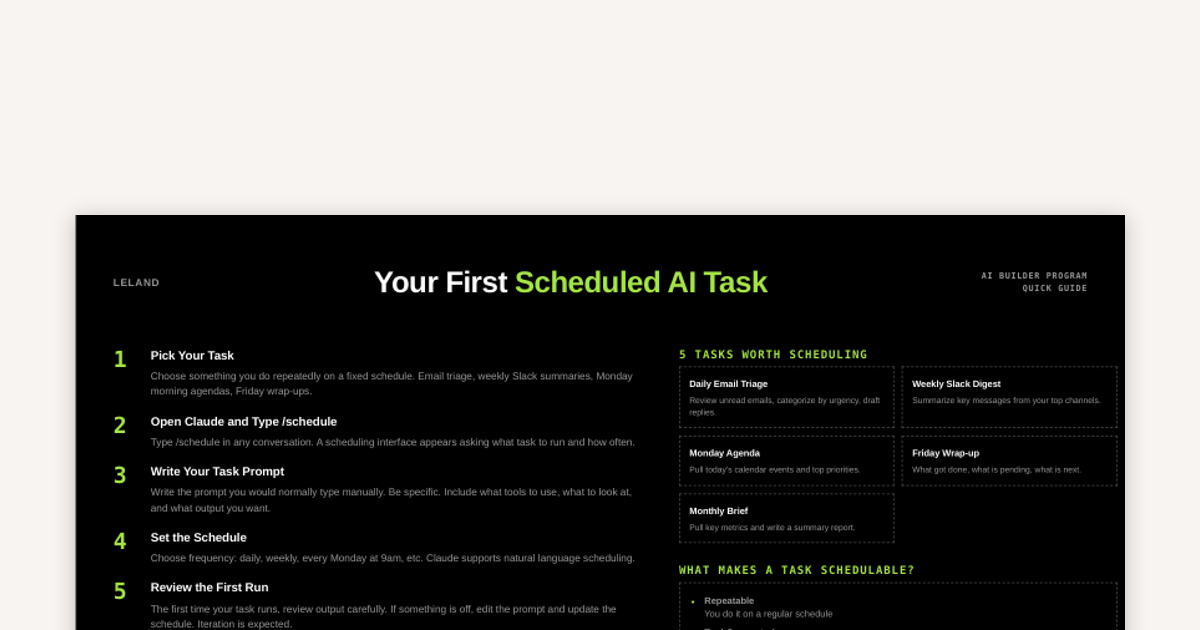
Create Scheduled Tasks in Claude
Learn a quick an easy way to set up automated tasks using either Claude Cowork or Claude Code.
Ace Your Consulting Case Interviews
After this session, you'll know how to structure your thinking under pressure, what separates a good case answer from a strong one, and how to handle the moments where candidates most often lose the interviewer. We'll cover the specific frameworks that hold up across McKinsey, BCG, and Bain formats, and how to communicate your reasoning in a way that signals real business intuition rather than rehearsed templates.


Headhunters and Resumes: How to Get Noticed in PE Recruiting
Private equity recruiting is highly selective, and your resume and cover letter need to communicate impact, rigor, and investment judgment quickly. This session is designed for candidates targeting PE roles who want to understand how top applicants position their experience and stand out on paper. You’ll learn how to structure a results-driven resume, highlight deal and transaction experience effectively, and craft a cover letter that clearly signals fit and interest in the firm.


GMAT Advanced Quant Workshop: Exponents & Roots - Applied Strategies & Tips
Many high-scoring GMAT candidates hit a ceiling on Quant because of advanced exponent and root problems. These questions aren’t just about knowing the rules—they test whether you can recognize patterns, simplify quickly, and avoid time-consuming calculations. In GMAT Advanced Quant Workshop: Exponents & Roots – Applied Strategies & Tips, you’ll learn how top performers approach the hardest versions of these questions. The coach regularly works 1:1 with GMAT candidates and will share the same problem-solving strategies used in coaching sessions to help students push from strong scores into the top percentile. Who This Is For - GMAT test-takers aiming for a 48–51 Quant score - Students comfortable with basics but struggling with harder exponent and root problems - Candidates looking to improve speed and efficiency on advanced Quant - Test-takers who want a clearer approach to high-difficulty problem types What You’ll Walk Away With - How to simplify complex radical and exponent expressions quickly - The exponent patterns that appear most often in hard GMAT problems - When to calculate exactly vs. when to use estimation strategically - The reasoning patterns that separate a 48 from a 51 on Quant

How to Automate Recurring Work in Cowork
Claude Cowork is an Anthropic tool available in the Claude Desktop app that can access your full computer and help you to automate your tasks.
Build a Quality Rubric for Your AI Workflow
A quality rubric is a set of explicit, measurable criteria that define what a good output looks like for a specific task. It answers the question: "How do I know when this is good enough to use?"
![How To Write Outstanding Law School Application Essays [4/16/2026] (Recording)](https://customer-14xsjmjbqk93tdwp.cloudflarestream.com/64995d66d0d56166e584f432e1b0cd66/thumbnails/thumbnail.jpg)
How To Write Outstanding Law School Application Essays [4/16/2026] (Recording)
Your law school application essays are arguably the most important aspect of your law school applications. To have the best outcomes and plenty of options at the end of the process, you need to craft compelling essays with solid narratives that paint a picture beyond your numbers. We will talk about different essay prompts and how best to tackle them, why it makes sense to have two 'main' essays instead of just one, how to handle optional essays and the dreaded 'why x school' essays. We will also have time for some 'Ask Me Anything' at the end.

Claude Chat vs. Cowork vs Code
There are a lot of options for how to approach tasks using AI. Learn which interface to reach for why one might be more suited to specific tasks than the others.

Giving Context to Your Agents: Making Your First CLAUDE.md
CLAUDE.md is a plain text file that loads automatically at the start of every Claude Code or Cowork session. It tells Claude who you are, what you are working on, what tools you use, and how you want Claude to behave.
Inside Private Equity: Ask a PE Founder and Former BlackRock Director Anything
Private equity can be hard to break into and even harder to fully understand from the outside. This session is for candidates who want a candid look into the industry from someone who has operated at a high level and built their own firm. You’ll learn how private equity professionals think about investing, what the day-to-day actually involves, and how candidates can better position themselves for roles in the field.

How to Transition Into AI from Any Background
Many professionals are interested in working in AI but aren’t sure how to translate their current skills into opportunities in the field. This session is designed for candidates from technical and non-technical backgrounds who want a realistic path to entering the AI ecosystem. You’ll learn how to identify transferable skills, position your experience for AI-related roles, and prioritize the tools, projects, or learning paths that hiring managers actually value.


CPT to FTE: Building Your Career Pipeline During Your U.S. Studies
Turning a CPT opportunity into a full-time role requires early planning and a clear strategy. In this session, we’ll break down how students can use internships, part-time roles, and on-campus opportunities to build a strong pipeline toward full-time employment in the U.S. You’ll learn how to choose roles that maximize conversion potential, build relationships with managers and recruiters, and position your experience for return offers or future sponsorship. Whether you’re just starting your studies or already on CPT, this session will help you take intentional steps toward a successful FTE outcome.


Global Admissions: What Korean MBA Applicants Get Wrong
Are you a Korean MBA applicant looking to navigate the global admissions landscape? Join me, Caolan, for an insightful session on the common pitfalls and unique challenges faced by Korean candidates in the MBA application process. With over 150 successful MBA and Master's admits to top programs like INSEAD, MIT Sloan, and London Business School, I specialize in cross-cultural applications and have a deep understanding of what it takes to stand out. Having worked with clients from leading companies such as Netflix and Deloitte, I bring a wealth of experience in crafting compelling applications that truly reflect your potential. My approach is precise, practical, and tailored to help you succeed in highly competitive admissions environments. You’ll learn to reinterpret your strengths through a global lens, connect your story to what elite programs truly value, and position yourself as a culturally fluent leader ready to thrive in international environments. Whether you’re applying to an Ivy League MBA or a European Master’s, this session will help you go beyond credentials to craft an application that feels both strategic and unmistakably human. Don't miss this opportunity to gain strategic insights and boost your confidence.

Your MBA Edge: Turning a Non-Traditional Path into a Winning App
Join this live conversation with a Korean INSEAD admit from a niche industry (gaming) and their admissions coach, Caolan. We’ll unpack how to build an authentic, coherent MBA story without over‑fixating on scores, even as a reapplicant or non‑traditional candidate. You’ll see how they framed transferable skills, targeted schools with different cultures, and prepared for interviews. - Learn how to craft a compelling and authentic application story that stands out, even with diverse career paths or perceived weaknesses like a lower GPA. - Understand why storytelling, strategic discussions, and a holistic approach can be more critical than perfect quantitative metrics (GMAT/GPA) for top MBA admissions. - Discover strategies to reframe your niche industry experience as a competitive advantage, turning perceived disadvantages into strengths. - Gain insights into researching and articulating school-specific fit, moving beyond generic website information to truly customize your application. - Be inspired by a reapplicant's journey to INSEAD, demonstrating that with the right approach and guidance, success is achievable for a wide range of profiles. - Learn what to look for in a consultant, including the importance of genuine care, industry understanding, and time investment. An engaging, interview-style conversation between Caolan Hunter and Gitak Kwak, followed by an open Q&A session, designed to empower aspiring MBA candidates, particularly those from non-traditional backgrounds or facing unique application challenges, by offering practical insights and an inspiring success story. Who it’s for: - Korean and international MBA hopefuls - Reapplicants or candidates from niche / non‑traditional industries - Applicants worried about stats (GPA/GMAT) or “imperfect” profiles

Three Principles for AI Coding
These three principles form the foundation of effective AI-assisted development. Master them and you'll ship better code faster.

AI Agents vs. Skills: How to Know What to Build
AI Agents and Skills handle tasks in fundamentally different ways. You don't want to create a custom agent when a simple skill will suffice, but a skill won't have the same scope an agent would. This guide outlines the differences between the two approaches and their use cases.
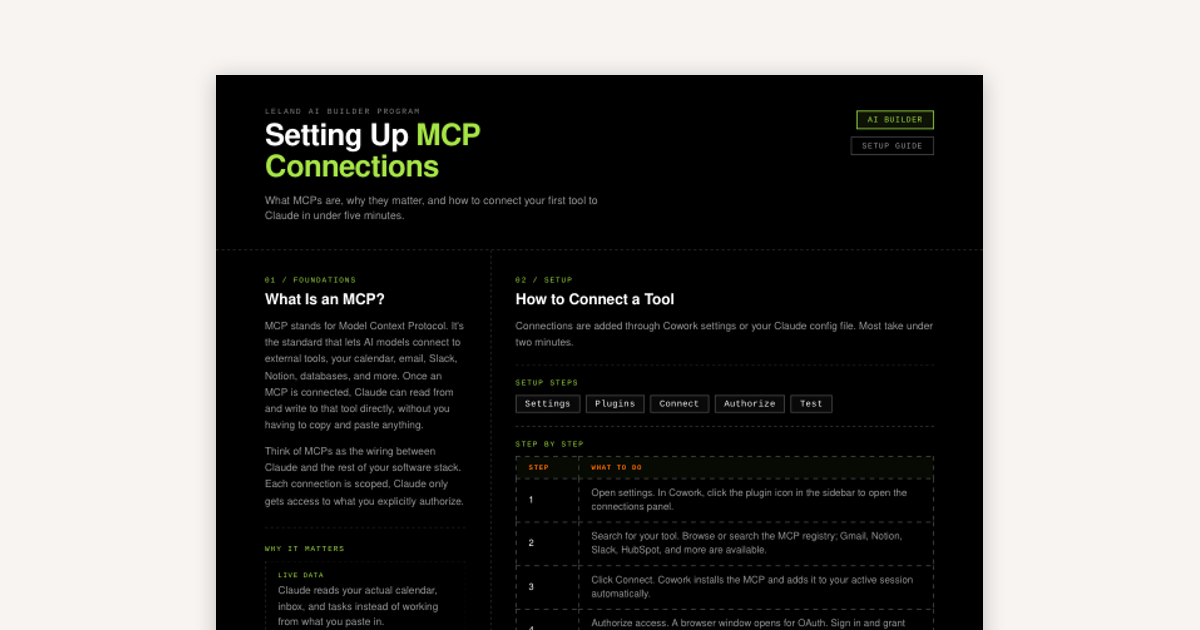
How to Set Up MCP Connections
MCP stands for Model Context Protocol. It's the standard that lets AI models connect to external tools, your calendar, email, Slack, Notion, databases, and more.
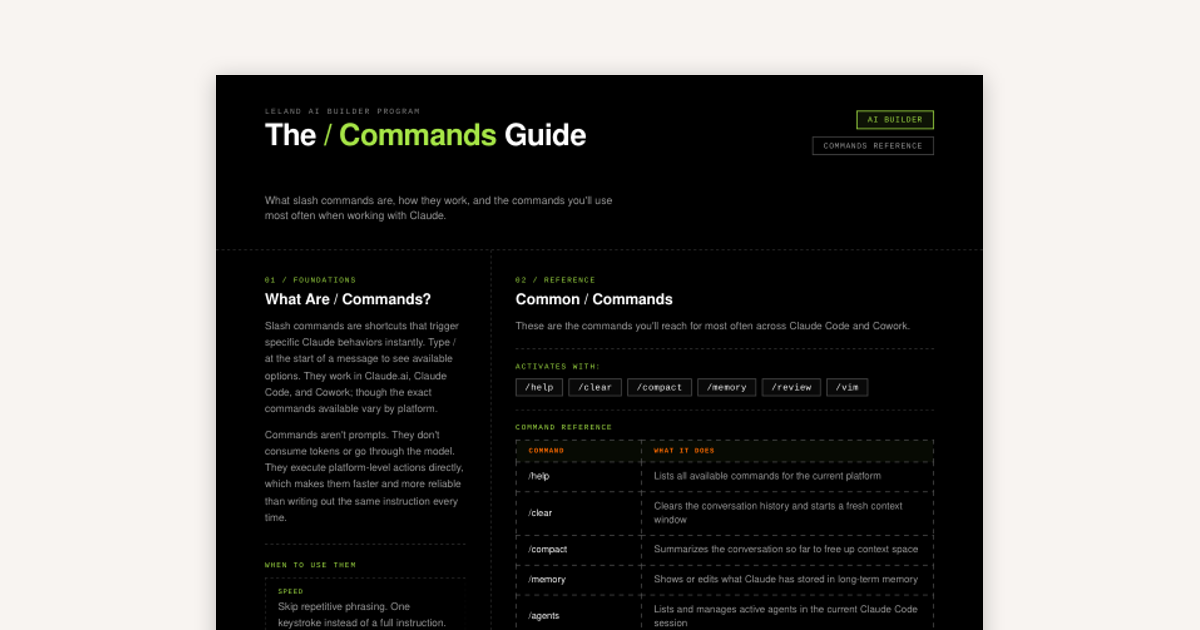
Slash Commands for AI Applications and Terminal
Learn what slash commands are, how they work, and what commands you'll use most when working with agents like Claude.
What It Takes to Pass the PE Technical Round
After this session, you will know how to structure a leveraged buyout model under time pressure, articulate an investment thesis that holds up to pushback, and answer the deal experience questions that consistently trip up strong candidates. The focus is on the patterns that separate people who pass from people who stall: where the logic breaks down, what interviewers are actually stress-testing, and how to think through a case you have never seen before.