Leland+ for Investment Banking







Popular on Leland+
![Coffee Chats: A Primer [8/25/2026] (Recording)](https://customer-14xsjmjbqk93tdwp.cloudflarestream.com/bcfc052549289b8bb5aac751b72e2739/thumbnails/thumbnail.jpg)
Coffee Chats: A Primer [8/25/2026] (Recording)
A coffee chat is a fifteen to thirty minute conversation with a banker. Casual in tone, evaluative in function. Treat it as an interview no matter how it was framed. That is the part people get wrong in both directions. Some show up stiff and over-rehearsed. Others hear "coffee" and show up with nothing. What is actually happening is simpler. First rounds go to candidates someone inside is pushing, and that push starts on this call. You are on it to do four things. Collect intelligence you will reuse later, turn the banker into an ally, form your own read on the group, and leave with the name of the next person to talk to. What we'll cover: - What a coffee chat is for, and the four things you are there to do - Why the first five minutes carry more weight than the rest - Tuning your questions to an analyst versus a VP or an MD - The two kinds of questions that land badly, and what to ask instead - What kills a call, including the topics to stay off - Ending on the ask, and how one chat becomes the next two Want to walk into these calls actually ready? Check out my Coffee Chat Ready package. Book a free 15-minute intro to see if it is a good fit. Part 3 of Coffee Chat Ready, a six part run on Tuesdays and Thursdays. Each one stands alone, so jump in anywhere. I'm the founder of OFFERGOBLIN and ex-Centerview tech.
![Tell Me About Yourself [8/27/2026] (Recording)](https://customer-14xsjmjbqk93tdwp.cloudflarestream.com/1106429fc0ed96aeae03c3024a3d00e5/thumbnails/thumbnail.jpg)
Tell Me About Yourself [8/27/2026] (Recording)
It is the one answer in the entire interview you can build completely before you walk in. The interviewer is asking for a story. The resume already lists what you did. What it cannot show is why those lines sit next to each other. The structure is HERO. Setup, challenge, turning point, resolution, future path. Sixty to ninety seconds, then stop. The turning point has to be an actual event, a class, a person, a job, because a named source is checkable and a vague one is not. Two things people get wrong in the other direction. If the prompt is literally walk me through your resume, that answer is chronological and it tracks the page in front of them, so do not force a story arc onto it. And do not answer why banking inside this one. Those are scored separately. Land the arc, name the target, stop talking. What we'll cover: - The five HERO slots in order, and what belongs in each - Why the turning point has to be an event and not a feeling - The four things being graded: structure, character, sourcing, delivery - What changes when the prompt is walk me through your resume instead - Why answering why banking inside this one costs you both answers - How to drill it: slots on paper, page away, say it out loud, record it Want to solidify your tell me about yourself and be done with it? I run a popular 90-minute session where we go deep and construct a strong, personal story. Book a free 15-minute intro to learn more. Part 4 of Coffee Chat Ready, a six part run on Tuesdays and Thursdays. Each one stands alone, so jump in anywhere. I'm the founder of OFFERGOBLIN and ex-Centerview tech.
![How to Get the Coffee Chat [8/20/2026] (Recording)](https://customer-14xsjmjbqk93tdwp.cloudflarestream.com/4e137e343b047a01844fafab11677b7d/thumbnails/thumbnail.jpg)
How to Get the Coffee Chat [8/20/2026] (Recording)
Nobody replies. That is the whole problem, and it is usually fixable. This is the outreach primer. Before you send anything, look at what the banker sees when your request lands. A LinkedIn with no photo and no school reads as someone there is no reason to take seriously, and the request gets declined. No resume in the thread and they may not bother taking the chance on you. Then the email itself. Who you are, one specific reason you want this person, three windows, resume attached. Under five sentences. The windows have rules people break constantly, and breaking one of them costs you the contact. What we'll cover: - Which channel to use first, and why the school or club pipeline beats a cold email - What a banker sees before deciding whether to take your call - The five sentence email, and the one specific reason that has to be in it - The rules for offering times, including the one that burns the contact - When to follow up, and the line between persistence and pestering - The referral email, and why it is the easiest one you will ever send Have a tricky networking situation? Book a free 15-minute intro and we will talk it through. Part 2 of Coffee Chat Ready, a six part run on Tuesdays and Thursdays. Each one stands alone, so jump in anywhere. I'm the founder of OFFERGOBLIN and ex-Centerview tech.
![The Deal Discussion Playbook [8/10/2026] (Recording)](https://customer-14xsjmjbqk93tdwp.cloudflarestream.com/b158cbb93ab4b565e3ad9b0731d3cb70/thumbnails/thumbnail.jpg)
The Deal Discussion Playbook [8/10/2026] (Recording)
After this session, you will know how to navigate compensation conversations, respond to exploding offers, and push back on deal terms without jeopardizing an offer. This playbook covers the specific moments in the negotiation process where candidates most commonly leave money on the table or signal the wrong things to a hiring team. Attending live means you can bring your actual situation, whether you have a competing offer, a timeline conflict, or a number that feels off, and get a direct read on how to handle it. A recording cannot replicate that exchange. The coach works inside these conversations regularly and will share the patterns and language that move outcomes in the right direction.
![Banking to Buy-Side: IB & Venture Playbook [6/17/2026] (Recording)](https://customer-14xsjmjbqk93tdwp.cloudflarestream.com/a446d064c8cf6b901eef161e584eb28e/thumbnails/thumbnail.jpg)
Banking to Buy-Side: IB & Venture Playbook [6/17/2026] (Recording)
Many finance professionals see investment banking as a stepping stone, but far fewer understand how to successfully make the jump to the buy side. This session is for candidates interested in venture capital, investing, and long-term finance careers who want a clearer roadmap for navigating that transition. You’ll learn how investment banking experience can be leveraged for buy-side opportunities, what firms look for in candidates making the move, and how to position yourself throughout the recruiting process. Join live to hear from two experts with extensive experience across both investment banking and venture capital and ask questions about your own career path. The speakers have firsthand experience navigating these industries and will share the patterns they see across successful transitions, common mistakes, and what differentiates candidates who break through. Expect practical insights and advice similar to what’s covered in 1:1 career coaching conversations.


Free
![Investment Banking Recruiting General Advice - Technical & Networking Prep [9/6/2026] (Recording)](https://customer-14xsjmjbqk93tdwp.cloudflarestream.com/f041b23ad2c9076b7951242972a0d470/thumbnails/thumbnail.jpg)
Investment Banking Recruiting General Advice - Technical & Networking Prep [9/6/2026] (Recording)
In this session we will go over the updated investment banking timeline, tips for recruiting, and best practices for preparing for interviews and networking calls.
![Breaking Into Investment Banking from Non-Traditional Backgrounds [6/16/2026] (Recording)](https://customer-14xsjmjbqk93tdwp.cloudflarestream.com/180647fa63c312b6aac30cbdb07c7c66/thumbnails/thumbnail.jpg)
Breaking Into Investment Banking from Non-Traditional Backgrounds [6/16/2026] (Recording)
If your resume doesn't follow the traditional finance recruiting path, this session will show you how to position your background so it reads as an asset, not a gap. We'll cover how to reframe non-traditional experience for banking roles, which transferable skills actually resonate with hiring managers, and how to approach networking when you don't have built-in alumni pipelines. Attending live means you can describe your specific background and get a direct read on how a recruiter or banker would interpret it, which a recording simply cannot replicate. The coach works with non-traditional candidates regularly and will share the patterns that tend to separate the ones who break in from the ones who stall out.

![Top 5 Tips to Stand Out in IB Recruiting [7/8/2026] (Recording)](https://customer-14xsjmjbqk93tdwp.cloudflarestream.com/831e25103452384fd76459e4073d5afd/thumbnails/thumbnail.jpg)
Top 5 Tips to Stand Out in IB Recruiting [7/8/2026] (Recording)
Investment banking recruiting is intensely competitive, and small differences in preparation can have an outsized impact on who gets interviews and offers. This session is for candidates who want to understand how to separate themselves in a crowded applicant pool and stand out to top firms. You’ll learn five high-impact strategies for strengthening your candidacy, positioning your experience effectively, and making a lasting impression throughout the recruiting process. Join live to hear from a former Associate at Goldman Sachs and Private Equity Director who has seen recruiting from both sides of the table. The speaker will share the habits, signals, and subtle differentiators that top firms pay attention to, along with common mistakes that hold strong candidates back. Expect practical advice and insider perspective you can immediately apply to your recruiting journey.

Free
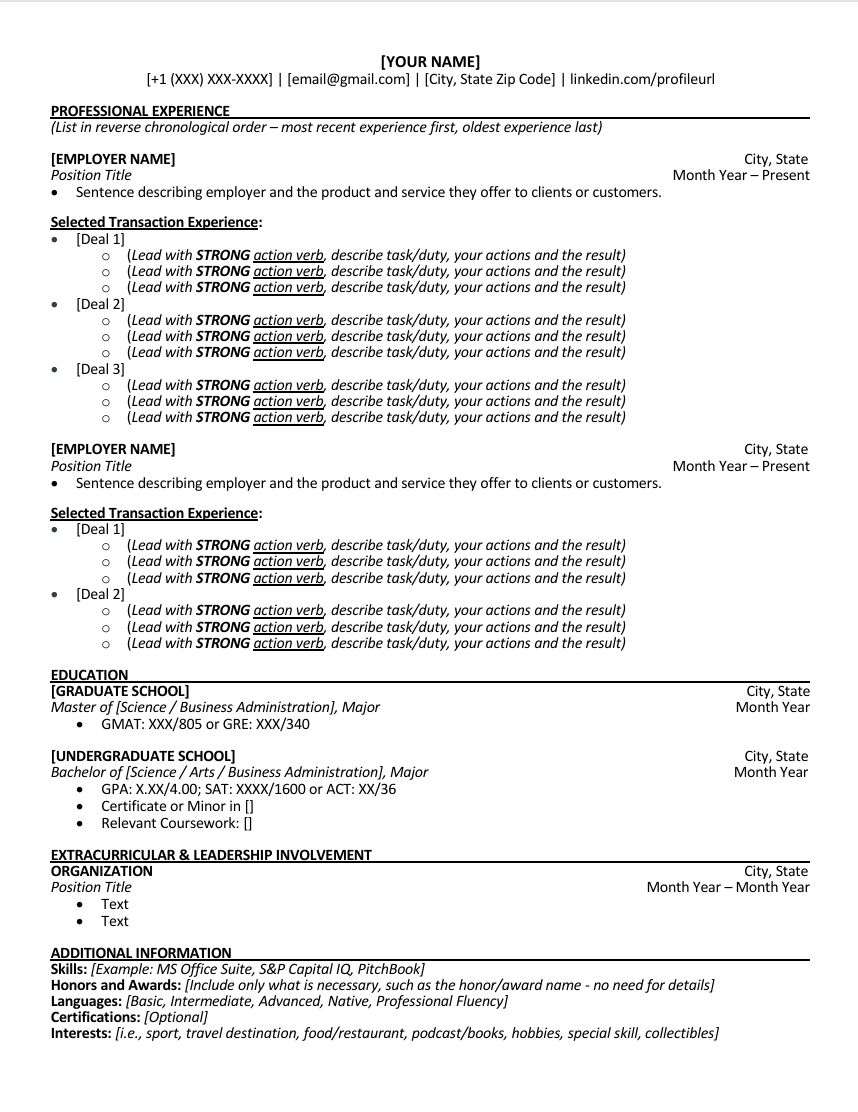
Finance Career Resume Template
A clean, one-page resume template designed for investment banking, private equity, and other finance careers. Includes guidance for structuring professional experience, transaction experience, education, leadership, skills, and interests.
Free

Investment Banking Technical Interview: 75 Essential Questions
Prepare for investment banking technical interviews with 75 essential questions covering accounting, enterprise and equity value, valuation, DCF and WACC, accretion/dilution, and M&A. Designed for Analyst and Associate recruiting, with questions progressing from core fundamentals to advanced transaction mechanics and M&A judgment.

Discounted Cashflow Modelling guide
Master DCF valuation with a guide built for real-world finance roles. This concise, practical resource will strengthen your technical foundations and refine your understand of the logic behind each calculation, so you can explain valuation concepts confidently in interviews.

What Top Investment Banks Are Looking For
Many candidates aiming for investment banking roles aren’t sure what actually differentiates applicants in a highly competitive process. This session is designed for students and early-career professionals who want to understand how top banks evaluate candidates beyond GPA and technical skills. You’ll learn what qualities banks prioritize, how to position your experiences effectively, and how successful candidates prepare for both networking and interviews.

![How Candidates Actually Land Elite Boutique Offers [4/30/2026] (Recording)](https://customer-14xsjmjbqk93tdwp.cloudflarestream.com/b7c84ff4ca21e185f74ccdc362c65dd1/thumbnails/thumbnail.jpg)
How Candidates Actually Land Elite Boutique Offers [4/30/2026] (Recording)
Elite boutique investment banking offers are highly competitive, and the candidates who break through are intentional about how they position their experience and navigate the process. This session is for students targeting firms like Evercore, Lazard, and PJT who want to understand what actually differentiates successful applicants. You’ll learn how to build a focused recruiting strategy, position your background to signal strong fit, and approach networking and interviews in a way that leads to real traction. Join live to hear how an experienced coach evaluates candidates targeting elite boutiques and the patterns they see across successful applicants. You’ll also have the chance to ask questions about your own recruiting approach and get real-time guidance typically shared in 1:1 coaching sessions.
What Top Investment Banking Candidates Do Differently: Strategy, Positioning & Interview Edge
In this session, you will learn how to position yourself as a compelling investment banking candidate before you ever walk into an interview. We will cover how to build a deal experience narrative that holds up under pressure, how to differentiate yourself in a crowded applicant pool, and what interviewers are actually evaluating when they ask behavioral questions.

How to Craft a Standout Resume for Investment Banking
After this session, you will know how to structure an investment banking resume that clears the initial screen and holds the attention of a recruiter who reviews hundreds in a single cycle. The coach will cover how to quantify deal exposure and financial skills without overstating your experience, how to tailor your bullets for bulge bracket versus boutique targets, and how to position non-traditional backgrounds so they read as assets rather than gaps.


What You Need to Know About Investment Banking Technical Interviews
Preparing for investment banking technical interviews can feel overwhelming, especially when you’re unsure which concepts interviewers actually prioritize. This session is designed for candidates targeting IB roles who want a clearer, more focused way to prepare for the accounting, valuation, and financial modeling questions that frequently appear in interviews. You’ll learn how bankers evaluate technical responses, which core topics consistently come up, and how to structure answers so you sound confident and precise under pressure.
Preparing now for IB Summer Recruiting
IB summer recruiting moves quickly, and the strongest candidates are the ones who prepare with intention well before applications open. The groundwork you lay now can dramatically shape your outcomes later. In this session, we’ll cover how to sharpen your technical skills, craft a resume that stands out, network strategically, and understand what banks are truly looking for in summer analysts. If you want to enter recruiting season focused, confident, and ready to compete at the highest level, this is where it starts.

How to Crush your Finance Behavioral Interviews
In finance interviews, technical skills get you in the room—but behavioral answers often decide who gets the offer. Your ability to tell clear, confident stories about leadership, resilience, and impact can make all the difference. In this session, you’ll learn how to structure powerful answers, anticipate the questions firms consistently ask, and turn your experiences into memorable, results-driven narratives. We’ll break down what interviewers are truly assessing and how to respond with clarity, confidence, and credibility. If you want to walk into your next finance interview prepared to stand out, this is where to start.

Landing an Investment Banking Role
Investment banking recruiting is highly competitive, and success depends on strategy, preparation, and timing. This session breaks down the full recruiting process, from understanding roles and timelines to building a strong resume, networking effectively, and preparing for technical and behavioral interviews. You’ll learn how banks evaluate candidates, what differentiates top applicants, and how to avoid common mistakes that derail otherwise strong profiles.


How to Stand Out in IB Recruiting
Investment banking recruiting is intensely competitive, and standing out requires more than strong grades and technical skills. This session breaks down how banks actually evaluate candidates, what differentiates top applicants, and how to position your background to signal readiness from day one. You’ll learn how to refine your resume, tell a compelling story, network strategically, and avoid common mistakes that quietly hurt your chances.