Leland+ Content Library

The Deferred Blueprint: A Detailed Guide to Breaking into M7 as a Deferred Applicant
Applying to deferred MBA programs can feel like a black box—especially when it comes to the ultra-competitive M7 schools. In this session, expert coach Tim F. will break down exactly what it takes to stand out as a deferred applicant. By the end, you’ll have a step-by-step blueprint for building a competitive application and putting yourself on the fast track to an M7 admit.

![Blank Page to Submitted: Step by Step Guide to Writing Your Personal Statement [8/20/2026] (Recording)](https://customer-14xsjmjbqk93tdwp.cloudflarestream.com/74b3e51823c196208e87bdfb604513f2/thumbnails/thumbnail.jpg)
Blank Page to Submitted: Step by Step Guide to Writing Your Personal Statement [8/20/2026] (Recording)
Writing an MBA personal statement can be challenging when you’re trying to turn your experiences and goals into a clear, compelling story. This session is designed for MBA applicants who want practical best practices for writing stronger essays and a better understanding of what makes a personal statement effective. Ben and Allie will walk through key principles for developing your story, structuring your essay, and strengthening your writing, with examples to show what these principles look like in practice. Attending live gives you the opportunity to bring your specific questions, whether you’re starting from a blank page or working through a particular school’s prompt, and get a direct response in the moment. Ben and Allie will share the advice and techniques they use when working with MBA applicants and, where helpful, walk through example essays to show how strong writing decisions come together. If you want practical guidance you can apply to your own essays, it’s worth joining live.


![Defining Your Personal Narrative for MBA Applications [6/3/2026] (Recording)](https://customer-14xsjmjbqk93tdwp.cloudflarestream.com/c5460a9acce116e231a4e3208d3b8e13/thumbnails/thumbnail.jpg)
Defining Your Personal Narrative for MBA Applications [6/3/2026] (Recording)
GIVEAWAY DURING THE EVENT: Join for the chance to win a free seat in Leland's MBA Bootcamp! Many MBA applicants have strong experiences, but struggle to turn them into a narrative that feels clear, cohesive, and memorable. This session is for candidates who want to better define the story they’re telling across their entire application. You’ll learn how to identify the themes that connect your experiences, communicate your goals with more clarity, and build a narrative that feels authentic while aligning with what admissions teams look for. Join live to ask questions about your own application story and get guidance from an expert MBA coach who is a Chicago Booth MBA and former admissions professional. The speaker has worked closely with applicants on positioning and storytelling and will share the patterns they see across successful candidates and standout essays. Expect practical insights and feedback similar to what’s covered in 1:1 admissions coaching conversations.

Navigating the Big Load of Big Law Recruiting
Big Law recruiting moves fast, feels intense, and can overwhelm even the strongest candidates if they’re not prepared. In this session, top Leland coach and lawyer Shayna R. will break down how the process really works, so you know exactly what to expect at every stage. By the end, you’ll have a clearer, calmer path through one of the most demanding recruiting cycles in professional careers.

Mastering the Verbal SAT: Key Techniques for Every Question Type
Struggling with tricky SAT verbal questions? Want to boost your Reading and Writing scores with proven strategies? In this session, expert coach Jessica F. will walk you through the exact techniques top scorers use to approach every question type with confidence. By the end, you’ll have a toolkit of practical strategies to tackle the Verbal SAT section with clarity and confidence—no matter your starting score.

Market Sizing – Answer Delivery
This video helps candidates see the proper technique for delivering a market sizing answer to an interview. It shows them how to confirm the goal, map out an approach, solve the problem, and deliver the final solution.


Tech Cover Letter Structure That Actually Converts
Cover letters may seem like a thing of the past, but that's because most of them suck. Stop regurgitating your resume (they already have it!) and instead make abundantly clear how you'll add value to their team.

Free

Product Management Week Kickoff
Product managers sit at the center of some of the world’s most impactful products, shaping what gets built, why it matters, and how millions of people experience technology. This kickoff session is for anyone exploring a future in product management and looking for a clearer roadmap into the field. You’ll learn what PMs do day to day, the skills that matter most, and how successful candidates position themselves for opportunities in an increasingly competitive market.


How to Craft a Standout Resume for Investment Banking
After this session, you will know how to structure an investment banking resume that clears the initial screen and holds the attention of a recruiter who reviews hundreds in a single cycle. The coach will cover how to quantify deal exposure and financial skills without overstating your experience, how to tailor your bullets for bulge bracket versus boutique targets, and how to position non-traditional backgrounds so they read as assets rather than gaps.


Applied to 1000 Tech Jobs with No Luck? Stand Out with Personal Projects
“Applied to 1000 tech jobs with no luck.” If that sounds familiar, you’re not alone—many candidates flood the market with generic resumes that don’t stand out. The truth is, recruiters and hiring managers are looking for more than just a list of responsibilities: they want to see initiative, impact, and skills in action. In this session, Annie F., a Leland coach with extensive experience in tech recruiting and product roles, will break down how personal projects can transform your application from forgettable to compelling. You’ll learn what types of projects make the strongest signals, how to showcase them effectively on your resume and in interviews, and why they often matter more than another line on your work experience. Whether you’re transitioning into tech or struggling to land interviews, this event will give you practical strategies to highlight your unique value and finally stand out from the crowd.


Write Exceptional Deferred MBA Essays

Letter of Rec Example - M7 Admit
A deep dive into an impactful letter of recommendation. See how a powerful LOR can help you stand out and get into a top M7 MBA program.
UCLA Anderson Example Essay 2: Career Goals
This is an example essay of the Career Goals essay which asks for the short-term and long-term career goals of the applicant (150 word limit).

![AMA with Liz C., former admissions director @ University of Houston Law Center [8/3/2026] (Recording)](https://customer-14xsjmjbqk93tdwp.cloudflarestream.com/64e5f22023611f774e3cfad9a087de42/thumbnails/thumbnail.jpg)
AMA with Liz C., former admissions director @ University of Houston Law Center [8/3/2026] (Recording)
If you're thinking about going to law school, you've likely got a TON of questions. While the application process is largely standardized across schools, not every admissions officer is going to have the same perspective, so it can be useful to hear from more than one. I was an assistant and associate director of admissions at the University of Houston Law Center for eight years, and my goal is to demystify the process for all applicants. Join me for an AMA-style office hours where you can bring your questions and we can chat about all things law school admissions!


How To Write Outstanding Law School Application Essays
Your law school application essays are arguably the most important aspect of your law school applications. To have the best outcomes and plenty of options at the end of the process, you need to craft compelling essays with solid narratives that paint a picture beyond your numbers. Join Indrani S., former Stanford Law School Admissions Officer, for this session focusing on topics such as different essay prompts and how best to tackle them, why it makes sense to have two 'main' essays instead of just one, and the dreaded 'why' essays.

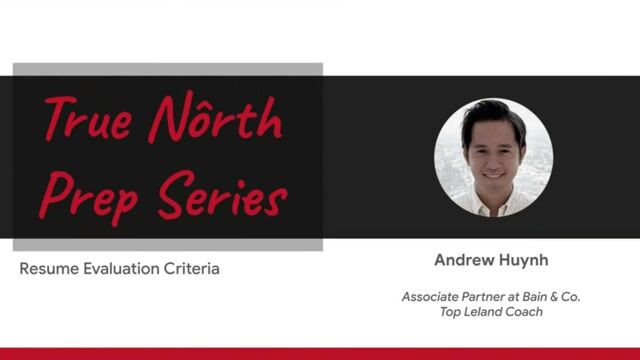
The Resume Screen: How to Get The First Interview
Your resume has seconds to make an impression before it’s sorted into "Interview" or "Reject." We strip away the fluff and focus on the high-impact signals that Bain screeners seek. Learn how to highlight the "so what" of your experience and structure your bullets to prove you already think like a consultant.


Tutor Skill
"/teach-me" acts as an adaptive conversational tutor that assesses baseline knowledge, builds a learning roadmap, teaches with analogies, checks understanding at each step, and closes with a summary and resources. To install, run this in your terminal after downloading the file: unzip ~/Downloads/teach-me-skill.zip -d ~/.claude/skills/teach-me/
![Why Your Career Pivot Story Isn't Working...(for Midlife Professionals) [8/12/2026] (Recording)](https://customer-14xsjmjbqk93tdwp.cloudflarestream.com/0f959cc691a2674f61febd1ae13d69e2/thumbnails/thumbnail.jpg)
Why Your Career Pivot Story Isn't Working...(for Midlife Professionals) [8/12/2026] (Recording)
You're not confused about whether to make a change. You're stuck on how to talk about it — to a former colleague, an interviewer, or yourself at midnight. This session is where that starts to shift. If you've been circling a career pivot for a while, you've probably noticed: the story you tell about it keeps coming out sideways. Too vague to be useful. Too hedged to be believed. Too much "I think maybe" and not enough of what you actually know. That's not a confidence problem. It's a structural one — and it's fixable in an hour. In this live session, you'll learn the two reasons pivot stories fall flat, try a tool that fixes both, and leave with one sentence you can actually say out loud — to a network contact, a recruiter, or the mirror. Is this for you? This session is a strong fit if: - You're in your 30s through 60s, with real work experience behind you, and you're thinking seriously about what's next - You have some runway — roughly 6 to 18 months — to land the right opportunity, not just an opportunity - You're motivated by finding alignment with your values and what you actually want from work now, not just by urgency - You're willing to turn your camera or microphone on and participate live — this session works because people do the exercise in real time, not because they watch it happen to someone else - You want a space to practice out loud without being judged for not having it all figured out yet This session is probably not the right fit if: - You have less than 5 years of full-time work experience - You need a job immediately — this is not a job-search-urgency session - You don't currently have the bandwidth for live participation and follow-through — which is completely fine, just not what this hour is for - You're looking to observe rather than engage, or you're not open to being contacted afterward with next steps and prompts to keep moving What you'll walk away with - One reframe — why direction matters more than clarity, and why waiting to feel "sure" is quietly keeping you stuck - One tool — the pivot sentence: a way to describe where you're headed that doesn't sound like a résumé or an apology - One real next step — no pressure, no pitch, just an open door if you want to keep going

![10 Must Haves for a Strong MBA Application [8/20/2026] (Recording)](https://customer-14xsjmjbqk93tdwp.cloudflarestream.com/d5f21db8cf54c31e49653b858dbe1b29/thumbnails/thumbnail.jpg)
10 Must Haves for a Strong MBA Application [8/20/2026] (Recording)
After this session, you will know exactly what separates competitive MBA applications from the ones that fall short. We will cover how to frame your post-MBA goals in a way that feels coherent and specific, how to assess whether your recommenders are actually positioned to advocate for you, and how to evaluate your own candidacy the way an admissions committee would. Attending live means you can ask a direct question about your profile and hear how an experienced coach thinks through a case like yours in real time, context that a recording simply cannot replicate. This coach works with MBA applicants daily and will be sharing the patterns that consistently show up across strong applications, offering a genuine look into how this work gets done.
Free
![Interview positioning for international candidates [9/13/2026] (Recording)](https://customer-14xsjmjbqk93tdwp.cloudflarestream.com/98d695187a96c557075ae1d18fd74ed2/thumbnails/thumbnail.jpg)
Interview positioning for international candidates [9/13/2026] (Recording)
The same answer that impresses interviewers in one country can quietly sink you in another. In this session, we'll break down why strong international candidates get misread in interviews and how to reposition your answers for the room you're actually in. You'll learn: (1) how interview expectations differ across the US, Europe, and Asia and what "confidence," "leadership," and "initiative" actually signal in each; (2) the three most common answer patterns that make international candidates sound junior, generic, or evasive and how to fix each one; (3) a practical framework for adapting your core stories to any cultural context without sounding rehearsed. Drawn from coaching 600+ international professionals through high-stakes interviews. Ideal for anyone interviewing across borders, whether you're moving abroad or joining a global team from home.