Leland+ for MBA




Popular on Leland+
10 Absolute Must-Haves to Break into the M7 [8/6/2026] (Recording)
Breaking into an M7 MBA program takes more than strong stats. The most successful applicants know how to build an application that clearly demonstrates leadership, impact, and fit. This session is for prospective MBA applicants who want to understand the qualities that consistently set admitted students apart. You'll learn the 10 essential elements of a competitive M7 application, the mistakes that weaken otherwise strong candidates, and where to focus your efforts for the greatest impact. Join live to hear from an MBA admissions expert with Chicago Booth admissions committee experience who has helped more than 200 clients earn MBA acceptances. The speaker will share practical insights from reviewing applications, proven strategies for standing out, and actionable advice you can immediately apply to strengthen your candidacy for top business schools.


AI vs MBA: Will Business School Still Matter in 10 Years? [8/22/2026] (Recording)
Curious about the future of business education in the age of AI? Join us for an engaging discussion on "AI vs MBA: Will Business School Still Matter in 10 Years?" where we'll explore the evolving landscape of business education and its relevance in a rapidly changing world. I'm Tomilola, your host for this session. With an MBA from Fisher College of Business and extensive experience as a Senior Product Manager at Microsoft, I've navigated the intersection of technology and business strategy. My journey includes founding TitanRConsulting, where I've empowered over 400 individuals to secure scholarships and Fortune 500 job offers, and leading strategic initiatives at Microsoft that have driven significant revenue growth. In this session, we'll delve into what employers will value most in future leaders, whether an MBA still provides a competitive advantage, skills that AI cannot replace and how applicants should position themselves today. If you're considering a traditional MBA, a part-time program, or an executive MBA, this event is tailored for you. Spaces are limited, so RSVP now to secure your spot and join the conversation on the future of business education!

Winning Essays from My HBS Admits [7/17/2026] (Recording)
Many applicants find a way to write at least one strong essay. But those who really maximize the essay-writing process develop clear narrative through-lines that connect the dots of their life, and articulate how they'll contributions to their target brand. Their two-dimensional writing brings out a three-dimensional personality. They have a “brand”. You know what they’re all about. This event will draw from example essays written by successful admits who I've personally coached, and helped land a spot at one or more top MBA programs. These essays were particularly strong in how they spoke to one another—how they created a holistic applicant who admissions committees could envision on campus. Their professional and judiciously placed personal experience offer evidence for why they’re the kind of person who will make a specific, meaningful difference in the world. During this session, we'll analyze these essays alongside you so you have a clear view into how you can apply what you've learned to your own writing, and put your best application forward for HBS.

What They Ask, What You Ask: A Complete Guide to MBA Behavioral Questions [9/24/2026] (Recording)
Once you're past the opener, the MBA interview becomes a conversation — and most candidates are only prepared for one direction of it. Behavioral questions are harder to predict and easier to fumble than the standard tell me about yourself / why mba / why here, and the questions you ask at the end of the interview are evaluated nearly as much as the answers you gave. As a Ross admissions interviewer, I've sat through countless interview conversations. The candidates who finish strong treat the full interview as a two-way exchange, not a performance. This session covers how to handle what comes after "tell me about yourself" — and how to close in a way that reinforces everything you just said. How MBA Behavioral Questions Are Different From What You'd Expect: These aren't job always interview questions. The framing and evaluation criteria are distinct. -What MBA programs are actually assessing in behavioral questions: self-awareness, leadership style, how you handle ambiguity -The most common behavioral questions and what interviewers are listening for beneath the surface -Why the STAR format produces flat answers — and what structure actually works better Telling Stories That Hold Up: A good behavioral answer doesn't just answer the question. It reveals something. -How to choose experiences that show what you want the interviewer to take away about you -How to be specific without over-explaining, and concise without underselling -What to do when the question doesn't map cleanly to an experience you've prepared Adcom vs. Alum Interviewers — What Changes: The interview format is the same. The dynamic isn't. -How adcom interviewers and alum interviewers are trained differently and what each is evaluating -Why alum interviewers often ask less predictable questions and how to stay grounded when they do -What each type of interviewer is most likely to flag as a concern — and how to address it before they have to ask What to Ask Your Interviewer (And Why Most Candidates Get This Wrong): The questions you ask are part of your evaluation. Most people treat them as an afterthought. -What your questions signal about your preparation, your priorities, and your fit -The difference between a strong question for an adcom interviewer and one for an alum — and why the distinction matters -Questions that land well, questions that fall flat, and what the interviewer is thinking in both cases


Essays: Learn from Past Admits & Elevate Your Writing [10/2/2026] (Recording)
Part 5 of 6 — Build Your Best MBA Application: One Piece at a Time, a free series (5:00–5:45pm ET). The essays are won before you write them. We'll start with the reflection work that saves weeks of revision later — show, don't tell; specifics beat adjectives; go deep, not wide — and why the anchor essay (Stanford's "What matters most to you, and why?") gets written first, with everything else flowing from it. Then we'll look at real essays from my clients admitted to top programs — full essays, not excerpts: what they wrote, why it worked, and the specific, repeatable moves you can bring into your own drafts. Plus how strong applicants differentiate across schools instead of copy-pasting one narrative, and the v1 → v3/v4 revision ladder my clients run. If you're heading into R1 or R2 drafts, this is the fastest way I know to calibrate what "great" actually looks like.
From Background to Business School: How to Build a Credible MBA Narrative [10/22/2026] (Recording)
Most "Why MBA" answers fail before they start, not because applicants can't write, but because they're answering the wrong question. As a Ross alum and admissions interviewer, I can tell you: the goals essay isn't about where you want to go. It's about whether adcom believes you'll get there, and whether an MBA is the logical next step for someone like you. This session breaks down how to build a goals narrative that's specific, credible, and connects your past to your future in a way that doesn't sound manufactured. What Adcom Is Actually Evaluating When They Read Your Goals Essay: It's not the goal itself, it's whether your story hangs together. -The three questions every adcom reader is asking while they read your answer -Why "I want to develop leadership skills" and similar answers kill otherwise strong applications -The difference between a goal that's ambitious and one that's believable The Architecture of a Strong Why MBA Story: Most applicants lead with too much context. Here's why that doesn't work and what to do instead. -How to connect your past experience to your post-MBA goal in a way that feels inevitable, not invented -The difference between a career change story and a career progression story, and how to tell yours -Why specificity is the single most important thing you can bring to this essay Where Applicants Lose Adcom's Trust: A weak goals essay doesn't just lose points, it raises questions about your whole application. -How vague goals undermine even a strong resume and work history -How to handle "why now" when there's no clean answer -What to do if your goals have shifted since you started the application Making It Concrete: A framework you can use immediately to test whether your story is working. -How to gut-check your narrative before you put it on paper -What a strong vs. weak Why MBA story actually looks like, side by side -The one question to ask yourself before you finalize anything
MBA Submit & Speak Part 1: The Final Ten Days [8/27/2026] (Recording)
Ten days out from your Round 1 deadline, everything feels urgent, and much of it truly is. What you may not have is time to do it all. This session opens a new three-part series, MBA Submit & Speak. We start where you are right now, in the last stretch before Round 1 closes, and we make the decisions that are still genuinely open to you. Not another round of line edits, but the calls that change what an admissions committee receives. Across the three sessions, we move from the last days before you submit to the interviews that follow. Attend all three to go from deadline to interview with one continuous plan, or drop into the single session you need most. In this session, you will learn how to spend your final ten days: • Decide school by school which programs belong in Round 1, and which one you should move to Round 2 on purpose rather than by accident. • See why the online application form itself, the biographical, employment, education, and activities sections that feel like paperwork, is read as closely as anything you write. • Learn when an optional essay or addendum helps you, and when saying nothing is the stronger answer. • Handle a recommender who has gone quiet with days left, without damaging the relationship or the recommendation. • Rank what is worth fixing in the last seventy-two hours and give yourself permission to leave the rest alone. The hardest part of the final ten days is not effort, it is order. A dozen legitimate tasks compete for the same few evenings, and from where you are sitting they all look equally important. This session puts them in sequence, so you know what to do first, what can wait until the night before, and what to let go of entirely, and you submit an application you chose rather than one the clock chose for you. I have guided more than 100 applicants into every M7 program, across the top 20 in the U.S., and into leading international programs, including INSEAD, London Business School, IESE, Esade, Oxford, Cambridge, NUS, and more. Spend your last ten days on what actually changes the outcome. Register now to claim your spot.
Looking to apply to a MBA program? Join the Live Q+A! [8/12/2026] (Recording)
Choosing between MBA programs can be tough! Is the part time for you? Full time? Executive? Join this live Q+A, where I'll share more about my journey choosing the UCLA MBA Executive program, and how I landed a spot in the Class of 2025. Leave with tips, strategies and insight to make the best decision for yourself. This session is applicable to all looking to choose between MBA programs. Come join! Spots are limited.

5 Best Practices for Writing an Excellent MBA Essay [6/3/2026] (Recording)
Great MBA essays don’t just sound polished, they make admissions readers remember you long after they finish reading. This session is for applicants who want a clearer understanding of what separates average essays from truly compelling ones. You’ll learn five core best practices for building a strong narrative, writing with more clarity and specificity, and aligning your essays with what top MBA programs are actually looking for. Join live to ask questions about your own essays and hear practical guidance from an expert MBA coach with dual degrees from M7 programs. The speaker has worked closely with applicants on crafting standout applications and will share the patterns they see across successful essays and common mistakes. Expect actionable insights and feedback similar to what’s covered in 1:1 admissions coaching conversations.

MiM, Masters and MBA Essays, Dissected: Same Four Questions, Almost Everywhere [10/7/2026] (Recording)
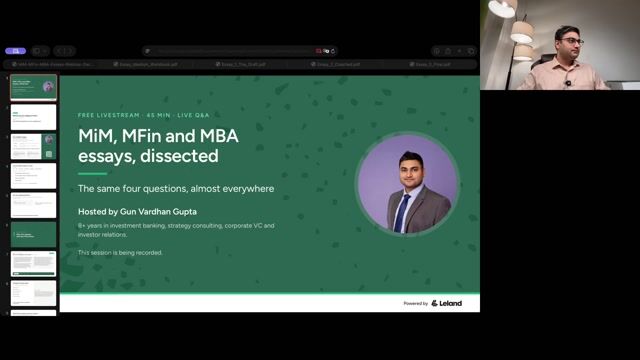
Most essay advice is a list of tips. This is the version I give paying clients, using a real submitted essay and the rebuilt one next to it. I did a Master in Management (MiM) and have spent 8+ years in strategy and finance across six countries. I have mentored clients on their MiM, Master in Finance and MBA applications across the US, Europe and Asia. I have read a lot of drafts that were competent and forgettable, which means I can tell you what a reader actually sees. In 1 hour, I will cover why fifteen prompts across five schools are really only four questions, and why that changes how much work this is. What each of the four is actually asking underneath the wording, and the word split I would recommend for each. Why most why-this-school paragraphs survive having the school name swapped, and what to write instead. The five things your goals answer needs, and the one sentence almost nobody includes that makes it read as considered rather than hopeful. The four angles on the contribution question, including the one schools care about more than applicants realise. What the personal question is actually testing, and the tone mistake people make while believing they are being self-aware. Where AI helps you, where it quietly sinks you, and the completely honest mistake that gets applicants flagged as dishonest. And the order I actually work in with clients, which starts nowhere near a first draft. This is for anyone writing essays for a MiM, Master in Finance, MBA or specialised master's, whether you have a blank page or a draft you are not happy with. Forty five minutes of content, then live Q&A, hands or chat. Bring a question about your own draft. Everyone who attends gets the Essay Ideation Workbook by email afterwards.
Is Your MBA Application Actually Ready for Round 1? [8/27/2026] (Recording)
Round 1 deadlines for top MBA programs land are fast approaching . If you're applying this cycle, you're weeks away from submitting, and it's easy to lose perspective on whether your application is actually strong or just feels done because you're tired of looking at it. I'm a former McKinsey consultant and HBS MBA. In this session, I'll walk through what actually separates a strong Round 1 application from one that gets rejected, focusing on the parts most applicants underestimate: story, positioning, and how your essays hold together as a coherent narrative, not just a collection of good individual answers. This isn't a test prep session. It's for people who've done the work and want a clear-eyed check before they hit submit, or who are close to done and want to know what's still missing. What we'll cover: - The difference between an application that's "finished" and one that's actually ready - How to spot a weak or disjointed narrative in your own essays - Common positioning mistakes that even strong candidates make - What admissions readers are actually looking for beyond the resume line items Come with questions. If you have a draft essay or two, even better, we'll use real examples where we can.

Deferred MBA Applications: What Top 10 Programs Reward Most [10/7/2026] (Recording)
Deferred MBA programs give college students a chance to secure a path to a top business school before starting their careers, but knowing what admissions committees actually value can be difficult. The strongest applicants understand how to make the most of their limited professional experience and demonstrate the potential top programs are looking for. This session is for college students applying to deferred MBA programs who want to build a more compelling application. You’ll learn what top programs reward most, how to position your experiences effectively, and where to focus your efforts to stand out. Join live to hear from an MBA expert who has coached 300+ clients and helped applicants gain admission to top business schools around the world. The speaker will share practical strategies for approaching deferred applications, common mistakes to avoid, and insights into what successful applicants do differently. Bring your questions and leave with a clearer strategy for strengthening your deferred MBA application.
Fix Your Essay Before It's Read and Forgotten [8/18/2026] (Recording)
Most MBA essay drafts are competent and entirely forgettable. Learn what separates a safe essay from one that gets remembered by an admissions committee reading hundreds of applications a week.

Round 2 MBA Roadmap: Master Your 4-Month Strategy for Top Programs [9/19/2026] (Recording)
With Round 1 applications wrapped up, September marks the official launch of the Round 2 cycle. With January deadlines fast approaching, candidates targeting M7 and top programs have roughly 15 weeks to build a standout application. As a recent Harvard Business School graduate, I'd like to offer a tactical, step-by-step masterclass on navigating the Round 2 timeline. Drawing on my firsthand experience as an applicant, I will break down a realistic week-by-week execution plan. You will learn how to sequence test prep alongside essay drafts, brief recommenders effectively, and build compelling narratives that resonate with elite admissions committees. Leave with a concrete roadmap to carry you through to submission (without the last-minute holiday scramble) followed by a live Q&A - looking forward to meeting you!

How to Make a Big International Career Move Without Wrecking Your Momentum [7/11/2026] (Recording)
Most international moves are planned as logistical exercises of visas, postcodes, and shipping boxes. But for high-performing professionals, the real risk isn't the paperwork; it’s the loss of career momentum. Whether you are choosing between staying where you are, applying for a degree abroad, or making a direct leap into a new market, the stakes are high. In this session, we move beyond the "backpacking expat" advice. We will look at how to evaluate international opportunities through a strategic lens, ensuring your next move compounds your future rather than interrupting it. We’ll discuss the exact frameworks used with mid-career professionals and high-achieving students to choose between cities like Copenhagen, Vienna, or Sydney, and how to know when a degree is a bridge, and when it’s just expensive avoidance. By the end of this livestream, you will be able to: 1. Apply the 4-Part Decision Lens: Evaluate any move based on career upside, visa/work-right reality, ROI/financial runway, and emotional sustainability. 2. Audit Your Path: Determine whether a direct job search, a Master’s/MBA bridge, or a hybrid strategy is the most viable route for your specific career stage. 3. Identify Momentum Killers: Recognize the common mistakes (like over-researching or under-translating experience) that cause high-performers to stall during relocation. 4. Draft a Post-Move Narrative: Begin framing your move so it fits into a coherent professional story that international recruiters actually trust. Outcomes 1. A Clearer Go/No-Go Framework: A structured way to stop second-guessing your choice between staying or going. 2. A Bridge Audit: Clarity on whether that degree you're considering is actually necessary for your target market's visa and hiring rules. 3. The Translation Checklist: A list of what in your current background needs to be pruned or massaged to make sense to an employer in a different system.
Differentiate your MBA Application: School Research & Networking Part 1 of 2 [11/4/2026] (Recording)
⚡ Most MBA applicants research schools and do some networking. Very few do either deeply or strategically enough to make their applications noticeably more specific, credible, and persuasive. Strong school research and strategic networking can shape almost every part of your MBA application: Why This School essays, career goals, contribution essays, interviews, campus visits, and even the relationships you begin building before business school. But simply reading a school website, attending an admissions webinar, or speaking with one student is not enough. This is Part 1 of a 2-part workshop series. In Part 1, I will teach you the research and networking system I use with MBA applicants. You will learn how to build an MBA Research Document that connects your background, goals, development needs, school resources, potential contributions, and conversations with students and alumni. You will then have one week to apply the system to your own target schools using the MBA Research & Networking Template. In Part 2, we move from strategy to execution: finding the right students and alumni, using LinkedIn and AI effectively, writing outreach messages, deciding what questions to ask, building genuine relationships, and turning what you learn into stronger essays and interview answers. ⚠️ Register for Part 2 in the event calendar on November 11th (scroll through the events list). I have run the original research and networking workshop multiple times each year, and it has consistently been one of my most popular and highly rated MBA preparation events. This two-part format gives you something previous versions could not: time to actually do the work between sessions and then return with real research, outreach, questions, and challenges. In Part 1, you’ll learn how to: 🔷 Conduct deep school research that goes far beyond rankings, websites, and admissions brochures 🔷 Identify the courses, professors, centers, experiential programs, career resources, clubs, students, and alumni most relevant to your goals 🔷 Determine not only what you want to gain from an MBA program, but what you can contribute in return 🔷 Build an MBA Research Document that becomes your central reference throughout the application process 🔷 Find and approach the students and alumni whose experiences can give you insights you cannot get from a website 🔷 Use AI to accelerate research without trusting unverified information 🔷 Translate your research and conversations into specific, credible material for essays and interviews By the end of the session, you will have a repeatable research and networking system for every school on your list and a clear plan for demonstrating why that MBA program makes sense for you, and why you make sense for it. Bonus Offer ✅ All attendees may request a free copy of the MBA Research & Networking Template. ⚡ Spots are limited. Register now and come prepared to turn school research and networking into a real competitive advantage.
Last Minute Office Hours Before R1 Deadlines [9/1/2026] (Recording)
With Round 1 MBA deadlines approaching, it’s easy to wonder whether your application is truly ready or if there are still important details you should address before submitting. These office hours are designed for MBA applicants who want a final opportunity to ask questions, troubleshoot specific parts of their application, and make thoughtful last-minute decisions before the deadline. Bring questions about your essays, recommendations, school selection, application strategy, or anything else you’re still working through. Attending live means you can get direct answers to your specific questions and hear how an experienced MBA admissions coach would approach your situation in real time. Rather than covering a set topic, this session gives you the flexibility to focus on the areas where you need the most guidance before submitting. If you have questions you want answered before R1, it’s worth joining live.
Free

Live GMAT Q&A: Your Last Weeks Before a Round 2 Score [11/19/2026] (Recording)
Testing before Round 2 deadlines in early January? Bring your questions about the final weeks of GMAT prep and get straight answers, live. You’ll leave with: • Clear answers to your own questions about the final stretch • How to judge whether a retake or one more practice block is worth it • What to focus on, and what to stop doing, in the last few weeks Who it’s for: GMAT test-takers aiming for a Round 2 MBA application who plan to sit the exam before the January deadlines.


Why MBA & Why Here: How to Answer the Most Important Interview Questions [9/10/2026] (Recording)
Nearly every MBA interview starts the same way. "Tell me about yourself." "Why do you want an MBA?" "Why this school?" Three questions every candidate knows are coming — and yet these are the answers interviewers remember most, because they reveal whether you actually know your own story. As a Ross admissions interviewer, I've heard every version of these answers. The ones that work aren't the most polished. They're the most specific, the most connected, and the clearest about what the candidate actually wants. This session breaks down how to answer each one in a way that holds up under follow-up. Tell Me About Yourself: This isn't an invitation to recite your resume. It's the first signal of whether you can communicate with clarity under pressure. -What interviewers are actually listening for in your self-introduction — and it's not a timeline of your career -How to build a two-minute answer that orients the interviewer, sets up your story, and makes them want to ask more -The most common version of this answer and why it doesn't work Why MBA: The oral version of this answer is different from the written one — and most candidates don't adjust. -Why reading your goals essay out loud is not an answer to this question -How to make your Why MBA feel like a natural conclusion rather than a rehearsed pitch -How to explain Why Now? in a compelling way -What interviewers are listening for that your essay already addressed (and what they're listening for that it didn't) Why This School: Most answers to this question sound like the school's own brochure. Here's how to not be that candidate. -What "Why This School" is really asking — it's a fit and preparation question as much as an enthusiasm question -How to build a specific answer that can't be copy-pasted to a different program -What interviewers think when they hear a generic "Why" answer and what it signals about your application overall Holding Up Under Follow-Up: The three-question opener is just the beginning. Here's how to prepare for what comes next. -How interviewers probe the answers you just gave and how to stay consistent -What it looks like when a candidate's story doesn't hold together — and how to make sure yours does -How to practice these answers so they sound natural rather than rehearsed
GMAT Jedi Math Tricks [8/18/2026] (Recording)
Struggling with GMAT math because you're used to relying on a calculator? This session is designed for GMAT test-takers who want to solve quantitative problems more quickly and confidently using mental math and strategic shortcuts. You’ll learn practical techniques for faster estimation, efficient arithmetic, and recognizing patterns that simplify complex calculations without sacrificing accuracy. Attending live gives you the opportunity to ask questions about the types of problems you find most challenging and see these strategies applied in real time. The speaker works closely with GMAT students and will share the patterns they see across high scorers, along with the mental approaches they use to solve problems efficiently under timed conditions. If you want to feel more confident tackling GMAT quant without a calculator, it’s worth joining live.