Leland+ Content Library
Select a category








































Popular on Leland+

Inside the Interview Room: Live MBB Case [9/3/2026] (Recording)
Live MBB case, worked start to finish, in real time. I'll walk through a full case the way it actually shows up in a McKinsey, Bain, or BCG first round: structuring the problem, sizing the market, and landing a recommendation under time pressure. You'll see how to build a framework from scratch instead of forcing a memorized one, how to handle the math without losing the thread of the business problem, and how to close with a clear "so what." By the end you'll have a repeatable structure you can use in your own interviews, not just notes on one case. Ex-McKinsey (Johannesburg, New York, San Francisco), Harvard MBA. I coach case prep for MBB-bound candidates on Leland.


🎥Ace MBA Video Assessments: Stand Out Without Sounding Scripted [8/6/2026] (Recording)
As AI makes written MBA essays easier to polish and harder to assess at face value, video assessments are becoming one of the clearest ways for admissions committees to hear directly from the applicant behind the application. In a 60- to 90-second response, schools can evaluate what even the strongest essay cannot fully prove: how you think in real time, communicate under pressure, explain your decisions, show self-awareness, and present yourself as a future classmate, teammate, and leader. More top MBA programs are now using video essays, Kira-style assessments, timed recorded questions, or video interviews as part of the admissions process, including Kellogg, MIT Sloan, Berkeley Haas, Yale SOM, INSEAD, IESE, IE Business School, London Business School, and others. In this live session, we will break down how to prepare strategically for MBA video assessments without sounding memorized, generic, or overly rehearsed. You will learn how to: * Understand what admissions committees are really testing * Build a flexible answer bank for common video questions * Structure strong responses under time pressure * Communicate with clarity, confidence, and authenticity on camera * Prepare for introductions, career goals, leadership stories, teamwork challenges, values, school fit, contribution, and unexpected behavioral prompts We will also walk through examples of how to turn scattered thoughts into focused, memorable answers. You will leave with a practical preparation system you can use before submission: a story bank, answer structures, a practice plan, and a clearer understanding of how to show personality, judgment, and communication skills when the camera turns on.

Top GRE Tips: Arithmetic and Sentence Equivalence Problems [7/9/2026] (Recording)
Some of the fastest score gains on the GRE come from mastering the question types that appear again and again. This session is for test takers who want to strengthen both their quantitative and verbal performance by improving their approach to arithmetic and sentence equivalence problems. You’ll learn proven strategies for solving common question types efficiently, avoiding costly mistakes, and building the skills needed to perform consistently on test day. Join live to hear from a GRE expert who has helped more than 50 students score 325+. The speaker will break down the patterns behind challenging arithmetic and sentence equivalence questions, share practical shortcuts, and demonstrate the techniques that top scorers use to maximize accuracy and speed. Expect actionable tips you can immediately apply to your GRE preparation.

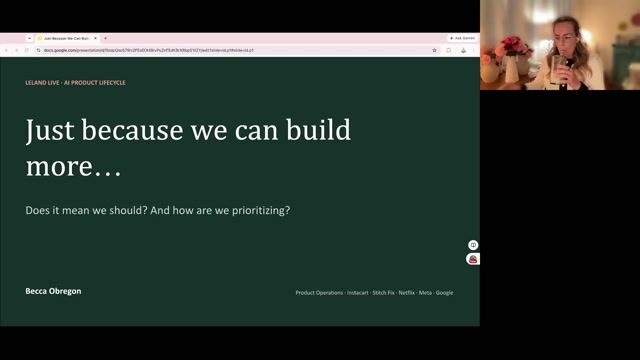
AI Product Lifecycle: Opportunities and Challenges [10/1/2026] (Recording)
In this free live session, we’ll explore why prioritization, customer discovery, product judgment, evaluation, and feedback loops become even more important as the cost of building decreases—and what that means for Product, Product Operations, and Program Management. We’ll discuss how AI is changing: * The traditional product development lifecycle * How teams decide what’s actually worth building * Prioritization when ideas can be tested and shipped much faster * The role of Product Ops in an AI-native organization * Evals, experimentation, and learning from production * Where new bottlenecks emerge as engineering velocity increases This will be an interactive conversation rather than a lecture. I’ll share frameworks and examples from my experience building and scaling Product Operations, and we’ll discuss how product organizations can move faster without simply building more. Great for: Product Managers, Product Ops leaders, Program Managers, operators, and anyone thinking about how AI will change the way modern product teams work. Free to attend. Bring your questions and your own experiences.


The International Applicant’s MBA Blueprint [7/21/2026] (Recording)
Applying to a U.S. MBA program as an international candidate presents both unique opportunities and unique challenges. While international applicants bring valuable global perspectives, cross-cultural experiences, and diverse professional backgrounds, they also face a highly competitive admissions environment and must effectively translate their experiences to a U.S.-based audience. The most successful international applicants do more than present impressive credentials. They demonstrate leadership, articulate a compelling career vision, and clearly communicate how their experiences, goals, and perspectives will contribute to the MBA community. This workshop explores how international candidates can navigate the admissions process strategically, build a compelling application narrative, and identify programs that align with their professional ambitions. By the end of this session, you will be able to: * Understand how U.S. MBA admissions committees evaluate international candidates. * Identify the key factors that distinguish successful international applicants. * Translate your professional accomplishments into language and examples that resonate with U.S. admissions readers. * Craft a career vision that connects your pre-MBA experience, MBA goals, and long-term aspirations. * Understand how academic performance, test scores, and professional experience are evaluated in an international context. * Avoid common mistakes international applicants make in essays, resumes, interviews, and recommendations. * Leave with a practical roadmap for strengthening your candidacy and maximizing your chances of admission.
Interviews: What to Expect & How to Prepare [10/16/2026] (Recording)
Part 6 of 6 — Build Your Best MBA Application: One Piece at a Time, a free series (5:00–5:45pm ET). Submit isn't the finish line — it's the start of interview prep. We'll map what each top program actually runs: GSB's blind interview (your interviewer hasn't read your file), HBS's by-invite conversation plus a 90-minute written reflection, Wharton's team-based discussion, Sloan's structured behavioral format, Kellogg's alumni conversations — and what interviewers are really scoring in each. Then, preparation that works: building 8–12 flexible stories that each answer multiple question types (instead of memorizing 30 single-use answers), working the four question buckets — setting the stage, negative-valence, positive-valence, and "Why X" — and sharpening your "Why MBA, why now" for the AI era. Practice out loud; reading answers in your head doesn't translate. Drawn from real questions in my recent client debriefs and hundreds of mock interviews. You'll leave with a prep plan you can run in the two weeks before any invite.


From the Experts: What Wins in M7 MBA Applications [7/15/2026] (Recording)
Applying to M7 MBA programs can feel overwhelming when you're trying to understand what separates admitted candidates from the many other highly qualified applicants in the pool. This session is designed for prospective MBA applicants who want a clearer understanding of what top programs value and how to position their candidacy effectively. You’ll learn how admissions committees evaluate applicants, the common traits that appear across successful applications, and how to strengthen your story across essays, recommendations, and interviews. Attending live gives you the opportunity to hear directly from experts who have spent years helping candidates navigate the MBA admissions process and ask questions about your own application strategy. The speakers will share the patterns they see across successful applicants, along with what they look for when evaluating overall candidacy and fit. If you want a better understanding of what wins in M7 MBA admissions, it’s worth joining live.


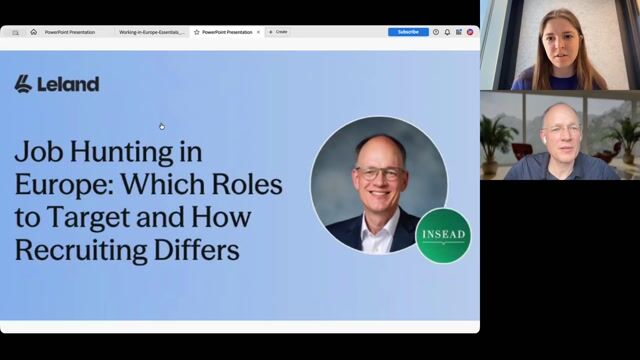
Job Hunting in Europe: Which Roles to Target and How Recruiting Differs [9/16/2026] (Recording)
Job hunting in Europe can look very different from recruiting in the U.S., from which roles are in demand to how applications, networking, and interviews typically work. This session is designed for professionals exploring opportunities in Europe who want a clearer strategy for targeting the right roles and navigating unfamiliar hiring processes. You’ll learn how to identify roles that align with your background, understand key differences in European recruiting, and adapt your application and networking approach accordingly. Attending live gives you the opportunity to ask questions about your target country, industry, or job search and get real-time guidance on the challenges you’re facing. The speaker will share practical insights on navigating European hiring processes and the patterns they see across successful international job searches. If you’re considering a move to Europe and want a more informed approach to your job search, it’s worth joining live.
Crush Your Med School Interview [8/25/2026] (Recording)
Your medical school interview is your opportunity to show admissions committees the person behind the application. The strongest candidates don't rely on rehearsed answers. They communicate with confidence, authenticity, and purpose. This session is for applicants who want to feel fully prepared for interview day and maximize their chances of earning an acceptance. You'll learn how to answer common interview questions, avoid the mistakes that hold applicants back, and present yourself in a way that leaves a lasting impression. Join live to hear from a medical school admissions expert whose students have earned more than 1,000 collective medical school acceptances. The speaker will share proven interview strategies, insights into what admissions committees are really evaluating, and practical techniques you can immediately apply to your own preparation. Expect actionable advice designed to help you interview with confidence and stand out.

Ace Investment Banking Interviews [7/16/2026] (Recording)
Investment Banking interviews start soon! Some candidates will be interviewing at the end of the summer or early fall. You have to be ready if you want to succeed. Competition is fierce, and expectations are high. Join me to understand how to Ace Investment Banking Interviews. Extensive Q&A opportunity.


Navigating Dual/Concurrent Degrees: MBA + Policy, Education, and STEM [6/11/2026] (Recording)
For some applicants, a traditional MBA is not the only path. Joint and concurrent degree programs can offer powerful ways to build interdisciplinary expertise, but they require careful strategic consideration. This session will explore when pairing an MBA with another graduate degree makes sense, how to evaluate program structures and tradeoffs, and how to determine whether a dual-degree path aligns with your long-term goals. Attendees will also learn how admissions committees assess dual-degree applicants and what makes for a compelling rationale.
Statement of Purpose Dos and Don'ts for STEM Masters & PhDs [8/6/2026] (Recording)
After this session, you will know how to position your research background and technical experience as a narrative rather than a list of credentials. We'll cover the structural mistakes that consistently weaken STEM statements of purpose, how to frame your "why this program" section with specificity that admissions committees actually respond to, and what distinguishes a compelling research fit statement from a generic one. Attending live means you can bring your specific situation, whether you're writing for a thesis-based PhD or a professional master's, and get a direct answer rather than general advice. This coach works with STEM applicants daily and will share the patterns that separate the statements that move applications forward from the ones that don't.
Free

Breaking LSAT November 170+, What High Scorers Do Differently [10/26/2026] (Recording)
Most LSAT prep means drilling more questions. The highest scorers do something different: they diagnose why they're actually missing points, then fix the reasoning gap instead of memorizing patterns. Zack breaks down what separates a 170+ score from a 160s plateau on the post-2024 LSAT, including where test-takers lose time in reading comprehension and how to spot trap answers in logical reasoning. Zack is an attorney and 99th-percentile scorer on the current LSAT who built his own RCS method (relevance, content, strength) after tutoring hundreds of students. His students average 15-20 point gains, with admits and scholarship offers at T14, T30, and T100 schools. Bring your toughest logical reasoning or reading comp questions; 45 minutes won't rebuild your prep plan, but it will sharpen how you approach the ones still tripping you up.

Decoding Tech Performance Reviews [8/27/2026] (Recording)
Performance reviews in tech can feel mysterious, especially when you work hard, deliver meaningful things, and still walk away unsure how your rating was decided. In this live session, I’ll break down what typically happens behind the scenes in performance reviews and calibration conversations. We’ll talk about what managers are actually looking for, why impact can be hard to communicate, and how to have better conversations with your manager before the next review cycle. You’ll leave with: - A clearer understanding of how reviews and calibration tend to work - The difference between activity, output, and impact - A better sense of what “performing at level” really means - Three practical questions to ask your manager - A framework for thinking about feedback, promotion, and your next move This is for software engineers and engineering managers who are preparing for a review, trying to make sense of a past review, or considering how to position themselves for more scope and growth. Bring your questions...I’ll leave time for live Q&A.

Mixtures and Weighted Averages with the Number Line Trick [8/6/2026] (Recording)
Come join this session to learn a very clearcut method for deciphering the most. complicated Mixture problems. I'll show you all the different variations of Mixture problems and how to tackle each type.


Starting Your GMAT Journey: An Introduction to the GMAT Focus Edition [6/30/2026] (Recording)
Starting GMAT prep can feel overwhelming when you’re not sure how the Focus Edition works or where to begin. This session is for anyone looking for a clear introduction to the GMAT and the strategies that lead to strong performance over time. You’ll learn how the exam is structured, what each section is designed to test, and how to build a study plan that sets you up for steady improvement. Join live to ask questions about your own starting point and get guidance from a GMAT expert with over 25,000 hours of tutoring experience. The speaker has worked with students across a wide range of score goals and will share the patterns they see across successful test takers and the foundational strategies that consistently make the biggest difference.
Consulting to MBA: What Actually Sets You Apart [9/22/2026] (Recording)
Consulting is one of the most common paths to an MBA, but coming from consulting doesn't automatically make your application stand out. The strongest candidates know how to translate their consulting experience into a compelling story about their leadership, goals, and reasons for pursuing an MBA. This session is for consultants considering business school who want to understand how to differentiate themselves in a competitive applicant pool. You'll learn how to position your consulting experience, approach the application process strategically, and avoid the common mistakes consulting applicants make. Join live for a panel of experts who have successfully made the transition from consulting to MBA programs. They'll answer the questions applicants most often have about the process and share firsthand insights on what they wish they had known before applying. Bring your questions and get practical advice for making your own transition to business school.

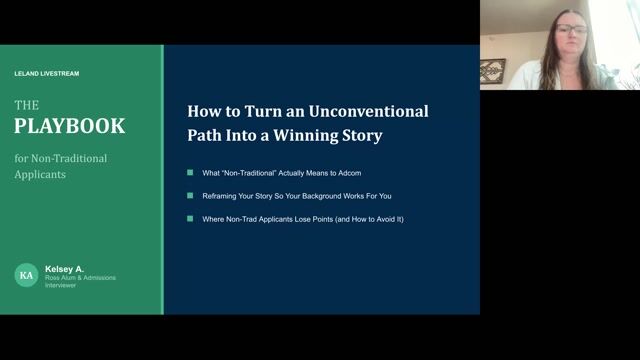
The Non-Traditional Applicant's Playbook: How to Turn an Unconventional Path Int [10/15/2026] (Recording)
Most MBA prep content assumes a standard path: two or three years at a bank or consulting firm, clean career progression, obvious "why MBA." If that's not you, most of the advice out there doesn't apply, and following it will make your application worse, not better. As a Ross admissions interviewer who has interviewed candidates with every kind of background, I know what separates the non-traditional applicants who get admitted from the ones who don't. This session is for anyone who's ever worried their resume won't make sense to adcom. What "Non-Traditional" Actually Means to Adcom: It doesn't mean what most applicants think — and the anxiety around it is usually misplaced. -How adcom actually defines non-traditional and what it signals to a reader -The difference between a non-traditional background that's an asset and one that raises real concerns -Why some of the most compelling applications come from candidates without the standard pedigree Reframing Your Story So Your Background Works For You: Trying to make an unconventional path sound traditional is the wrong move. -How to find the through-line in a career that doesn't look linear on paper -Why your differentiated experience is more valuable than you've been told -How to position yourself as a distinct perspective Where Non-Traditional Applicants Lose Points (And How to Avoid It): The mistakes that hurt non-traditional candidates are specific and largely avoidable. -The essay and resume mistakes that come up most often in non-traditional applications -How to handle "why now" and "why MBA" when your path doesn't have an obvious answer -What adcom is actually concerned about when they see an unconventional background — and how to address it directly -How to use your recommenders strategically when your background is atypical