Leland+ Content Library
Free
![How to Capitalize on a Coffee Chat [9/3/2026] (Recording)](https://customer-14xsjmjbqk93tdwp.cloudflarestream.com/546c0d76e7f891535b053dbceafc3c2e/thumbnails/thumbnail.jpg)
How to Capitalize on a Coffee Chat [9/3/2026] (Recording)
Most people send a thank you note and never speak to that person again. The note was never the point. First rounds go to candidates someone inside is pushing, and one conversation almost never does that on its own. Most of the people I know who ended up at JP Morgan ran more than twenty of these. So the work is in what happens after. Write down what stuck the moment you hang up, because it fades faster than you think and the thank you note needs one specific detail in it. Then the ask, which is the last two minutes of the call and the entire reason the next two chats exist. Then the check in, which most people skip, and which is why they are not on anyone's radar in January. The other thing you are collecting is your own answers. The line you use in a February interview is usually something a banker volunteered in September, and you only have it if you wrote it down. What we'll cover: - What to write down the moment the call ends, and why the note needs one specific detail - The thank you email inside twenty four hours, and what actually earns a reply - Ending on the ask, and how to get the introduction made over email instead of just a name - The referral email, and why it is the easiest one you will ever send - Checking in later with something worth sending, and how to still be on a radar in January - How many chats per firm is normal, and why boutiques are different Want to get more out of the chats you are already having? Book a free 15-minute intro and we will talk through your networking situation. Part 6 of Coffee Chat Ready, a six part run on Tuesdays and Thursdays. Each one stands alone, so jump in anywhere. I'm the founder of OFFERGOBLIN and ex-Centerview tech.
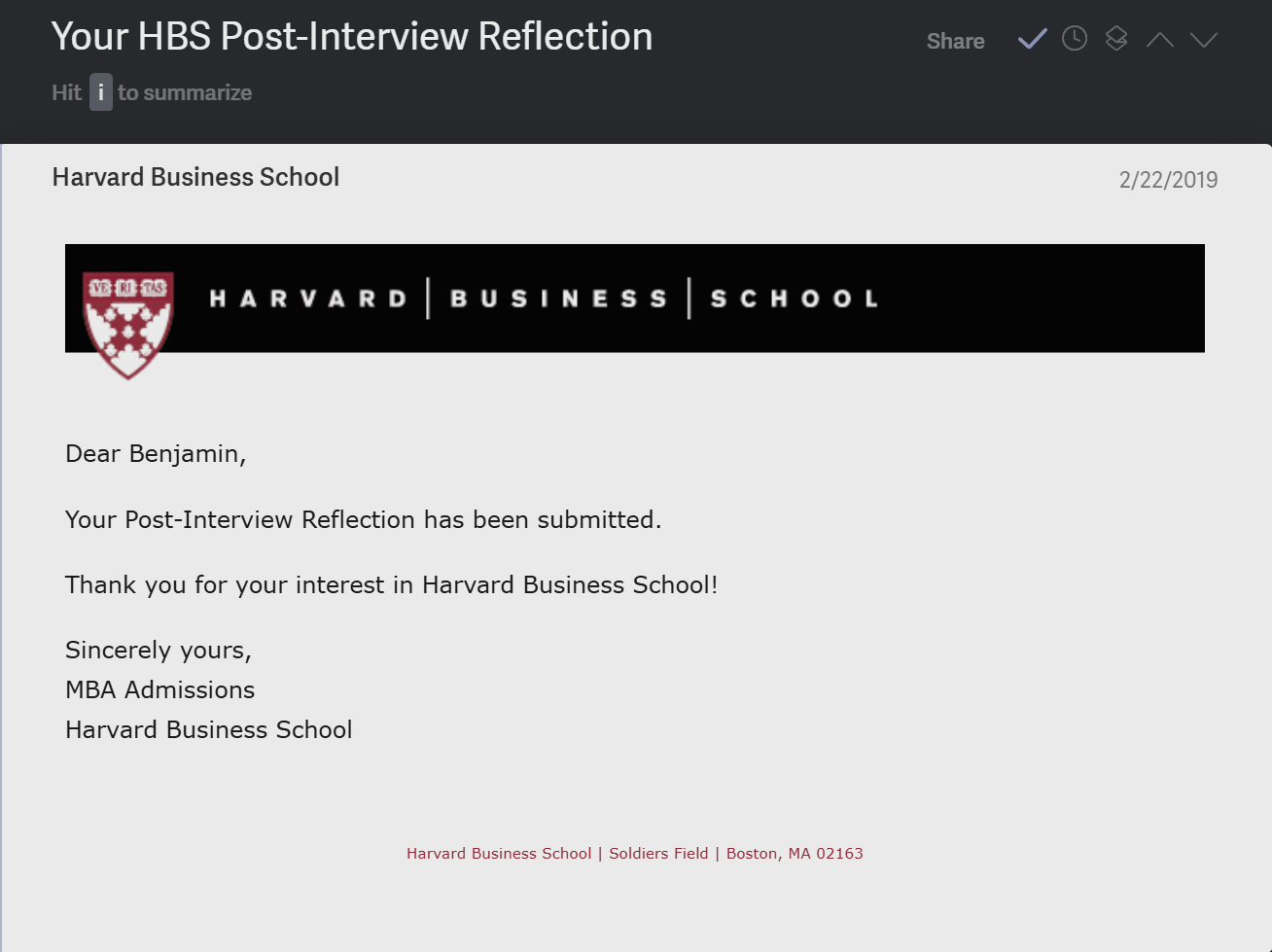
HBS Post-Interview Reflection Letter | 2027 Admit Example
Attached is an example of somebody I worked with who got in last cycle and I think did a great job with their HBS interview reflection letter. My core guidance: - Right after your interview, take a few minutes and write everything down. It's going to be helpful for later so that you don't have to rely exclusively on your memory. Then take an hour or two, decompress and get writing. - Short and sweet — grateful-professional is your tone - Directly reference your convo. Nothing generic whatsoever. If it sounds impersonal, delete it. - Don't brag or flex, but do mention a highlight/detail/nuance or two you would've gotten to with 5 more minutes of time. - About two-thirds of a page is right length-wise. - Make sure if they don't offer, that you get your interviewer's names anyway. That's important. They probably will but just in case. You'll feel silly writing a letter to someone whose name you don't know.

![Avoid Burnout During Recruiting Cycles [6/22/2026] (Recording)](https://customer-14xsjmjbqk93tdwp.cloudflarestream.com/adb0a5d409d2eaee05241866e89983fb/thumbnails/thumbnail.jpg)
Avoid Burnout During Recruiting Cycles [6/22/2026] (Recording)
Job searching while managing work, family responsibilities, financial pressure, or everyday life can quietly become overwhelming. Many people approach recruiting as an “always on” process — constantly applying, preparing, networking, and second-guessing decisions — until exhaustion starts affecting their focus, confidence, and well-being. In this practical and supportive session, former Amazon Recruiting Leader and Executive Coach Lisa Lawrence shares a structured approach to navigating recruiting cycles without burning out. Drawing from years of experience in hiring, coaching, and leadership, Lisa breaks down how to approach the process more intentionally — with better systems, clearer priorities, and healthier boundaries. You’ll learn how to manage the mental load of job searching alongside existing responsibilities, prepare effectively without falling into endless “grind mode,” communicate your experience with greater clarity, and make more grounded decisions throughout the process. The session also includes simple mindfulness and nervous system regulation practices designed to help you stay focused, resilient, and clear-headed during periods of uncertainty and transition. In this session, we’ll cover: • Why recruiting feels so mentally draining • How to structure your search more sustainably • Setting boundaries while balancing work and job hunting • Smarter approaches to interview preparation and networking • How to communicate your impact and experience clearly • Simple mindfulness tools to reduce overwhelm and improve clarity • Avoiding the “always applying” cycle that leads to burnout
![Summer Sprint: Jumpstart Your PE Recruiting Prep [6/11/2026] (Recording)](https://customer-14xsjmjbqk93tdwp.cloudflarestream.com/e5b4c78723dbb93a2f1e1f4fa8e42614/thumbnails/thumbnail.jpg)
Summer Sprint: Jumpstart Your PE Recruiting Prep [6/11/2026] (Recording)
In this session, you will leave knowing how to structure your PE recruiting timeline before fall cycles accelerate, what sourcing and deal experience interviewers actually weight when screening candidates, and how to position your background for firms at different stages and strategies. These are the patterns that consistently separate candidates who get to final rounds from those who stall early. Attending live means you can ask directly about your specific profile and hear how those details change the advice, context a recording cannot give you. The coach works with PE candidates daily and will share the same frameworks they use when evaluating where a candidate actually stands and what needs to move first.
![What PE Firms Actually Look For in Candidates [5/20/2026] (Recording)](https://customer-14xsjmjbqk93tdwp.cloudflarestream.com/e356aa32ffa9eb47786230cacfce6731/thumbnails/thumbnail.jpg)
What PE Firms Actually Look For in Candidates [5/20/2026] (Recording)
FREE COACHING SESSION GIVEAWAY FOR LIVE ATTENDEES. Private equity recruiting is extremely selective, and firms are looking for more than just strong technical skills or prestigious backgrounds. This session is for students and early-career professionals who want to understand what actually drives candidate selection at PE firms. You’ll learn how investment judgment, deal experience, and narrative fit factor into hiring decisions, and how top candidates position themselves across resume, networking, and interviews. Join live to hear perspectives from a panel of experienced PE coaches who have worked closely with successful candidates and understand what differentiates those who receive offers. The discussion will follow a curated set of high-impact questions, offering structured insights and real examples of how top candidates are evaluated.
![Banking to Buy-Side: IB & Venture Playbook [5/18/2026] (Recording)](https://customer-14xsjmjbqk93tdwp.cloudflarestream.com/ac6f9e553c96b1ea7b702fa9dec81c80/thumbnails/thumbnail.jpg)
Banking to Buy-Side: IB & Venture Playbook [5/18/2026] (Recording)
After this session, you'll understand how investment banking experience translates into a credible VC narrative and where most candidates lose the thread making that transition. We'll cover how to position deal experience for early-stage fund interviews, what VC firms actually look for in candidates coming from IB versus other paths, and how to think about sourcing as a differentiator when you have limited buy-side exposure. Attending live means you can bring your specific background and get a direct read on how it lands, which a recording cannot replicate. The coach works inside this industry and will share the patterns they see across candidates who successfully make this move, giving you a real look at how practitioners evaluate this transition.


![Turning a Non-Traditional Background Into a PE Offer: Retail Banking to PE [4/30/2026] (Recording)](https://customer-14xsjmjbqk93tdwp.cloudflarestream.com/97370860a074e2b184cd0f27cfcf02c1/thumbnails/thumbnail.jpg)
Turning a Non-Traditional Background Into a PE Offer: Retail Banking to PE [4/30/2026] (Recording)
If your background is non-traditional for PE, this session will show you exactly how to reframe that experience into a compelling PE narrative, how to identify the right funds to target given your profile, and how to position your deal exposure in a way that resonates with PE interviewers. Non-traditional candidates often lose ground in the screening phase, and this session addresses the specific signals that help you clear it. Attending live means you can ask how your particular background maps to this framework and hear a direct response, not a general one. The coach works with candidates navigating this exact transition regularly, and the patterns they share about what separates successful non-traditional hires are worth showing up to hear firsthand.

![How to Use AI to Break Into Investment Banking & Private Equity [5/21/2026] (Recording)](https://customer-14xsjmjbqk93tdwp.cloudflarestream.com/1562bed454b6e7d378cc7c0cdc5273f9/thumbnails/thumbnail.jpg)
How to Use AI to Break Into Investment Banking & Private Equity [5/21/2026] (Recording)
In this session, you will learn how to use AI tools to research firms, personalize cold outreach, and prep for technical interviews in investment banking and private equity recruiting. You will also walk away with a framework for identifying which parts of your application process AI can accelerate versus where it tends to create generic, forgettable work. Attending live means you can ask how these approaches apply to your specific background, whether that is a non-target school, a career pivot, or a gap in your deal experience, and hear the answer in real time rather than guessing from a recording. The coach works directly with candidates breaking into finance and will share the patterns that consistently separate the ones who get interviews from the ones who do not.
![GMAT Quant Isn't About Math: The 4 Skills That Decide Your Quant Score [6/16/2026] (Recording)](https://customer-14xsjmjbqk93tdwp.cloudflarestream.com/f04148d8eea1ada4a8de0447cfc23ba2/thumbnails/thumbnail.jpg)
GMAT Quant Isn't About Math: The 4 Skills That Decide Your Quant Score [6/16/2026] (Recording)
About this event You've done hundreds of problems. You know the formulas. Your score isn't moving. Here's why: the GMAT isn't actually testing your math. The math on Quant is high school level — it has to be, because there's no calculator. What separates a 600 from a 700+ isn't more content knowledge. It's the four test-taking skills that decide how every problem unfolds: how you choose your path, how you manage time, how you handle stress, and how you maintain focus across 45 minutes. In this 60-minute session, we'll deep-dive each of those four skills using the same framework I use with my 1:1 students on Leland. You'll see live problem walkthroughs showing the difference between a 4-minute "compute the obvious thing" path and a 20-second "make your life easy" path — and you'll learn the single mental move that makes the second one feel natural. By the end, you'll have a personalized diagnostic of your own weakest skill — and a concrete 4-week plan to actually move your score. --------------------------------------- What you'll learn Why "more practice" doesn't fix the plateau — and what does The 4 Test-Taking Abilities behind every top score (Strategy / Methodology, Time Management, Stress Management, Focus) and how each one maps onto specific in-the-moment moves The one mental question to ask before every Quant problem that re-routes you from the long path to the short one The skip decision framework — when to invest, when to bank time, and how to make the call at the 1-minute mark instead of the 2-minute mark An anti-paralysis protocol for the moment you go blank on test day Your personal TTA profile via 3 live polls — including a 4-question diagnostic that tells you exactly where your prep should focus next --------------------------------------- What you'll walk away with A clear picture of your weakest skill out of the four — and why it's almost certainly the lever that will move your score the most A calibrated 4-week prep plan A short list of pattern-recognition moves you can use on your very next practice session --------------------------------------- Who this event is for - Pre-test or mid-prep MBA applicants targeting 700+ - Students who have plateaued despite putting in significant prep hours - Anyone whose mock scores consistently trail their practice scores by 5+ points - Students who have done content review and want to know what to do next This is not a content-review session. We will not cover formulas, definitions, or "how to solve a quadratic." If you're at the foundational-content stage, this event will be most useful after you've done your first content pass. --------------------------------------- Format 60 minutes, live Fully worked problems demonstrating compute-first vs. think-first approaches Open Q&A at the end --------------------------------------- About the host Josh P. is a GMAT coach on Leland who works with students across all three sections — Quantitative Reasoning, Verbal Reasoning, and Data Insights. He has developed a structured methodology for diagnosing and addressing the test-taking skills that determine scores — refined across hundreds of 1:1 students over multiple years. The four-skill framework taught in this event applies across the whole test; tonight we focus it on Quant. His students span pre-MBA candidates targeting top-10 programs, professionals returning to the test after a long gap, and applicants who have hit a plateau and need a fresh diagnostic to break through. Book a free 1:1 intro on his Leland profile to discuss your own GMAT prep.

![AMA: Buying a Business as a Serial Acquirer [8/15/2026] (Recording)](https://customer-14xsjmjbqk93tdwp.cloudflarestream.com/c380521ee35f970a28bc4c54efd605b8/thumbnails/thumbnail.jpg)
AMA: Buying a Business as a Serial Acquirer [8/15/2026] (Recording)
Buying a business sounds simple: find a great company, make an offer, close the deal, and become an owner. The reality is much more complicated. Join Mark Fleming, CFA, FRM, for an open AMA on what it actually takes to buy, operate, and grow small businesses. Since acquiring his first company in 2017, Mark has partnered with operators to buy 20+ businesses across multiple industries, exited two, and advised buyers through more than 100 additional acquisition processes. Bring your questions about finding deals, evaluating opportunities, financing acquisitions, negotiating with sellers, structuring partnerships, navigating diligence, and avoiding expensive mistakes. Whether you're actively searching, preparing for your first acquisition, or thinking about building a portfolio of businesses, this is your chance to ask questions and hear lessons learned from hundreds of real deals (including the ones he walked away from).

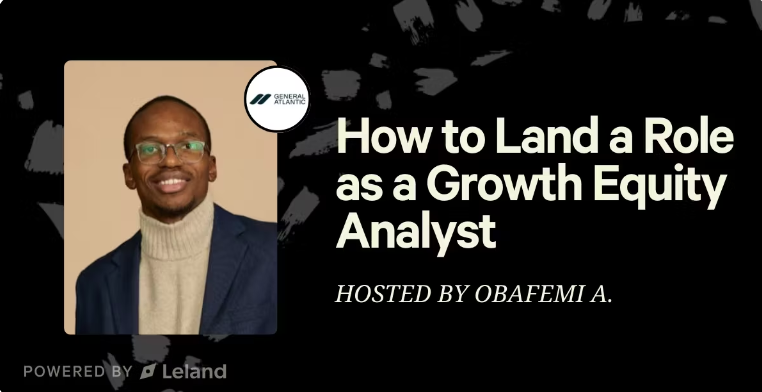
How to Land a Role as a Growth Equity Analyst
Breaking into growth equity is competitive, and most candidates struggle because they don't know how the role differs from traditional private equity or what firms are actually evaluating. This session is for undergraduates, MBA students, and early-career professionals who are actively recruiting for growth equity analyst positions. You'll leave with a clearer understanding of how to position your deal experience, what frameworks interviewers use to assess market sizing and company evaluation, and how to tailor your story for growth-stage investing roles specifically. Attending live gives you the chance to ask questions about your specific background and get real-time feedback that a recording simply can't offer. The insights shared here reflect the patterns seen across successful candidates, the kind of guidance that typically comes up in one-on-one coaching conversations. If you're actively recruiting or plan to start soon, this is worth your time.

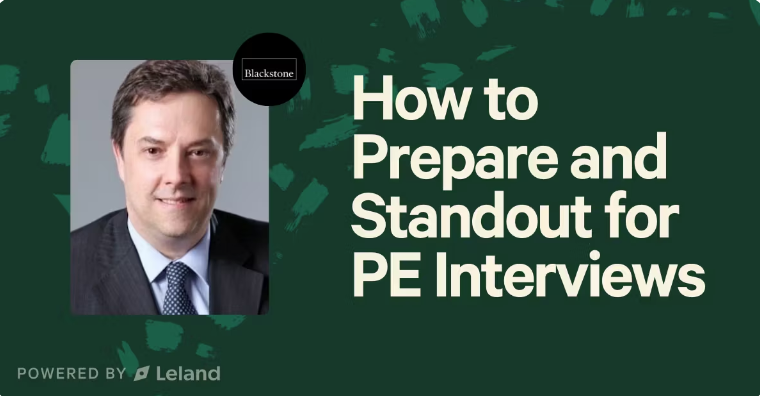
How to Prepare and Standout for PE Interviews
Breaking into private equity is competitive, and strong technical skills alone won’t separate you from the pack. This session is for candidates preparing for PE interviews who want to understand what actually stands out in the room—and the subtle mistakes that can quietly weaken your candidacy. You’ll learn how to position your deal experience with clarity, master the nuances of case studies and LBO discussions, and communicate investor judgment in a way that reflects how firms truly evaluate talent. Join live to ask your specific questions about headhunters, modeling tests, or navigating on-cycle and off-cycle processes, and get real-time feedback grounded in 20+ years as a principal and investor. The speaker works 1:1 with candidates and will share the patterns they see across successful applicants and what they personally look for when evaluating hires. If you’re serious about breaking into PE, this is a conversation worth being in live.
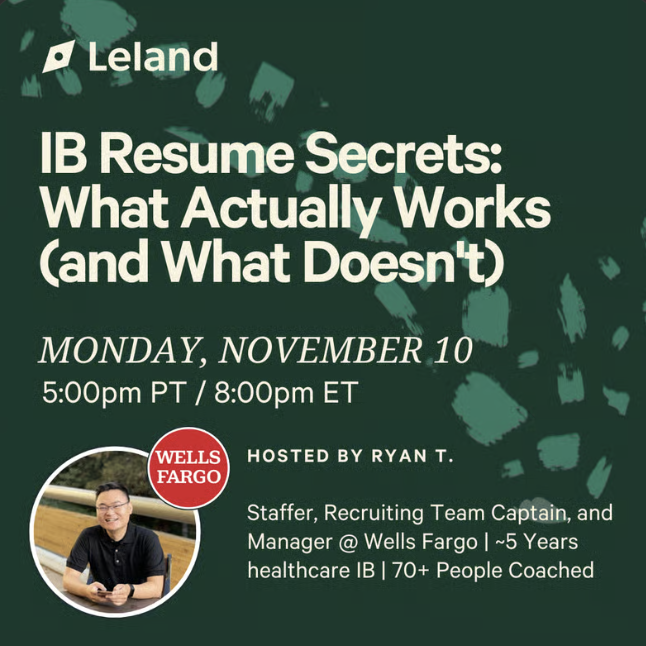
IB Resume Secrets: What Actually Works (and What Doesn't)
Breaking into investment banking starts with one thing: a resume that grabs attention. But with so many conflicting tips out there, it’s hard to know what really matters to recruiters and deal teams. In this session, Ryan T., a former Investment Banker at Wells Fargo Securities with nearly 5 years of experience in healthcare investment banking, will reveal what top firms actually look for in resumes. Ryan has served as Staffer, Recruiting Team Captain, and Manager - interviewing, hiring, and training multiple analyst classes while executing $10B+ in deals across 90+ transactions. He’s also coached 70+ candidates into roles at leading firms, so you won't want to miss his advice! You’ll learn how to structure your bullet points for maximum impact, highlight the experiences that truly matter, and avoid the common mistakes that hold applicants back. Whether you’re recruiting for summer analyst positions or full-time roles, this session will give you the insight and clarity to stand out in one of the most competitive fields in finance.

How to Run an Efficient Small Business Search
Buying a small business sounds simple until you actually start searching. Suddenly you are juggling deal flow, broker calls, industry research, financial review, diligence, and legal concepts. All while trying to keep your life and job moving. This session is for the person who is ramping into acquisition entrepreneurship and wants real guidance, not a generic accelerator curriculum and not “just ask ChatGPT.” If you are smart, motivated, and serious about buying a business but feel overwhelmed by the volume of decisions and the lack of a clear path, this will click. We will walk through what an efficient search actually looks like in the real world: the phases of search, where people waste time, what progress looks like, and what it realistically takes to get competent. Spoiler: 5 hours a week is usually not enough. Most people underestimate the reps required (think hundreds of hours, not a weekend), and the main goal is to compress the learning curve by focusing on the highest-leverage work. What you will leave with: - A clear picture of the search process end-to-end and what “good” looks like at each stage - The real time commitment and why most searches stall - Practical ways to run search faster and cleaner (systems, workflows, decision filters) - A map of the core skill areas you need to build: deal sourcing, industry analysis, financial fluency, diligence, and negotiation A simple decision framework for your next step: learn it, hire it out, or partner Who this is for: - You want to buy a small business, but you do not want to wander for 12 months figuring it out the hard way - You want more hands-on support than an accelerator, and more signal than generic online content - You are ready to put in the work, but you want a more efficient path and fewer dead ends We will also share a bit of our own search context - what we have tried, what has worked, what has not - and why we believe 1:1 support can meaningfully cut down ramp time when you apply it correctly. If you have been circling ETA and keep thinking “this is a lot,” you are not wrong. Come get a sharper path.

The Career Accelerator: A Playbook for Your Job Search
Differentiate your MBA Application: School Research & Networking Part 1 of 2
⚡School research and networking are the secret weapons that separate good MBA applicants from the ones admissions committees can’t forget. They shape every part of your application, from essays and interviews to your ability to turn a waitlist into an admit. Yet most applicants never learn how to do them at the level that truly changes the game. This is Part 1 of a two-part workshop series. In this session, you will learn the research and networking strategy and methods. You will then have two weeks to complete your own school research and networking as guided homework. In Part 2, I will demonstrate how to put this work into action through a live walkthrough, including discussion of participant progress and real questions that arise during the process. ⚠️Register for Part 2 in the event calendar on March 13th Part 1 has been my most popular event, run multiple times each year, and consistently rated by attendees as one of the most helpful and actionable MBA preparation sessions they’ve experienced. This is the first time I am introducing the Part 2 execution workshop. In this session, you’ll discover how to: 🔷 Conduct deep-dive school research that goes far beyond websites and brochures 🔷 Strategically network with the right people, turning what may be the greatest networking opportunity of your life into a clear advantage for admission and beyond 🔷 Create an MBA Journey document that becomes your central reference for aligning fit, goals, and contributions across the application 🔷 Integrate your findings seamlessly into essays, interviews, networking conversations, and campus interactions You’ll learn how to pinpoint the exact courses, professors, centers, career services, experiential programs, internships, clubs, culture elements, current students, and alumni connections that will help you achieve your goals, and how to clearly show the value you will bring in return. By the end of this session, you will know how to demonstrate, with clarity and credibility, that you and your target MBA program are the right fit for each other. Bonus Offer ✅1 attendee will receive a free 1-hour coaching session. ✅All attendees may request a free copy of the MBA Research & Networking Template. ⚡Spots are limited. Register now to gain the advantage that can set your MBA application apart.
Free
![Why Banking, Why This Firm, Why This Group [9/1/2026] (Recording)](https://customer-14xsjmjbqk93tdwp.cloudflarestream.com/e9f03a827ecb4c6d7235bd42c92b68f2/thumbnails/thumbnail.jpg)
Why Banking, Why This Firm, Why This Group [9/1/2026] (Recording)
Swap the word banking for consulting. If your answer still holds, you have not answered the question. That is the test, and most answers fail it. Fast paced, smart people, steep learning curve. All true, all interchangeable, all heard forty times this month by the person across the table. Three questions, scored separately, proved three different ways. Why banking is proved by your past. Why this firm is proved by your conversations. Why this group is proved at desk level, by someone who actually sits on it. One structure underneath all three. Claim, reason, evidence, impact. Sixty seconds. The evidence slot is the one that decides the answer, and it is the only slot you cannot write at your desk. That is why this session sits here in the run and not at the start. You do not walk into the chats with these answers. You walk out with them. What we'll cover: - The swap test and the name swap test, and how to run both on the answer you already have - Claim, reason, evidence, impact, and why evidence is the only slot with lead time - Where firm evidence comes from: named conversations, one deal known properly, platform, direct experience - Coverage versus product, and why a group answer that never names an industry is not an answer - How the bar moves at a bulge bracket versus an elite boutique versus a regional office - The failure that costs the most, which is being specific enough to be interesting and thin enough to collapse on the follow up Want to solidify your whys and be done with them? I run a popular 90-minute session where we go deep and construct a strong, personal story. Book a free 15-minute intro to learn more. Part 5 of Coffee Chat Ready, a six part run on Tuesdays and Thursdays. Each one stands alone, so jump in anywhere. I'm the founder of OFFERGOBLIN and ex-Centerview tech.