Leland+ Content Library

Cybersecurity Governance for IT Leaders Executive Framework
Cybersecurity Governance for IT Leaders: A Practical Executive Framework Effective cybersecurity governance requires more than sophisticated security technologies. Organizations can invest millions of dollars in advanced cybersecurity solutions, but those investments can be undermined if employees lack the awareness and training to recognize threats and respond appropriately. Developed by a CISSP-certified technology executive, former Citi global technology leader, and university professor with more than 20 years of enterprise technology leadership experience, this practical workbook approaches cybersecurity from a business, governance, risk management, and organizational leadership perspective. The framework incorporates four principles that have shaped my management philosophy: Discipline: Establish consistent cybersecurity governance practices, clear accountability, and effective monitoring and reporting routines. Anticipation: Identify emerging threats, vulnerabilities, and organizational weaknesses before they develop into serious security incidents. Address risks proactively rather than waiting for problems to escalate. Communication: Translate technical cybersecurity concerns into understandable business risks. Know your message, understand your audience, and ensure that employees, managers, and executives receive relevant, actionable information. Credibility: Make realistic security commitments and deliver on them. Consistent execution builds trust among business leaders, regulators, customers, and employees. Once credibility is lost, rebuilding it can be extremely difficult. A central theme of this workbook is the importance of cybersecurity education and employee awareness. Technology alone cannot protect an organization. Employees must understand the risks associated with phishing, social engineering, credential compromise, and other common threats. Cybersecurity education should be continuous, practical, and appropriate to employees' responsibilities. Leaders must also evaluate whether training is changing behavior, not simply whether employees completed a course. What You'll Learn and Practice This workbook includes practical frameworks, exercises, and worksheets covering: - Cybersecurity governance responsibilities and accountability. - Translating technical vulnerabilities into business risks. - Proactive risk identification and escalation. - Executive cybersecurity reporting and communication. - Cybersecurity awareness, employee education, and human-risk management. - Security governance decision-making scenarios. - A human-risk governance assessment worksheet. - A structured 30/60/90-day cybersecurity governance improvement plan. - An executive governance readiness checklist. Who Should Use This Resource? IT directors, CIOs, CTOs, cybersecurity managers, technology risk professionals, project and program leaders, and executives responsible for technology oversight and organizational resilience. The objective: Help technology leaders strengthen cybersecurity governance, anticipate risks, develop security-aware employees, establish accountability, and make informed decisions that protect their organizations. This is not a technical cybersecurity configuration manual. It is a practical, experience-based leadership framework designed to connect cybersecurity investments, employee behavior, business risk, and executive accountability.

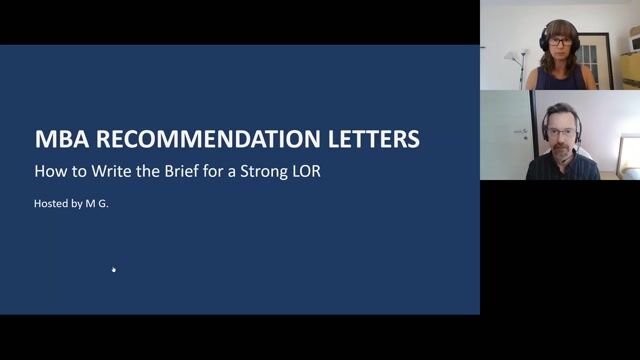
MBA Recommendation Letters: How to Write the Brief for a Strong LOR [10/15/2026] (Recording)
Leave this session with a clear plan for your recommenders and a ready-to-use brief template you can send them this week. Your recommendation letters are the one part of your application written by someone else, and they carry real weight with admissions committees. Most recommenders want to help but do not know what schools are looking for, which examples to use, or how their letter fits with the rest of your application. A strong brief, sometimes called a recommender packet, gives them exactly that. For Round 2, now is the time to prepare it, while your recommenders still have weeks rather than days. In this session, you will: • Learn how to choose between a senior title and someone who truly knows your work, and what to do if your manager cannot know you are applying • See what schools actually ask recommenders, including leadership competency grids and school-specific questions • Learn how to make the ask clearly and lock in a completion date • Compare weak and strong briefs side by side, and see what to include so your recommenders can write with specific examples • Prepare your recommenders for the constructive feedback question, where many otherwise strong letters fall short • Understand how to handle recommenders who ask you to write the letter yourself, and what international applicants should consider when a recommender writes in a second language Most applicants send their recommenders a resume and hope for the best. The result is often two letters that repeat the same achievements in general terms. A strong brief assigns each recommender different examples based on what they personally saw you do, so each letter adds something new to your application instead of repeating the other. I have guided 100+ applicants into every M7, across the top 20 in the U.S., and leading international programs (INSEAD, LBS, IESE, Esade, Oxford, Cambridge, NUS, and more). Give your recommenders everything they need to write specific, credible letters. Register now to claim your spot.

Summer Leadership Series: Clarity For Your Next Chapter [7/22/2026] (Recording)
How Great Leaders Make Decisions Without Perfect Information Have you ever felt stuck between multiple good options? Whether you're considering a promotion, changing careers, transitioning from the military, starting a business, or simply trying to figure out what's next, uncertainty can make even capable leaders feel overwhelmed. The challenge usually isn't a lack of information—it's the pressure to make the "right" decision. In this interactive 45-minute workshop, we'll explore why high performers often struggle with major life and career decisions and introduce practical tools to help you move forward with greater clarity and confidence. This isn't a presentation about finding the perfect answer. It's a conversation about learning to trust yourself, align your decisions with your values, and take the next step with intention. What You'll Learn During this session, you'll: • Understand why capable leaders often feel stuck during periods of transition. • Learn a simple framework for making decisions when certainty isn't possible. • Explore the role values, identity, and energy play in creating clarity. • Work through a guided reflection exercise to identify your own "next waypoint." • Leave with practical questions and tools you can immediately apply to your career and life. Who Should Attend? This session is designed for: Mid-career and senior professionals. Anyone navigating transition. Executives and emerging leaders. Entrepreneurs and business owners. Anyone facing an important decision or a new chapter in life. No matter where you are in your journey, you'll leave with a greater perspective and a practical framework for navigating uncertainty with confidence. What You'll Walk Away With By the end of our time together, you'll have: ✅ A clearer understanding of what's driving your current decisions. ✅ A framework for moving from uncertainty to intentional action. ✅ Reflection tools you can continue using long after the session. ✅ Greater confidence in identifying and taking your next step. My hope isn't that you leave with your next ten years figured out. My hope is that you leave knowing your next waypoint. Because you don't have to see the entire horizon. You only have to trust yourself enough to steer toward the next waypoint.

How to Run an Efficient Small Business Search
Buying a small business sounds simple until you actually start searching. Suddenly you are juggling deal flow, broker calls, industry research, financial review, diligence, and legal concepts. All while trying to keep your life and job moving. This session is for the person who is ramping into acquisition entrepreneurship and wants real guidance, not a generic accelerator curriculum and not “just ask ChatGPT.” If you are smart, motivated, and serious about buying a business but feel overwhelmed by the volume of decisions and the lack of a clear path, this will click. We will walk through what an efficient search actually looks like in the real world: the phases of search, where people waste time, what progress looks like, and what it realistically takes to get competent. Spoiler: 5 hours a week is usually not enough. Most people underestimate the reps required (think hundreds of hours, not a weekend), and the main goal is to compress the learning curve by focusing on the highest-leverage work. What you will leave with: - A clear picture of the search process end-to-end and what “good” looks like at each stage - The real time commitment and why most searches stall - Practical ways to run search faster and cleaner (systems, workflows, decision filters) - A map of the core skill areas you need to build: deal sourcing, industry analysis, financial fluency, diligence, and negotiation A simple decision framework for your next step: learn it, hire it out, or partner Who this is for: - You want to buy a small business, but you do not want to wander for 12 months figuring it out the hard way - You want more hands-on support than an accelerator, and more signal than generic online content - You are ready to put in the work, but you want a more efficient path and fewer dead ends We will also share a bit of our own search context - what we have tried, what has worked, what has not - and why we believe 1:1 support can meaningfully cut down ramp time when you apply it correctly. If you have been circling ETA and keep thinking “this is a lot,” you are not wrong. Come get a sharper path.

Summer Leadership Series: Clarity For Your Next Chapter [7/16/2026] (Recording)
How Great Leaders Make Decisions Without Perfect Information Have you ever felt stuck between multiple good options? Whether you're considering a promotion, changing careers, transitioning from the military, starting a business, or simply trying to figure out what's next, uncertainty can make even capable leaders feel overwhelmed. The challenge usually isn't a lack of information—it's the pressure to make the "right" decision. In this interactive 45-minute workshop, we'll explore why high performers often struggle with major life and career decisions and introduce practical tools to help you move forward with greater clarity and confidence. This isn't a presentation about finding the perfect answer. It's a conversation about learning to trust yourself, align your decisions with your values, and take the next step with intention. What You'll Learn During this session, you'll: • Understand why capable leaders often feel stuck during periods of transition. • Learn a simple framework for making decisions when certainty isn't possible. • Explore the role values, identity, and energy play in creating clarity. • Work through a guided reflection exercise to identify your own "next waypoint." • Leave with practical questions and tools you can immediately apply to your career and life. Who Should Attend? This session is designed for: Mid-career and senior professionals. Anyone navigating transition. Executives and emerging leaders. Entrepreneurs and business owners. Anyone facing an important decision or a new chapter in life. No matter where you are in your journey, you'll leave with a greater perspective and a practical framework for navigating uncertainty with confidence. What You'll Walk Away With By the end of our time together, you'll have: ✅ A clearer understanding of what's driving your current decisions. ✅ A framework for moving from uncertainty to intentional action. ✅ Reflection tools you can continue using long after the session. ✅ Greater confidence in identifying and taking your next step. My hope isn't that you leave with your next ten years figured out. My hope is that you leave knowing your next waypoint. Because you don't have to see the entire horizon. You only have to trust yourself enough to steer toward the next waypoint.

You vs. You | How to Stop Self Sabotaging
You're not lazy. You're not unmotivated. You're not broken. You're just stuck. And there's a reason for that. You vs. You is for the person who has every reason to be moving forward, but somehow keeps getting in their own way. The one who procrastinates on the very things they care about most. Who burns out chasing goals that never seem to fill the gap. Who knows what they want, but can't figure out why they can't make it happen. That feeling isn't a character flaw. It's self sabotage — and it's running quietly in the background of almost everything you do. In this ebook, you'll finally understand why. You'll learn how 95% of your daily decisions are being made for you by a subconscious that was programmed long before you had any say in it. You'll see exactly how your values, your beliefs, and your deepest fears are shaping your choices and keeping you stuck. And most importantly, you'll walk away with real, practical tools to start changing it. Inside, you'll discover: • Why self sabotage has nothing to do with willpower, and everything to do with your subconscious programming. • The hidden values and faulty beliefs driving your burnout, your procrastination, and your patterns in relationships. • A step-by-step process to identify your self sabotaging behaviors and trace them back to their root cause. • Exercises to reprogram your belief system and finally start making decisions that align with who you actually want to be. This isn't another generic self help book about thinking positive. It's an honest, grounded guide to understanding yourself at a level most people never reach, and using that understanding to start building a life you don't need to escape from. At the end of this book, you'll gain a level of self-awareness that most people spend years in therapy trying to find. Ready to go deeper? Every purchase includes access to a special one-time offer of 50% off your first life coaching session — because reading it is just the beginning. Message me directly on Leland to claim.

GMAT Quant Isn't About Math: The 4 Skills That Decide Your Quant Score [6/16/2026] (Recording)
About this event You've done hundreds of problems. You know the formulas. Your score isn't moving. Here's why: the GMAT isn't actually testing your math. The math on Quant is high school level — it has to be, because there's no calculator. What separates a 600 from a 700+ isn't more content knowledge. It's the four test-taking skills that decide how every problem unfolds: how you choose your path, how you manage time, how you handle stress, and how you maintain focus across 45 minutes. In this 60-minute session, we'll deep-dive each of those four skills using the same framework I use with my 1:1 students on Leland. You'll see live problem walkthroughs showing the difference between a 4-minute "compute the obvious thing" path and a 20-second "make your life easy" path — and you'll learn the single mental move that makes the second one feel natural. By the end, you'll have a personalized diagnostic of your own weakest skill — and a concrete 4-week plan to actually move your score. --------------------------------------- What you'll learn Why "more practice" doesn't fix the plateau — and what does The 4 Test-Taking Abilities behind every top score (Strategy / Methodology, Time Management, Stress Management, Focus) and how each one maps onto specific in-the-moment moves The one mental question to ask before every Quant problem that re-routes you from the long path to the short one The skip decision framework — when to invest, when to bank time, and how to make the call at the 1-minute mark instead of the 2-minute mark An anti-paralysis protocol for the moment you go blank on test day Your personal TTA profile via 3 live polls — including a 4-question diagnostic that tells you exactly where your prep should focus next --------------------------------------- What you'll walk away with A clear picture of your weakest skill out of the four — and why it's almost certainly the lever that will move your score the most A calibrated 4-week prep plan A short list of pattern-recognition moves you can use on your very next practice session --------------------------------------- Who this event is for - Pre-test or mid-prep MBA applicants targeting 700+ - Students who have plateaued despite putting in significant prep hours - Anyone whose mock scores consistently trail their practice scores by 5+ points - Students who have done content review and want to know what to do next This is not a content-review session. We will not cover formulas, definitions, or "how to solve a quadratic." If you're at the foundational-content stage, this event will be most useful after you've done your first content pass. --------------------------------------- Format 60 minutes, live Fully worked problems demonstrating compute-first vs. think-first approaches Open Q&A at the end --------------------------------------- About the host Josh P. is a GMAT coach on Leland who works with students across all three sections — Quantitative Reasoning, Verbal Reasoning, and Data Insights. He has developed a structured methodology for diagnosing and addressing the test-taking skills that determine scores — refined across hundreds of 1:1 students over multiple years. The four-skill framework taught in this event applies across the whole test; tonight we focus it on Quant. His students span pre-MBA candidates targeting top-10 programs, professionals returning to the test after a long gap, and applicants who have hit a plateau and need a fresh diagnostic to break through. Book a free 1:1 intro on his Leland profile to discuss your own GMAT prep.