Leland+ Content Library
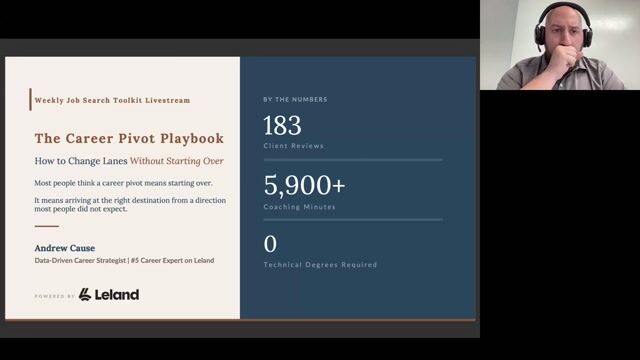
The Career Pivot Playbook: How to Change Lanes Without Starting Over [9/8/2026] (Recording)
Most people think a career pivot means starting over. It doesn't. It means arriving at the right destination from a direction most people didn't expect. I made the move from full-cycle recruiter and sourcer at JPMorganChase, EY, and Fisher Investments to People Analytics Developer at JPMorganChase. No CS degree, no data science bootcamp. Just a clear why, a transferable story, and a strategy for making the move without walking away from everything I had built. This session is that exact playbook. The data backs it up: 80% of career changers report greater happiness after making the move. 77% earn the same or more within two years. The risk is real but it's smaller than the fear makes it feel. The timing also matters: 53% of employers have dropped degree requirements in favor of demonstrated skills. The credential gap that used to stop most pivoters is closing. The playbook has changed. This session is built around that reality. Here's what we'll cover: The Decision: How to tell the difference between a real signal and a bad week, and the excuses that keep people stuck. The Internal Pivot Advantage: The most underrated career move available. Why pivoting before you have to, inside your current company, can change everything. Your WHY as the Thread: Most people answer the pivot question defensively. We build the narrative that makes your non-linear path look intentional, not accidental. The Transferable Asset Audit: You are not starting from zero. We map what already transfers, and identify the one gap actually worth closing. Overcoming It in Interviews: The three pivot traps that trip up career changers, and how to handle each one without apologizing for your path. Live Q&A closes the session.


AMA: Insider Tips from 20+ yrs of MBA Admissions & Coaching
Unlock the secrets of MBA admissions with Christine, a seasoned one-of-a-kind expert with 20+ years of admissions experience across three elite MBA programs. This "Ask Me Anything" session is your chance to gain invaluable insights into the application process. Christine's impressive background includes admissions roles at Chicago Booth, London Business School, and Yale School of Management, where she has helped craft MBA classes and understands the nuances of what makes a successful applicant. With a track record of over 400 M7 admits and more than $5 million in scholarship awards secured for her clients, Christine is a one-of-a-kind consultant equipped to guide you through every step of your MBA journey. Join us to explore application strategies, discuss how to make a stand out MBA resume, learn what makes a candidate stand out, and gain insight into how applications are reviewed and admissions decisions are made. Christine's no-nonsense, tell-it-like-it-is approach will help you craft an authentic story that highlights your unique strengths and differences. Whether you're just starting your MBA application journey or you're already on your way, join me and leave equipped with insights into the M7 (and beyond) application process.

Is Your MBA Application Actually Ready for Round 1? [8/27/2026] (Recording)
Round 1 deadlines for top MBA programs land are fast approaching . If you're applying this cycle, you're weeks away from submitting, and it's easy to lose perspective on whether your application is actually strong or just feels done because you're tired of looking at it. I'm a former McKinsey consultant and HBS MBA. In this session, I'll walk through what actually separates a strong Round 1 application from one that gets rejected, focusing on the parts most applicants underestimate: story, positioning, and how your essays hold together as a coherent narrative, not just a collection of good individual answers. This isn't a test prep session. It's for people who've done the work and want a clear-eyed check before they hit submit, or who are close to done and want to know what's still missing. What we'll cover: - The difference between an application that's "finished" and one that's actually ready - How to spot a weak or disjointed narrative in your own essays - Common positioning mistakes that even strong candidates make - What admissions readers are actually looking for beyond the resume line items Come with questions. If you have a draft essay or two, even better, we'll use real examples where we can.

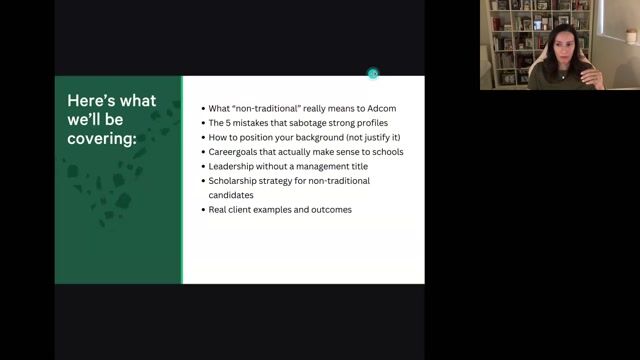
Non-Traditional Background? How to Turn Your Background into an MBA Advantage [8/23/2026] (Recording)
If you’re applying to an MBA without a classic finance or consulting background, this session is for you. As a former Director of MBA Admissions, I’ve reviewed thousands of applications from artists, engineers, entrepreneurs, nonprofit leaders, healthcare professionals, teachers, athletes, and career-switchers — and I know exactly how unconventional profiles can rise to the top of the pile. In “Non-Traditional Background? Here’s How to Make the MBA Adcom Say Yes”, I’ll break down how admissions committees actually evaluate candidates with unique paths, what they value most, and how you can present your story in a way that feels authentic, powerful, and strategically aligned with what top programs are seeking. We’ll cover: What “non-traditional” really means in MBA admissions The strengths and blind spots most unconventional applicants have How to highlight your transferable skills (leadership, analytical ability, impact) How to position pivots, gaps, or non-linear paths The elements of a compelling narrative that stands out Real examples of successful non-traditional admits A live Q&A to answer your specific questions Whether you come from the arts, education, government, startups, healthcare, hospitality, science, military, or any unexpected field, you’ll walk away with clarity and a concrete strategy for making the adcom say yes.

From IT Manager to IT Director Leadership Workbook
Advance your technology leadership career with a practical development framework based on more than 20 years of global IT management and executive leadership experience. Created by a former Citi global technology executive, university dean, and professor, this workbook is designed for IT professionals, team leaders, and managers preparing to transition into director-level and senior technology leadership roles. At the center of the guide are four leadership principles that have shaped my management philosophy: Discipline: Establish priorities, execute consistently, and follow through on responsibilities. Anticipation: Identify emerging challenges, avoid procrastination, and address difficult problems before they escalate. Effective leaders don't simply react to problems; they anticipate what comes next. Communication: Know your message, understand your audience, and invest the time necessary to communicate effectively. Credibility: Always do what you say you will do. Consistently honoring commitments builds trust and professional reputation. Once credibility is lost, rebuilding it can be extremely difficult. What You'll Learn and Practice This workbook includes a leadership self-assessment, practical IT management scenarios, a risk anticipation exercise, a stakeholder communication worksheet, a commitment audit, and a structured 30/60/90-day leadership development plan. Rather than presenting generic leadership theories, the guide encourages you to evaluate your own management behaviors, apply practical executive leadership principles, and develop measurable actions for professional growth. Who Should Use This Resource? IT managers, technical team leaders, aspiring IT directors, project and program managers, and technology professionals seeking greater leadership responsibilities. The objective: Help you move beyond managing daily technology operations toward becoming a proactive, credible, and strategically effective technology leader.


Why Strong People Start Looking Weak in New Rooms — And How to Fix It [7/22/2026] (Recording)
It is a painful irony: you are technically excellent, you have a proven track record, and you’ve earned your seat, but the moment you enter an unfamiliar professional culture or a more senior global room, you start sounding less clear than you actually are. This is the phenomenon of being "Badly Translated." When high-performers move into global teams (like my clients at Netflix APAC) or competitive international interviews, they often default to tactical, deferential, or over-explanatory habits that make them appear more junior than they are. This livestream is about reclaiming your signal. We will break down why your experience isn't landing and how to shift from sharing information to demonstrating judgment. By the end of this livestream, you will be able to: 1. Spot the Deferential Trap: Identify the specific linguistic and behavioral habits that make you sound like an executor rather than a peer in senior meetings. 2. Master Recommendation Language: Move beyond just asking questions or providing updates to using the phrasing that senior leaders use to direct attention. 3. Shift from Biography to Positioning: Reframe your self-introduction so that it highlights your judgment and impact rather than just a list of tasks you’ve performed. 4. Audit Your Visibility: Understand the Invisible High-Performer pattern and how to enter a conversation early enough to help define the question, not just answer it. Outcomes 1. The Senior Signal Toolkit: A set of 5 specific entry-lines and phrases you can use in your next global meeting to sound more strategic. 2. Interview Re-Framing: A new way to answer "Tell me about yourself" that stops being a history lesson and starts being a value proposition. 3. Confidence Audit: A personal diagnostic to see where your meeting confidence is dropping and whether the gap is lack of knowledge or a habit of seeking permission.

How to get a Search Fund internship with no PE background
Most candidates aiming for a search fund internship are not underqualified. They’re mis-targeted. They chase prestige instead of fit, spend weeks reaching out to the wrong searchers, and then wonder why nothing moves. I’m Reuben, founder of Parceros Capital. I’ve raised money, built operating plans, and run internship cohorts where I review work, coach output, and decide who’s ready to be trusted with real responsibility. I’ve also helped people land internships at other search funds when it was clear the fit was better elsewhere. That’s part of how I think about this ecosystem: reputation matters, and you never know where one strong reference can take you. This webinar is for undergrads and MBAs who want a real shot or professionals desiring a career switch without a private equity background. I’ll walk you through how search fund internship hiring actually works, what “fit” really means (stage, thesis, geography, working style), and how to position yourself as valuable on day one. The mindset shift is simple: stop leading with what you want to get out of it and start leading with what you can contribute. We’ll also get clear on what interns should do that doesn’t replace paid contractors. Contractors handle specialized execution. Interns create leverage and trust. If you understand that difference, your outreach lands differently. I’ll share a Fit Scorecard you can use to build a smarter target list, plus a practical outreach structure that earns replies. I’ll also do a quick teardown of a common outreach message and show you what I’d change to make it credible. At the end, I’ll share an optional next step for anyone who wants hands-on help: a short 1:1 sprint where we build your best-fit target list, tighten your narrative, and leave you with outreach copy and a proof-of-work plan you can run immediately. If you want to move fast, RSVP and come ready to work.
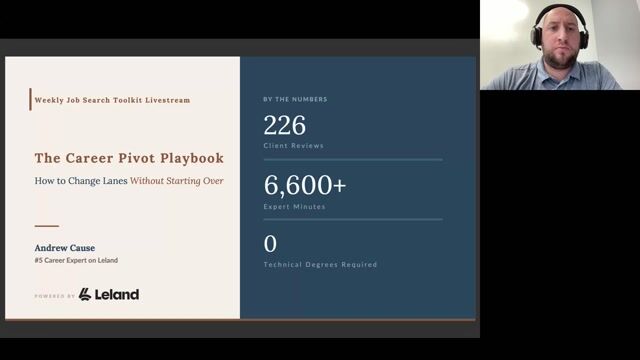
The Career Pivot Playbook: How to Change Lanes Without Starting Over [10/6/2026] (Recording)
Most people think a career pivot means starting over. It doesn't. It means arriving at the right destination from a direction most people didn't expect. I made the move from Full-Cycle Recruiter and Sourcer at JPMorganChase, EY, and Fisher Investments to People Analytics Analyst at JPMorganChase. No CS degree, no bootcamp. Just a clear why, a transferable story, and a strategy for making the move without walking away from everything I had built. The data backs it up: 80% of career changers report greater happiness after making the move. 77% earn the same or more within two years. The risk is real but it's smaller than the fear makes it feel. The timing also matters: 53% of employers have dropped degree requirements in favor of demonstrated skills. The credential gap that used to stop most pivoters is closing. The playbook has changed. This session is built around that reality. Here's what we'll cover: The Decision: How to tell the difference between a real signal and a bad week, and the excuses that keep people stuck. The Internal Pivot Advantage: The most underrated career move available. Why pivoting before you have to, inside your current company, can change everything. Your WHY as the Thread: Most people answer the pivot question defensively. We build the narrative that makes your non-linear path look intentional, not accidental. The Transferable Asset Audit: You are not starting from zero. We map what already transfers, and identify the one gap actually worth closing. Overcoming It in Interviews: The three pivot traps that trip up career changers, and how to handle each one without apologizing for your path. Live Q&A closes the session. Bring your current role, your target direction, and your biggest blocker. Attending live means you can bring your specific situation and hear how the framework applies to your actual pivot, context a recording can't replicate.

AMA with a Former BCG Partner & Interviewer [6/22/2026] (Recording)
Interested in consulting? Curious about how top firms actually evaluate candidates? Join this interactive AMA with a former BCG Partner who progressed from Associate to Partner and spent years interviewing 100+ candidates, leading experienced-hire recruiting, and helping shape hiring decisions. This is not a presentation. There are no slides and no scripted agenda. Instead, you'll have the opportunity to ask candid questions and get direct, insider perspectives on the topics that matter most to you. The conversation will be driven entirely by your questions, allowing us to focus on the areas where you need the most guidance. Topics may include: * Building an effective application strategy * CV positioning and standing out from the crowd * Referrals and networking that actually make a difference * Choosing the right office * Avoiding the mistakes that derail otherwise strong candidates * Case interview preparation * Behavioral and fit interviews * What interviewers are really looking for * How to maximize your chances of receiving an offer Having served as an anchor interviewer and led recruiting efforts, I have a unique perspective on what separates successful candidates from those who fall short—and what it takes not only to break into consulting, but to thrive once you're there. Whether you're applying this cycle, preparing for interviews, or simply exploring consulting as a career path, this is an opportunity to get honest answers and practical advice from someone who has been on the decision-making side of the table. Please RSVP to secure your spot.
Free

3 AI Skills to Land Your Job in ... The Green Energy Industry
Some people assume green energy is about policy, subsidies, and political will. In practice, the industry runs on physical hardware as demanding as any in heavy manufacturing. A wind turbine nacelle housing a gearbox that must perform reliably at 100 meters altitude in North Sea conditions for 25 years. A solar panel assembly sealed well enough to withstand thermal cycling, humidity, and UV exposure across decades of outdoor installation. A battery cell precise enough in its chemistry and construction to store grid-scale energy without degradation. These are tangible products; the energy transition does not happen without them. I spent more than 10 years selling to the green energy industry, working across its supply chain at the component and system level. Beyond that, I have coached candidates on Leland preparing for roles in this sector, several of whom have since been successfully hired. I understand what green energy companies require from their people; I also know which skills are shifting fast right now because of AI. This Tuesday session covers the green energy industry: one of the fastest-growing, most capital-intensive, and most consequential sectors in the global economy. We will discuss three specific AI skills that are changing what hiring managers expect, and how you can demonstrate them before you walk into an interview. If you want a career where the tangible product you help bring to market contributes to something larger than a balance sheet, this session is for you.

Coffee Chats: A Primer [8/25/2026] (Recording)
A coffee chat is a fifteen to thirty minute conversation with a banker. Casual in tone, evaluative in function. Treat it as an interview no matter how it was framed. That is the part people get wrong in both directions. Some show up stiff and over-rehearsed. Others hear "coffee" and show up with nothing. What is actually happening is simpler. First rounds go to candidates someone inside is pushing, and that push starts on this call. You are on it to do four things. Collect intelligence you will reuse later, turn the banker into an ally, form your own read on the group, and leave with the name of the next person to talk to. What we'll cover: - What a coffee chat is for, and the four things you are there to do - Why the first five minutes carry more weight than the rest - Tuning your questions to an analyst versus a VP or an MD - The two kinds of questions that land badly, and what to ask instead - What kills a call, including the topics to stay off - Ending on the ask, and how one chat becomes the next two Want to walk into these calls actually ready? Check out my Coffee Chat Ready package. Book a free 15-minute intro to see if it is a good fit. Part 3 of Coffee Chat Ready, a six part run on Tuesdays and Thursdays. Each one stands alone, so jump in anywhere. I'm the founder of OFFERGOBLIN and ex-Centerview tech.

🎥Ace MBA Video Assessments: Stand Out Without Sounding Scripted [8/6/2026] (Recording)
As AI makes written MBA essays easier to polish and harder to assess at face value, video assessments are becoming one of the clearest ways for admissions committees to hear directly from the applicant behind the application. In a 60- to 90-second response, schools can evaluate what even the strongest essay cannot fully prove: how you think in real time, communicate under pressure, explain your decisions, show self-awareness, and present yourself as a future classmate, teammate, and leader. More top MBA programs are now using video essays, Kira-style assessments, timed recorded questions, or video interviews as part of the admissions process, including Kellogg, MIT Sloan, Berkeley Haas, Yale SOM, INSEAD, IESE, IE Business School, London Business School, and others. In this live session, we will break down how to prepare strategically for MBA video assessments without sounding memorized, generic, or overly rehearsed. You will learn how to: * Understand what admissions committees are really testing * Build a flexible answer bank for common video questions * Structure strong responses under time pressure * Communicate with clarity, confidence, and authenticity on camera * Prepare for introductions, career goals, leadership stories, teamwork challenges, values, school fit, contribution, and unexpected behavioral prompts We will also walk through examples of how to turn scattered thoughts into focused, memorable answers. You will leave with a practical preparation system you can use before submission: a story bank, answer structures, a practice plan, and a clearer understanding of how to show personality, judgment, and communication skills when the camera turns on.
Free

Get Recognized at Work: 5 Steps to Document and Show Your Impact
Inside the 5‑Step Recognition Playbook This isn’t a fluffy checklist. It’s the exact process I use with senior women in tech to help them get promoted, become the obvious choice for big opportunities, and feel grounded in their own impact. You’ll learn how to: 1. Get out of the self‑doubt spiral. Use a simple self‑coaching model to separate “what actually happened” from the harsh story your brain is telling about you. 2. Choose a “10% better” thought. Stop forcing fake affirmations and find language that actually feels believable in your body. 3. Run a weekly Recognition Retro. Block 30 minutes, open one document, and build a running evidence file of your wins and why they mattered. 4. Turn wins into impact statements. Use my template to learn to talk about your work clearly in 1:1s, team updates, and reviews. 5. Design recognition that works for you. Clarify how you like to be recognized and how you want decision‑makers to see your work. This is for you if... ✦ You’re a woman senior IC or manager in tech and your work is strong, but your promotion timeline doesn’t reflect it. ✦ You feel behind compared to peers with louder self‑promotion, even when you know your impact is just as big (or bigger). ✦ You’ve tried “just speaking up more,” but it feels vague, cringey, or like one more thing on your plate. ✦ You want a concrete, repeatable way to see your own impact and talk about it without feeling like you’re bragging. If you’re tired of waiting to be noticed and ready to start designing your own recognition, this guide is for you.

Why Your Career Pivot Story Isn't Working...(for Midlife Professionals) [8/12/2026] (Recording)
You're not confused about whether to make a change. You're stuck on how to talk about it — to a former colleague, an interviewer, or yourself at midnight. This session is where that starts to shift. If you've been circling a career pivot for a while, you've probably noticed: the story you tell about it keeps coming out sideways. Too vague to be useful. Too hedged to be believed. Too much "I think maybe" and not enough of what you actually know. That's not a confidence problem. It's a structural one — and it's fixable in an hour. In this live session, you'll learn the two reasons pivot stories fall flat, try a tool that fixes both, and leave with one sentence you can actually say out loud — to a network contact, a recruiter, or the mirror. Is this for you? This session is a strong fit if: - You're in your 30s through 60s, with real work experience behind you, and you're thinking seriously about what's next - You have some runway — roughly 6 to 18 months — to land the right opportunity, not just an opportunity - You're motivated by finding alignment with your values and what you actually want from work now, not just by urgency - You're willing to turn your camera or microphone on and participate live — this session works because people do the exercise in real time, not because they watch it happen to someone else - You want a space to practice out loud without being judged for not having it all figured out yet This session is probably not the right fit if: - You have less than 5 years of full-time work experience - You need a job immediately — this is not a job-search-urgency session - You don't currently have the bandwidth for live participation and follow-through — which is completely fine, just not what this hour is for - You're looking to observe rather than engage, or you're not open to being contacted afterward with next steps and prompts to keep moving What you'll walk away with - One reframe — why direction matters more than clarity, and why waiting to feel "sure" is quietly keeping you stuck - One tool — the pivot sentence: a way to describe where you're headed that doesn't sound like a résumé or an apology - One real next step — no pressure, no pitch, just an open door if you want to keep going

MBA Personal Branding: How to Stand Out in a Crowded Applicant Pool [11/5/2026] (Recording)
Leave this session knowing exactly what sets you apart, with a ready-to-use worksheet to build your personal brand, differentiator, and narrative theme. Consultants, engineers, finance professionals, and applicants from well-represented countries often compete against hundreds of candidates with similar titles, employers, and test scores. Admissions committees are not asking whether you are qualified. They are asking what you will bring that the next applicant will not. What makes you memorable is rarely your job title. It is your experiences, your values, and how you connect them. In this session, you will: • Learn why a strong profile can still blend in, and what admissions readers look for beyond credentials • Identify the experiences and values that distinguish you from applicants with similar backgrounds • Turn those insights into a clear personal brand, a differentiator, and a narrative theme • Compare weak and strong examples side by side, so you can recognize the difference in your own materials • Learn how to carry your narrative consistently across your essays, short answers, resume, and interviews Most applicants try to stand out by listing bigger achievements, but a larger team or a higher revenue number still sounds like everyone else in their industry. The details that distinguish you are often ones you have overlooked because they feel ordinary to you: a place you grew up, a problem you took on outside your role, or a reason you made a difficult career choice. Combined with your professional experience, those details make your application one the committee remembers. I have guided 100+ applicants into every M7, across the top 20 in the U.S., and leading international programs (INSEAD, LBS, IESE, Esade, Oxford, Cambridge, NUS, and more). Show admissions committees what only you can bring to their class. Register now to claim your spot.

Non-US Elite MBA Pathways: INSEAD, HKUST & IESE
This session moves beyond school rankings to give you the strategic framework for building a truly global career. Join cross-cultural career coach Caolan Hunter (ex-On, Ogilvy) to learn how to integrate your career, education, and long-term life goals into a coherent international strategy. We will start by exploring the specific pathways offered by elite non-US business schools like INSEAD, HKUST, and IESE, using them as a lens to understand the bigger picture of strategic mobility. By the end of this session, you will stop thinking “US or nothing” and leave with a concrete, strategic shortlist of serious non-US MBA targets aligned with visa reality, your career goals, and your risk tolerance. Learning Objectives: What You Will Learn 1. The Real Global MBA Landscape: Understand the true power centers of business education beyond the United States and how they offer distinct advantages. 2. Visa & Post-Study Work Reality: Decode the practical realities of post-MBA life in Europe and Asia, focusing specifically on post-study work rights, the ease of corporate hiring for international graduates, and viable pathways to long-term residency. 3. Strategic Career Positioning: Learn how hiring logic differs from the US and why the smaller, more international cohorts at these schools can provide stronger access. We’ll explain where non-US MBAs over-perform, particularly in sectors like luxury, consulting, sustainability, finance, and deep tech. Key Outcomes: What You Will Walk Away With 1. A Reframed Worldview: You'll gain a new understanding of INSEAD, HKUST, and IESE not as "alternatives," but as premier, strategic choices for a global career. 2. Visa & Employability Clarity: You'll have clear, actionable insights into the post-MBA visa and employment landscape in Europe and Asia, ensuring your school choice leads to a real career outcome. 3. A Personal Viable Pathway Map: You will leave with the tools to build a personal map connecting your background to the right program and region, aligning your education with your long-term life goals. 4. Strategic Confidence: You will have the confidence and evidence to know that for many career paths, a non-US MBA is a strategic advantage, not a second-tier option.

True North Prep: Winning the Bain Offer
How to Capitalize on a Coffee Chat [9/3/2026] (Recording)
Most people send a thank you note and never speak to that person again. The note was never the point. First rounds go to candidates someone inside is pushing, and one conversation almost never does that on its own. Most of the people I know who ended up at JP Morgan ran more than twenty of these. So the work is in what happens after. Write down what stuck the moment you hang up, because it fades faster than you think and the thank you note needs one specific detail in it. Then the ask, which is the last two minutes of the call and the entire reason the next two chats exist. Then the check in, which most people skip, and which is why they are not on anyone's radar in January. The other thing you are collecting is your own answers. The line you use in a February interview is usually something a banker volunteered in September, and you only have it if you wrote it down. What we'll cover: - What to write down the moment the call ends, and why the note needs one specific detail - The thank you email inside twenty four hours, and what actually earns a reply - Ending on the ask, and how to get the introduction made over email instead of just a name - The referral email, and why it is the easiest one you will ever send - Checking in later with something worth sending, and how to still be on a radar in January - How many chats per firm is normal, and why boutiques are different Want to get more out of the chats you are already having? Book a free 15-minute intro and we will talk through your networking situation. Part 6 of Coffee Chat Ready, a six part run on Tuesdays and Thursdays. Each one stands alone, so jump in anywhere. I'm the founder of OFFERGOBLIN and ex-Centerview tech.
✍️ Write MBA Essays That Stand Out: Why MBA, Why Now, Why This School [6/25/2026] (Recording)
🤔Are you struggling to write clear, specific, and convincing answers to “Why an MBA?”, “Why now?”, and “Why this school?” These three questions sit at the heart of almost every strong MBA application. They may look simple, but weak answers are one of the fastest ways to sound generic, unfocused, or interchangeable with thousands of other applicants. In this focused 45-minute session, you’ll learn how to turn these core essay themes into a sharper, more differentiated MBA story. ✍️ We’ll break down what admissions committees are really looking for, why these questions matter so much, and the most common mistakes applicants make when writing about their goals, timing, and school fit. You’ll see examples drawn from successful MBA application materials, along with detailed analysis of what makes an answer strong or weak. We’ll cover how to connect your background, career goals, personal motivations, and school research into essays that feel specific, credible, and authentic. You’ll also learn how to avoid vague claims like “global network,” “diverse community,” and “leadership opportunities,” and replace them with school-specific details that actually strengthen your candidacy. By the end of the session, you’ll understand how to: ✅ Build stronger answers to “Why MBA?”, “Why now?”, and “Why this school?” ✅ Connect your past experience to your future goals ✅ Show real school fit without sounding generic ✅ Make your essays more personal, strategic, and admissions-ready ✅ Avoid common essay mistakes that weaken otherwise strong applications We’ll close with a live Q&A where you can ask about your own essay strategy, school fit, goals, or anything that wasn’t fully clear from the presentation. Seats are limited, so register now to strengthen one of the most important parts of your MBA application. 🚀 ⭐ Plus, attendees who stay for the full session will automatically be entered to win a free 1-hour coaching session with me, a $259 value.

Why MBA & Why Here: How to Answer the Most Important Interview Questions [9/10/2026] (Recording)
Nearly every MBA interview starts the same way. "Tell me about yourself." "Why do you want an MBA?" "Why this school?" Three questions every candidate knows are coming — and yet these are the answers interviewers remember most, because they reveal whether you actually know your own story. As a Ross admissions interviewer, I've heard every version of these answers. The ones that work aren't the most polished. They're the most specific, the most connected, and the clearest about what the candidate actually wants. This session breaks down how to answer each one in a way that holds up under follow-up. Tell Me About Yourself: This isn't an invitation to recite your resume. It's the first signal of whether you can communicate with clarity under pressure. -What interviewers are actually listening for in your self-introduction — and it's not a timeline of your career -How to build a two-minute answer that orients the interviewer, sets up your story, and makes them want to ask more -The most common version of this answer and why it doesn't work Why MBA: The oral version of this answer is different from the written one — and most candidates don't adjust. -Why reading your goals essay out loud is not an answer to this question -How to make your Why MBA feel like a natural conclusion rather than a rehearsed pitch -How to explain Why Now? in a compelling way -What interviewers are listening for that your essay already addressed (and what they're listening for that it didn't) Why This School: Most answers to this question sound like the school's own brochure. Here's how to not be that candidate. -What "Why This School" is really asking — it's a fit and preparation question as much as an enthusiasm question -How to build a specific answer that can't be copy-pasted to a different program -What interviewers think when they hear a generic "Why" answer and what it signals about your application overall Holding Up Under Follow-Up: The three-question opener is just the beginning. Here's how to prepare for what comes next. -How interviewers probe the answers you just gave and how to stay consistent -What it looks like when a candidate's story doesn't hold together — and how to make sure yours does -How to practice these answers so they sound natural rather than rehearsed