Leland+ Content Library

LSAT Q & A: All Questions Welcome! [9/25/2026] (Recording)
When is the best time to take the LSAT? Should I read the question stem or the stimulus first? Go to a testing site or take the remote LSAT? What's the deal with accommodations? Do law schools care how many times I take the test? Is T-14 or bust worth it? Come ask whatever's on your mind regarding any phase of LSAT prep and law school admissions. Whether you have an obscure question about logical reasoning or just want to know what path is right for you, I am here to deliver thoughtful, honest answers based on my years of admissions and test prep knowledge!


Summer Sprint: Jumpstart Your PE Recruiting Prep [6/11/2026] (Recording)
In this session, you will leave knowing how to structure your PE recruiting timeline before fall cycles accelerate, what sourcing and deal experience interviewers actually weight when screening candidates, and how to position your background for firms at different stages and strategies. These are the patterns that consistently separate candidates who get to final rounds from those who stall early. Attending live means you can ask directly about your specific profile and hear how those details change the advice, context a recording cannot give you. The coach works with PE candidates daily and will share the same frameworks they use when evaluating where a candidate actually stands and what needs to move first.

What PE Firms Actually Look For in Candidates [5/20/2026] (Recording)
FREE COACHING SESSION GIVEAWAY FOR LIVE ATTENDEES. Private equity recruiting is extremely selective, and firms are looking for more than just strong technical skills or prestigious backgrounds. This session is for students and early-career professionals who want to understand what actually drives candidate selection at PE firms. You’ll learn how investment judgment, deal experience, and narrative fit factor into hiring decisions, and how top candidates position themselves across resume, networking, and interviews. Join live to hear perspectives from a panel of experienced PE coaches who have worked closely with successful candidates and understand what differentiates those who receive offers. The discussion will follow a curated set of high-impact questions, offering structured insights and real examples of how top candidates are evaluated.

Banking to Buy-Side: IB & Venture Playbook [5/18/2026] (Recording)
After this session, you'll understand how investment banking experience translates into a credible VC narrative and where most candidates lose the thread making that transition. We'll cover how to position deal experience for early-stage fund interviews, what VC firms actually look for in candidates coming from IB versus other paths, and how to think about sourcing as a differentiator when you have limited buy-side exposure. Attending live means you can bring your specific background and get a direct read on how it lands, which a recording cannot replicate. The coach works inside this industry and will share the patterns they see across candidates who successfully make this move, giving you a real look at how practitioners evaluate this transition.


Turning a Non-Traditional Background Into a PE Offer: Retail Banking to PE [4/30/2026] (Recording)
If your background is non-traditional for PE, this session will show you exactly how to reframe that experience into a compelling PE narrative, how to identify the right funds to target given your profile, and how to position your deal exposure in a way that resonates with PE interviewers. Non-traditional candidates often lose ground in the screening phase, and this session addresses the specific signals that help you clear it. Attending live means you can ask how your particular background maps to this framework and hear a direct response, not a general one. The coach works with candidates navigating this exact transition regularly, and the patterns they share about what separates successful non-traditional hires are worth showing up to hear firsthand.


GMAT Quant Isn't About Math: The 4 Skills That Decide Your Quant Score [6/16/2026] (Recording)
About this event You've done hundreds of problems. You know the formulas. Your score isn't moving. Here's why: the GMAT isn't actually testing your math. The math on Quant is high school level — it has to be, because there's no calculator. What separates a 600 from a 700+ isn't more content knowledge. It's the four test-taking skills that decide how every problem unfolds: how you choose your path, how you manage time, how you handle stress, and how you maintain focus across 45 minutes. In this 60-minute session, we'll deep-dive each of those four skills using the same framework I use with my 1:1 students on Leland. You'll see live problem walkthroughs showing the difference between a 4-minute "compute the obvious thing" path and a 20-second "make your life easy" path — and you'll learn the single mental move that makes the second one feel natural. By the end, you'll have a personalized diagnostic of your own weakest skill — and a concrete 4-week plan to actually move your score. --------------------------------------- What you'll learn Why "more practice" doesn't fix the plateau — and what does The 4 Test-Taking Abilities behind every top score (Strategy / Methodology, Time Management, Stress Management, Focus) and how each one maps onto specific in-the-moment moves The one mental question to ask before every Quant problem that re-routes you from the long path to the short one The skip decision framework — when to invest, when to bank time, and how to make the call at the 1-minute mark instead of the 2-minute mark An anti-paralysis protocol for the moment you go blank on test day Your personal TTA profile via 3 live polls — including a 4-question diagnostic that tells you exactly where your prep should focus next --------------------------------------- What you'll walk away with A clear picture of your weakest skill out of the four — and why it's almost certainly the lever that will move your score the most A calibrated 4-week prep plan A short list of pattern-recognition moves you can use on your very next practice session --------------------------------------- Who this event is for - Pre-test or mid-prep MBA applicants targeting 700+ - Students who have plateaued despite putting in significant prep hours - Anyone whose mock scores consistently trail their practice scores by 5+ points - Students who have done content review and want to know what to do next This is not a content-review session. We will not cover formulas, definitions, or "how to solve a quadratic." If you're at the foundational-content stage, this event will be most useful after you've done your first content pass. --------------------------------------- Format 60 minutes, live Fully worked problems demonstrating compute-first vs. think-first approaches Open Q&A at the end --------------------------------------- About the host Josh P. is a GMAT coach on Leland who works with students across all three sections — Quantitative Reasoning, Verbal Reasoning, and Data Insights. He has developed a structured methodology for diagnosing and addressing the test-taking skills that determine scores — refined across hundreds of 1:1 students over multiple years. The four-skill framework taught in this event applies across the whole test; tonight we focus it on Quant. His students span pre-MBA candidates targeting top-10 programs, professionals returning to the test after a long gap, and applicants who have hit a plateau and need a fresh diagnostic to break through. Book a free 1:1 intro on his Leland profile to discuss your own GMAT prep.

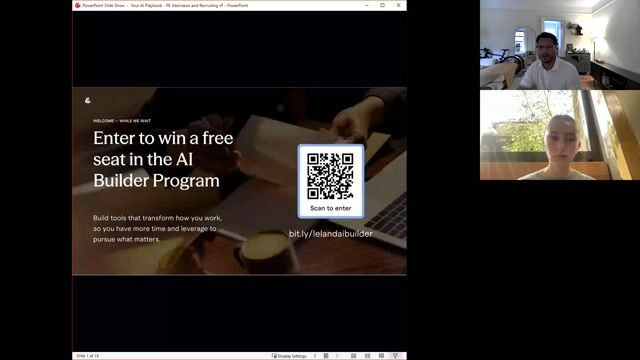
Your AI Playbook: What Works in PE Interviews & Recruiting [9/23/2026] (Recording)
AI is becoming a bigger part of how candidates prepare for private equity recruiting, but knowing how to use AI effectively can be the difference between a useful tool and a distraction. This session is for aspiring PE professionals who want to understand where AI can actually improve their recruiting and interview preparation. You’ll learn practical ways to use AI to sharpen your technicals, strengthen your deal discussions, and prepare more efficiently for the PE interview process. Join live to hear from a private equity expert and current VP at Author Capital Partners. The speaker will share a practical AI playbook for recruiting, including where AI can add the most value, how to use it without relying on it too heavily, and strategies you can put into practice immediately.


How to Use AI to Break Into Investment Banking & Private Equity [5/21/2026] (Recording)
In this session, you will learn how to use AI tools to research firms, personalize cold outreach, and prep for technical interviews in investment banking and private equity recruiting. You will also walk away with a framework for identifying which parts of your application process AI can accelerate versus where it tends to create generic, forgettable work. Attending live means you can ask how these approaches apply to your specific background, whether that is a non-target school, a career pivot, or a gap in your deal experience, and hear the answer in real time rather than guessing from a recording. The coach works directly with candidates breaking into finance and will share the patterns that consistently separate the ones who get interviews from the ones who do not.
Why You? Building Your PE Interview Story [10/21/2026] (Recording)
PE interviews spend surprisingly little time on modeling and a lot of time on one question: why you, why this fund, why now. Candidates who clear the technical screen still stumble here because they haven't built a story that connects their background to a specific investing thesis. This workshop breaks down how to frame your path, your deal experience (or lack of it), and any non-traditional background into something a partner remembers. Adam has sat on both sides of PE interviews and has a clear read on what separates a forgettable answer from one that gets a candidate to the next round. If you're prepping for first rounds or still shaping how you talk about yourself, this is a chance to pressure-test that story before it matters.


AMA: Buying a Business as a Serial Acquirer [8/15/2026] (Recording)
Buying a business sounds simple: find a great company, make an offer, close the deal, and become an owner. The reality is much more complicated. Join Mark Fleming, CFA, FRM, for an open AMA on what it actually takes to buy, operate, and grow small businesses. Since acquiring his first company in 2017, Mark has partnered with operators to buy 20+ businesses across multiple industries, exited two, and advised buyers through more than 100 additional acquisition processes. Bring your questions about finding deals, evaluating opportunities, financing acquisitions, negotiating with sellers, structuring partnerships, navigating diligence, and avoiding expensive mistakes. Whether you're actively searching, preparing for your first acquisition, or thinking about building a portfolio of businesses, this is your chance to ask questions and hear lessons learned from hundreds of real deals (including the ones he walked away from).

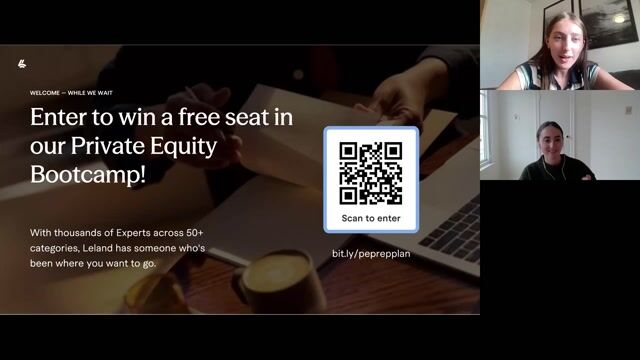
Build Your PE Prep Plan [9/21/2026] (Recording)
PE recruiting moves quickly, and trying to prepare without a clear plan can leave you scrambling when interviews arrive. The strongest candidates know what to prioritize, how to structure their preparation, and where to spend their limited time for the biggest impact. This session is for aspiring private equity professionals who want a focused roadmap for getting interview-ready. You’ll learn how to structure your prep, prioritize technicals and deal experience, and build the investing skills needed to perform with confidence. Join live to hear from a private equity expert and former investor at a leading software-focused PE firm. The speaker will share practical preparation strategies, common mistakes that derail candidates, and a clear framework for building an effective PE prep plan. You’ll leave with a more focused approach to your recruiting preparation and a better sense of what it takes to be ready when interviews come.


How to Land a Role as a Growth Equity Analyst
Breaking into growth equity is competitive, and most candidates struggle because they don't know how the role differs from traditional private equity or what firms are actually evaluating. This session is for undergraduates, MBA students, and early-career professionals who are actively recruiting for growth equity analyst positions. You'll leave with a clearer understanding of how to position your deal experience, what frameworks interviewers use to assess market sizing and company evaluation, and how to tailor your story for growth-stage investing roles specifically. Attending live gives you the chance to ask questions about your specific background and get real-time feedback that a recording simply can't offer. The insights shared here reflect the patterns seen across successful candidates, the kind of guidance that typically comes up in one-on-one coaching conversations. If you're actively recruiting or plan to start soon, this is worth your time.

IB Technicals 5: M&A and Accretion Dilution [9/29/2026] (Recording)
M&A applies valuation to a live decision: why a company buys another, what it pays, and what the deal does to the buyer. Building is slow and buying is fast. The catch is that the buyer pays a premium, usually twenty to forty percent over where the target already trades, so the deal has to create more value than the market already priced in. Synergies are the argument for that, and cost synergies are the only ones bankers count on. The question that carries the most interview volume in this block is accretion and dilution, and it comes down to one comparison: the earnings you are buying against the cost of the financing you used to buy them. Then the mechanics underneath, starting with goodwill, which appears the moment you pay more than book value. What we'll cover: - Why companies acquire, and why synergies have to exceed the premium - Cost synergies versus revenue synergies, and why bankers only count on one of them - Cash, debt, or stock: which is most accretive, and why - The P/E arbitrage rule, and the earnings yield trick that answers it in your head - Goodwill, and what happens when you write up assets for book but not for tax - The sell-side process, and selling to a sponsor versus a strategic Want to be done with the M&A block? I run a 90-minute mock interview, a full simulation and then rapid-fire technicals on whatever broke. Book a free 15-minute intro to see if it is a good fit. Part 5 of IB Technicals, a six part run on Tuesdays and Thursdays. Each night covers how the concept works and, more importantly, how to actually answer the questions on it, with the stories and details behind them. Each one stands alone, so jump in anywhere. I'm the founder of OFFERGOBLIN and ex-Centerview tech.

How to Prepare and Standout for PE Interviews
Breaking into private equity is competitive, and strong technical skills alone won’t separate you from the pack. This session is for candidates preparing for PE interviews who want to understand what actually stands out in the room—and the subtle mistakes that can quietly weaken your candidacy. You’ll learn how to position your deal experience with clarity, master the nuances of case studies and LBO discussions, and communicate investor judgment in a way that reflects how firms truly evaluate talent. Join live to ask your specific questions about headhunters, modeling tests, or navigating on-cycle and off-cycle processes, and get real-time feedback grounded in 20+ years as a principal and investor. The speaker works 1:1 with candidates and will share the patterns they see across successful applicants and what they personally look for when evaluating hires. If you’re serious about breaking into PE, this is a conversation worth being in live.

IB Resume Secrets: What Actually Works (and What Doesn't)
Breaking into investment banking starts with one thing: a resume that grabs attention. But with so many conflicting tips out there, it’s hard to know what really matters to recruiters and deal teams. In this session, Ryan T., a former Investment Banker at Wells Fargo Securities with nearly 5 years of experience in healthcare investment banking, will reveal what top firms actually look for in resumes. Ryan has served as Staffer, Recruiting Team Captain, and Manager - interviewing, hiring, and training multiple analyst classes while executing $10B+ in deals across 90+ transactions. He’s also coached 70+ candidates into roles at leading firms, so you won't want to miss his advice! You’ll learn how to structure your bullet points for maximum impact, highlight the experiences that truly matter, and avoid the common mistakes that hold applicants back. Whether you’re recruiting for summer analyst positions or full-time roles, this session will give you the insight and clarity to stand out in one of the most competitive fields in finance.


How to Run an Efficient Small Business Search
Buying a small business sounds simple until you actually start searching. Suddenly you are juggling deal flow, broker calls, industry research, financial review, diligence, and legal concepts. All while trying to keep your life and job moving. This session is for the person who is ramping into acquisition entrepreneurship and wants real guidance, not a generic accelerator curriculum and not “just ask ChatGPT.” If you are smart, motivated, and serious about buying a business but feel overwhelmed by the volume of decisions and the lack of a clear path, this will click. We will walk through what an efficient search actually looks like in the real world: the phases of search, where people waste time, what progress looks like, and what it realistically takes to get competent. Spoiler: 5 hours a week is usually not enough. Most people underestimate the reps required (think hundreds of hours, not a weekend), and the main goal is to compress the learning curve by focusing on the highest-leverage work. What you will leave with: - A clear picture of the search process end-to-end and what “good” looks like at each stage - The real time commitment and why most searches stall - Practical ways to run search faster and cleaner (systems, workflows, decision filters) - A map of the core skill areas you need to build: deal sourcing, industry analysis, financial fluency, diligence, and negotiation A simple decision framework for your next step: learn it, hire it out, or partner Who this is for: - You want to buy a small business, but you do not want to wander for 12 months figuring it out the hard way - You want more hands-on support than an accelerator, and more signal than generic online content - You are ready to put in the work, but you want a more efficient path and fewer dead ends We will also share a bit of our own search context - what we have tried, what has worked, what has not - and why we believe 1:1 support can meaningfully cut down ramp time when you apply it correctly. If you have been circling ETA and keep thinking “this is a lot,” you are not wrong. Come get a sharper path.

The Career Accelerator: A Playbook for Your Job Search

Differentiate your MBA Application: School Research & Networking Part 1 of 2
⚡School research and networking are the secret weapons that separate good MBA applicants from the ones admissions committees can’t forget. They shape every part of your application, from essays and interviews to your ability to turn a waitlist into an admit. Yet most applicants never learn how to do them at the level that truly changes the game. This is Part 1 of a two-part workshop series. In this session, you will learn the research and networking strategy and methods. You will then have two weeks to complete your own school research and networking as guided homework. In Part 2, I will demonstrate how to put this work into action through a live walkthrough, including discussion of participant progress and real questions that arise during the process. ⚠️Register for Part 2 in the event calendar on March 13th Part 1 has been my most popular event, run multiple times each year, and consistently rated by attendees as one of the most helpful and actionable MBA preparation sessions they’ve experienced. This is the first time I am introducing the Part 2 execution workshop. In this session, you’ll discover how to: 🔷 Conduct deep-dive school research that goes far beyond websites and brochures 🔷 Strategically network with the right people, turning what may be the greatest networking opportunity of your life into a clear advantage for admission and beyond 🔷 Create an MBA Journey document that becomes your central reference for aligning fit, goals, and contributions across the application 🔷 Integrate your findings seamlessly into essays, interviews, networking conversations, and campus interactions You’ll learn how to pinpoint the exact courses, professors, centers, career services, experiential programs, internships, clubs, culture elements, current students, and alumni connections that will help you achieve your goals, and how to clearly show the value you will bring in return. By the end of this session, you will know how to demonstrate, with clarity and credibility, that you and your target MBA program are the right fit for each other. Bonus Offer ✅1 attendee will receive a free 1-hour coaching session. ✅All attendees may request a free copy of the MBA Research & Networking Template. ⚡Spots are limited. Register now to gain the advantage that can set your MBA application apart.

Why Banking, Why This Firm, Why This Group [9/1/2026] (Recording)
Swap the word banking for consulting. If your answer still holds, you have not answered the question. That is the test, and most answers fail it. Fast paced, smart people, steep learning curve. All true, all interchangeable, all heard forty times this month by the person across the table. Three questions, scored separately, proved three different ways. Why banking is proved by your past. Why this firm is proved by your conversations. Why this group is proved at desk level, by someone who actually sits on it. One structure underneath all three. Claim, reason, evidence, impact. Sixty seconds. The evidence slot is the one that decides the answer, and it is the only slot you cannot write at your desk. That is why this session sits here in the run and not at the start. You do not walk into the chats with these answers. You walk out with them. What we'll cover: - The swap test and the name swap test, and how to run both on the answer you already have - Claim, reason, evidence, impact, and why evidence is the only slot with lead time - Where firm evidence comes from: named conversations, one deal known properly, platform, direct experience - Coverage versus product, and why a group answer that never names an industry is not an answer - How the bar moves at a bulge bracket versus an elite boutique versus a regional office - The failure that costs the most, which is being specific enough to be interesting and thin enough to collapse on the follow up Want to solidify your whys and be done with them? I run a popular 90-minute session where we go deep and construct a strong, personal story. Book a free 15-minute intro to learn more. Part 5 of Coffee Chat Ready, a six part run on Tuesdays and Thursdays. Each one stands alone, so jump in anywhere. I'm the founder of OFFERGOBLIN and ex-Centerview tech.
Free
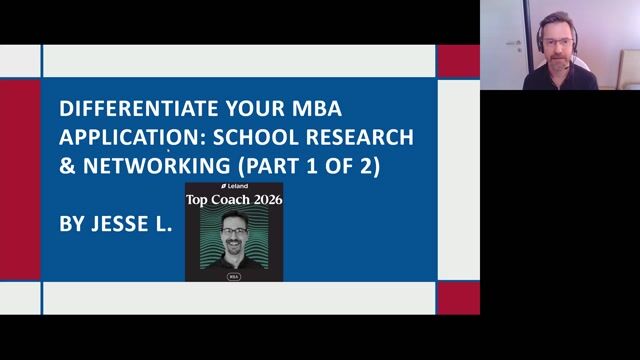
Differentiate your MBA Application: School Research & Networking Part 1 of 2 [11/4/2026] (Recording)
⚡ Most MBA applicants research schools and do some networking. Very few do either deeply or strategically enough to make their applications noticeably more specific, credible, and persuasive. Strong school research and strategic networking can shape almost every part of your MBA application: Why This School essays, career goals, contribution essays, interviews, campus visits, and even the relationships you begin building before business school. But simply reading a school website, attending an admissions webinar, or speaking with one student is not enough. This is Part 1 of a 2-part workshop series. In Part 1, I will teach you the research and networking system I use with MBA applicants. You will learn how to build an MBA Research Document that connects your background, goals, development needs, school resources, potential contributions, and conversations with students and alumni. You will then have one week to apply the system to your own target schools using the MBA Research & Networking Template. In Part 2, we move from strategy to execution: finding the right students and alumni, using LinkedIn and AI effectively, writing outreach messages, deciding what questions to ask, building genuine relationships, and turning what you learn into stronger essays and interview answers. ⚠️ Register for Part 2 in the event calendar on November 11th (scroll through the events list). I have run the original research and networking workshop multiple times each year, and it has consistently been one of my most popular and highly rated MBA preparation events. This two-part format gives you something previous versions could not: time to actually do the work between sessions and then return with real research, outreach, questions, and challenges. In Part 1, you’ll learn how to: 🔷 Conduct deep school research that goes far beyond rankings, websites, and admissions brochures 🔷 Identify the courses, professors, centers, experiential programs, career resources, clubs, students, and alumni most relevant to your goals 🔷 Determine not only what you want to gain from an MBA program, but what you can contribute in return 🔷 Build an MBA Research Document that becomes your central reference throughout the application process 🔷 Find and approach the students and alumni whose experiences can give you insights you cannot get from a website 🔷 Use AI to accelerate research without trusting unverified information 🔷 Translate your research and conversations into specific, credible material for essays and interviews By the end of the session, you will have a repeatable research and networking system for every school on your list and a clear plan for demonstrating why that MBA program makes sense for you, and why you make sense for it. Bonus Offer ✅ All attendees may request a free copy of the MBA Research & Networking Template. ⚡ Spots are limited. Register now and come prepared to turn school research and networking into a real competitive advantage.