Leland+ Content Library

Build a Job Search Operating System (JSOS) [5/13/2026] (Recording)
Build Anything Series · Event 01 · Free · Live The job search is the most expensive workflow most people will ever run — and the one they're least equipped for. Spreadsheets, sticky notes, half-tracked outreach, lost interview notes. By the end of this hour, you'll learn how to create a complete Job Search Operating System to help you land your next offer. What we'll walk through live: - A real applicant tracker | every role, company, and contact in one view. Status, last action, next step, follow-up date. - Automated outreach + research | pull company context, drafts personalized outreach, surfaces the right people to message. - Synced notes, prep, offer comparison | interview notes that auto-link to the role, prep doc generation per company, structured offer comparison when it's time to choose. Who it's for: - People actively job searching or about to start - Career switchers, returning-to-work folks, recent grads - Anyone who's run a search before and remembers losing track of half of it Not a fit if: - You enjoy manual data entry and Excel-tab chaos - You'd rather pay $300 for a static prompt template that fails instead of learning the principles yourself - You want a one-click magic button I'll be honest about where AI helps and where it doesn't, and how to keep the system running without me. Bring your laptop and follow along, or lean in, watch, and replicate after.


Big 10 to MBB + Big Tech: Positioning Yourself to Get Offers
This guide was written by a former Bain & Company Associate Consultant, now in a Strategy and Operations role at LinkedIn, who went through the full MBB recruiting process out of Indiana University's Kelley School of Business. It covers everything that actually matters when you are trying to break into a top consulting firm or land a Big Tech strategy role from a non-target school. Inside you will find a no-nonsense breakdown of how MBB firms actually differ, what a competitive application looks like, how to build a resume that passes the ten-second scan, and the networking approach that moves the needle versus the one that wastes your time. The guide goes deep on case interview preparation, including the pyramid framework approach and what interviewers are genuinely evaluating in the room, and covers the behavioral and fit interview with the same level of honesty. The final chapter covers what transfers from consulting to Big Tech, how that recruiting process works, and how to negotiate an offer once you have one. This is not generic advice. It is based on having gone through the process recently, having sat on the other side of the table at Bain, and having made the transition to Big Tech firsthand.

The Reapplicant's Advantage: Turning Setback into Strategy. [7/22/2026] (Recording)
For many successful MBA graduates, rejection was not the end of the journey—it was the turning point. When approached with strategy, reflection, and renewed purpose, reapplying can transform a setback into a compelling statement of resilience, growth, and focus. Admissions committees respect candidates who demonstrate perseverance, self-awareness, and the ability to learn from experience—but only when that growth is clear, specific, and credible. This workshop will help you turn a “ding” into a competitive edge. You’ll learn how to conduct a clear-eyed assessment of your previous application, identify what may have held you back, highlight meaningful progress since your last submission, and approach the reapplicant essay with authenticity and impact. More than damage control, the reapplication process is an opportunity to show the admissions committee that you are stronger, more prepared, and more intentional than before. Done well, your reapplication can tell a sharper, more mature, and more persuasive story. By the end of this session, you will be able to: * Conduct a candid self-assessment to identify weaknesses in your previous application and opportunities for improvement. * Demonstrate tangible growth through professional achievements, academic progress, leadership development, and deeper extracurricular or community impact. * Refine your school strategy by aligning more precisely with programs where your fit, goals, and competitiveness are strongest. * Craft a powerful reapplicant essay that emphasizes resilience, growth, and renewed commitment—without sounding defensive or making excuses. * Strengthen recommendations and school engagement by securing enthusiastic advocates and building more authentic connections with your target programs.
CV and LORs (Recommendation letters): Two documents to get right first [10/15/2026] (Recording)
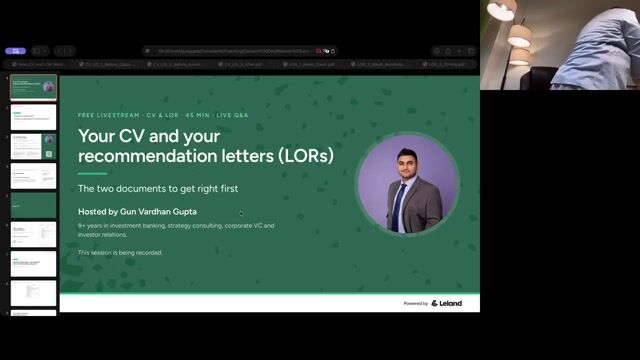
Most people write their essays first and ask for recommendation letters last. That is backwards, and this session is about why. I did a Master in Management and have spent 8+ years in strategy and finance across six countries. I have mentored clients on their MiM, Master in Finance and MBA applications across the US, Europe and Asia. In this session I will take a real submitted CV and rebuild it in front of you, two pages down to one, and then do the same with a recommendation letter. In 1 hour, I will cover why your CV is read before anything else in your file and what a reader actually sees in the first thirty seconds. The eight problems on a real application CV, marked up live, including the one that has nothing to do with your experience and everything to do with the order of your sections. Two tests you can run on your own CV tonight in ten minutes. Why your referee writes from your CV, which is the reason these two documents belong in the same conversation. How to choose a referee, and why the most impressive person who will say yes is usually the wrong answer. What separates a letter that helps from one that quietly does nothing, using a real example that looks perfectly good until you know what to look for. And the three questions that turn a vague letter into a specific one, which is the only part of this document you actually control. This is for anyone applying to a MiM, Master in Finance, MBA or specialised master's, and it is most useful if you have not yet asked anyone for a letter. Forty five minutes of content, then live Q&A, hands or chat. Everyone who attends gets the Recommendation Workbook by email afterwards.
Resume to Interview: How to Build a Consulting Resume That Gets You in the Room [9/16/2026] (Recording)
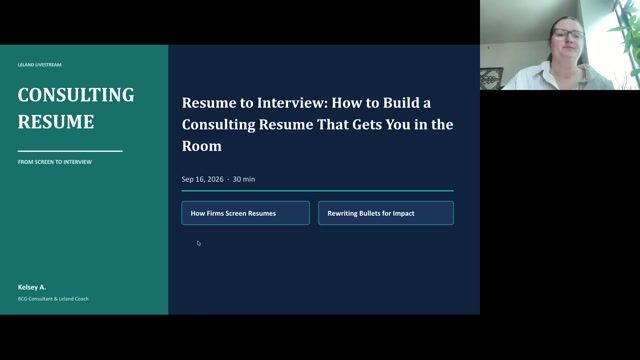
The consulting resume is the first thing (after resumes) that determines whether you ever get to show your case skills. Most candidates underestimate it — they submit a strong resume by any normal standard and assume it'll get through. But the consulting resume is evaluated against a specific set of criteria, and what makes a resume strong for a bank or a tech company is not the same thing that makes it strong for BCG or McKinsey. As a former BCG interviewer and Ross peer coach, I have a firsthand understanding of what makes a resume interview-worthy vs. how it can miss the mark. How Consulting Firms Actually Screen Resumes -The signals firms are looking for on a first pass: impact, leadership, and trajectory, and more -Why a resume that got you your last job won't necessarily get you a consulting interview Writing Bullets That Show Impact the Way Consulting Firms Define It -The difference between describing what you did and demonstrating what you drove -How to quantify impact when your work wasn't measured in revenue or headcount -What a strong consulting resume bullet sounds like vs. the version many candidates submit What Firms Are Actually Looking For Beyond the Bullets -How to signal leadership, analytical ability, and client-facing potential through your experience, even if it might not seem obvious -How to frame extracurriculars, leadership roles, and non-work experience so they count -What to do if your GPA, school, or background puts you outside the "standard" profile — and when it matters Making Your Resume Firm-Ready Before You Submit: -A checklist grounded in what actually gets candidates to the first round -What to fix before applications open and what doesn't matter as much as you think -How to know when your resume is actually ready


AMA: Breaking into MBB - Nailing the Recruiting Process and Case Interviews [10/13/2026] (Recording)
Recruiting for MBB consulting? Join this session as we discuss what you can do to set yourself apart to secure an interview, and eventually nail those interviews. Having just gone through the MBA consulting recruiting process at Chicago Booth last fall, securing offers from Bain, BCG, and McKinsey, I’ll give you the latest tips and tricks on how to bring out your best self and maintain composure during the intense recruiting process and case interviews. This session is designed for anyone trying to pivot into consulting, including MBA candidates, career switchers, and undergraduate students. I’ll tailor which topics we cover to the specific questions you all have, but below are key topics I’ll come ready to discuss. We'll discuss the following best practices that apply to anyone recruiting for consulting: -How often to practice casing, who to practice with, and how to practice (which frameworks to learn, case logs, etc.) -Simulating case day, such as preparing for interviewers who try to throw you off -Nailing pre-interview assessments (McKinsey Solve, Bain TestGorilla, BCG Casey, etc.) -How to prepare for the behavioral interview (what stories to come prepared with, having a great answer for “why this consulting firm”, etc.) -Resume tips For current MBA and undergraduate candidates, we'll discuss how to navigate the on-campus recruiting process, including: -Making a good first impression as you meet firm reps on campus -How to reach out for coffee chats and who to reach out to -Best practices during those coffee chats -Nailing your 15- and 60-second intro and your “why consulting” -Best practices at invite-only events -How to prepare for practice cases with MBB reps (Bain loves to do these) Feel free to come with questions and RSVP to secure your spot!
Free

Resume to Interview: How to Build a Consulting Resume That Gets You in the Room [10/22/2026] (Recording)
The consulting resume is the first thing (after resumes) that determines whether you ever get to show your case skills. Most candidates underestimate it — they submit a strong resume by any normal standard and assume it'll get through. But the consulting resume is evaluated against a specific set of criteria, and what makes a resume strong for a bank or a tech company is not the same thing that makes it strong for BCG or McKinsey. As a former BCG interviewer and Ross peer coach, I have a firsthand understanding of what makes a resume interview-worthy vs. how it can miss the mark. How Consulting Firms Actually Screen Resumes -The signals firms are looking for on a first pass: impact, leadership, and trajectory, and more -Why a resume that got you your last job won't necessarily get you a consulting interview Writing Bullets That Show Impact the Way Consulting Firms Define It -The difference between describing what you did and demonstrating what you drove -How to quantify impact when your work wasn't measured in revenue or headcount -What a strong consulting resume bullet sounds like vs. the version many candidates submit What Firms Are Actually Looking For Beyond the Bullets -How to signal leadership, analytical ability, and client-facing potential through your experience, even if it might not seem obvious -How to frame extracurriculars, leadership roles, and non-work experience so they count -What to do if your GPA, school, or background puts you outside the "standard" profile — and when it matters Making Your Resume Firm-Ready Before You Submit: -A checklist grounded in what actually gets candidates to the first round -What to fix before applications open and what doesn't matter as much as you think -How to know when your resume is actually ready
MBA Submit & Speak Part 2: The Interview Questions You Know Are Coming [9/17/2026] (Recording)
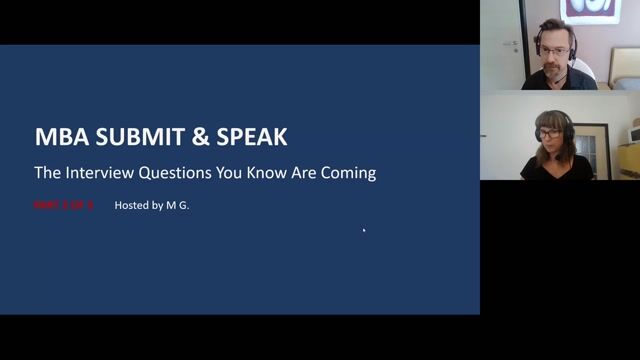
The MBA interview invitation is out of your hands. Preparing for the first questions they ask is not. This is the second session of the MBA Submit & Speak series. Your application is in, and the waiting has started, which makes this the best preparation window you will get. We take the handful of questions that open almost every MBA interview and work through what a strong answer to each one actually has to do. Across the three sessions, we move from the last days before you submit to the interview that follows. Attend all three to go from deadline to interview with one continuous plan, or drop into the single session you need most. In this session, we work through the questions every interviewer asks: • Walk me through your resume, and why the three-minute answer so often turns into six minutes of chronology. • Why an MBA and why now, spoken out loud, which is a different task from the same question on the page. • Why this school, in a year when every applicant has read the same website and repeats the same phrases. • Why you, and how to answer it without either shrinking or overselling. These are guaranteed questions, and that is exactly what makes a mediocre answer expensive. Your interviewer has heard hundreds of versions and is listening for the one that sounds like a person rather than a rehearsed applicant. Because you know these are coming, you can prepare them properly, and this session shows you what properly looks like. I have guided more than 100 applicants into every M7 program, across the top 20 in the U.S., and into leading international programs, including INSEAD, London Business School, IESE, Esade, Oxford, Cambridge, NUS, and more. Be ready for the questions you can see coming. Register now to claim your spot.

Blank Page to Clear Outline: Get Unstuck on Your Personal Essay
Feeling stuck on your personal essay? You're not alone. Trust, you are not the only senior who keeps putting off writing their application essay. You're sure you'll be able to finish once you start. You just need to put something - anything - on the page, but going from 0 to 1 feels harder than going from 1 to 100. And advice like "just start!", "show who you are," "brainstorm some ideas," isn't working, right? Join Isamar V., a former Stanford admissions officer and college application coach, in this workshop where she will guide you as you complete 3 exercises to go from a blank page to a clear essay outline in 1 hour. Get your pen and paper (or laptop) ready because this isn't just a lecture. You are going to put in the work in this workshop. If you have no idea what you want to write about --> You'll leave with several ideas, topics, and stories to choose from If you have an idea or story but don't know if it's good --> You'll leave with personal reflections to make it good If you have a story that you're excited about, but just haven't sat down to write --> You'll leave with an outline If you already have an outline, but just no written draft --> You'll have a dedicated hour to write You'll also get some tips for how to go from outline to a first written draft. Whether you're just starting or need a fresh perspective, the goal for you is to feel unstuck and excited to write your story.
How to Capitalize on a Coffee Chat [9/3/2026] (Recording)
Most people send a thank you note and never speak to that person again. The note was never the point. First rounds go to candidates someone inside is pushing, and one conversation almost never does that on its own. Most of the people I know who ended up at JP Morgan ran more than twenty of these. So the work is in what happens after. Write down what stuck the moment you hang up, because it fades faster than you think and the thank you note needs one specific detail in it. Then the ask, which is the last two minutes of the call and the entire reason the next two chats exist. Then the check in, which most people skip, and which is why they are not on anyone's radar in January. The other thing you are collecting is your own answers. The line you use in a February interview is usually something a banker volunteered in September, and you only have it if you wrote it down. What we'll cover: - What to write down the moment the call ends, and why the note needs one specific detail - The thank you email inside twenty four hours, and what actually earns a reply - Ending on the ask, and how to get the introduction made over email instead of just a name - The referral email, and why it is the easiest one you will ever send - Checking in later with something worth sending, and how to still be on a radar in January - How many chats per firm is normal, and why boutiques are different Want to get more out of the chats you are already having? Book a free 15-minute intro and we will talk through your networking situation. Part 6 of Coffee Chat Ready, a six part run on Tuesdays and Thursdays. Each one stands alone, so jump in anywhere. I'm the founder of OFFERGOBLIN and ex-Centerview tech.

Fit Is Not a Freebie: How Firms Actually Evaluate Your Behavioral Interviews [8/11/2026] (Recording)
Most candidates spend 90% of their prep time on cases and assume fit will take care of itself. It doesn't. Fit is evaluated with the same rigor as the case at every MBB firm, and the interviewers asking behavioral questions are trained to score them. As a former BCG interviewer, I've sat on both sides of that table, and the gap between what candidates think they're being evaluated on and what's actually happening is significant. This session covers what firms are actually looking for and how to build a fit preparation strategy that works. How Fit Is Actually Scored at MBB: This isn't a casual conversation, it's a structured evaluation with specific criteria. -Why fit isn't just about whether your interviewer likes you, but it's a scored component with defined qualities -The qualities that interviewers are looking for in every fit story, regardless of firm Telling Fit Stories That Actually Work: The format most candidates use produces weak answers. -Why STAR produces flat, unmemorable answers and what to do instead -How to structure a leadership, impact, or conflict story so it actually lands -What makes a fit story memorable vs. one that interviewers forget before the next candidate walks in Building Your Story Bank Before Recruiting Season: Having one good story is not enough. -How many stories you actually need and how to choose which experiences to use -Why most candidates recycle the same stories across question types and how to avoid it -How to adapt a single experience to multiple fit questions without it sounding rehearsed Live Example: A strong fit answer, broken down for what makes it work, and the common version of the same story that doesn't.
Free

Slides for Fit Is Not a Freebie: How Firms Actually Evaluate Your Behavioral Interviews
Most candidates spend 90% of their prep time on cases and assume fit will take care of itself. It doesn't. Fit is evaluated with the same rigor as the case at every MBB firm, and the interviewers asking behavioral questions are trained to score them. As a former BCG interviewer, I've sat on both sides of that table, and the gap between what candidates think they're being evaluated on and what's actually happening is significant. This session covers what firms are actually looking for and how to build a fit preparation strategy that works. How Fit Is Actually Scored at MBB: This isn't a casual conversation, it's a structured evaluation with specific criteria. -Why fit isn't just about whether your interviewer likes you, but it's a scored component with defined qualities -The qualities that interviewers are looking for in every fit story, regardless of firm Telling Fit Stories That Actually Work: The format most candidates use produces weak answers. -Why STAR produces flat, unmemorable answers and what to do instead -How to structure a leadership, impact, or conflict story so it actually lands -What makes a fit story memorable vs. one that interviewers forget before the next candidate walks in Building Your Story Bank Before Recruiting Season: Having one good story is not enough. -How many stories you actually need and how to choose which experiences to use -Why most candidates recycle the same stories across question types and how to avoid it -How to adapt a single experience to multiple fit questions without it sounding rehearsed Live Example: A strong fit answer, broken down for what makes it work, and the common version of the same story that doesn't.
MBA Submit & Speak Part 3: The Interview Questions You Cannot Predict [10/8/2026] (Recording)
You cannot know which behavioral questions you will be asked. You can still be ready. This is the final session of the MBA Submit & Speak series. Invitations are landing, and the questions that help decide many interviews are the ones no list can anticipate. Rather than memorizing answers, we build the system that lets a small set of real stories cover a very large set of possible questions. Across the three sessions, we move from the last days before you submit to the interview that follows. Attend all three to go from deadline to interview with one continuous plan, or drop into the single session you need most. In this session, you will build the preparation that unpredictable questions require: • Build a story bank of five or six real experiences, and learn how a single experience answers several different questions depending on how you frame it. • Handle the failure question and the conflict question, where most applicants either flinch or confess too much. • Answer a situational question about something you have never done, without inventing experience you do not have. • Recover when a question lands and no story comes to mind. • Ask the questions you have for your interviewer, and close the conversation on your terms. This is where interviews are won and lost. Two applicants with the same record can walk out having told completely different stories about themselves, and the disparity is almost never talent. It is preparation of a kind most applicants never do. They are not short of question lists. They are either overwhelmed by how long those lists are and unsure where to start, or working through them one by one, writing out an answer to every question. Neither approach survives contact with a real interview. This session gives you a system that does. I have guided more than 100 applicants into every M7 program, across the top 20 in the U.S., and into leading international programs, including INSEAD, London Business School, IESE, Esade, Oxford, Cambridge, NUS, and more. Walk in ready for anything they ask. Register now to claim your spot.
What They Ask, What You Ask: A Complete Guide to MBA Behavioral Questions [9/24/2026] (Recording)
Once you're past the opener, the MBA interview becomes a conversation — and most candidates are only prepared for one direction of it. Behavioral questions are harder to predict and easier to fumble than the standard tell me about yourself / why mba / why here, and the questions you ask at the end of the interview are evaluated nearly as much as the answers you gave. As a Ross admissions interviewer, I've sat through countless interview conversations. The candidates who finish strong treat the full interview as a two-way exchange, not a performance. This session covers how to handle what comes after "tell me about yourself" — and how to close in a way that reinforces everything you just said. How MBA Behavioral Questions Are Different From What You'd Expect: These aren't job always interview questions. The framing and evaluation criteria are distinct. -What MBA programs are actually assessing in behavioral questions: self-awareness, leadership style, how you handle ambiguity -The most common behavioral questions and what interviewers are listening for beneath the surface -Why the STAR format produces flat answers — and what structure actually works better Telling Stories That Hold Up: A good behavioral answer doesn't just answer the question. It reveals something. -How to choose experiences that show what you want the interviewer to take away about you -How to be specific without over-explaining, and concise without underselling -What to do when the question doesn't map cleanly to an experience you've prepared Adcom vs. Alum Interviewers — What Changes: The interview format is the same. The dynamic isn't. -How adcom interviewers and alum interviewers are trained differently and what each is evaluating -Why alum interviewers often ask less predictable questions and how to stay grounded when they do -What each type of interviewer is most likely to flag as a concern — and how to address it before they have to ask What to Ask Your Interviewer (And Why Most Candidates Get This Wrong): The questions you ask are part of your evaluation. Most people treat them as an afterthought. -What your questions signal about your preparation, your priorities, and your fit -The difference between a strong question for an adcom interviewer and one for an alum — and why the distinction matters -Questions that land well, questions that fall flat, and what the interviewer is thinking in both cases