How to Properly Evaluate a Startup
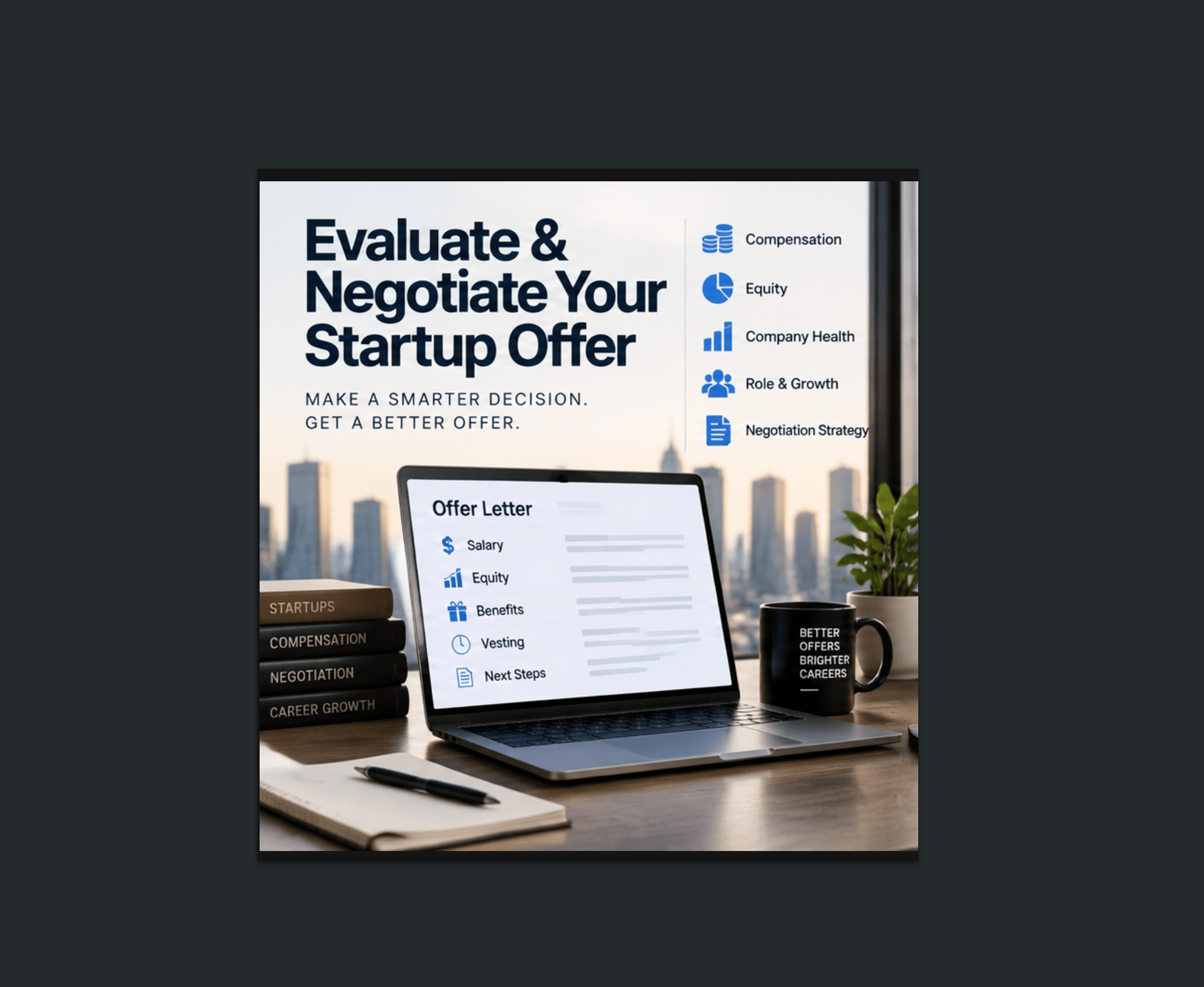
This 60-minute coaching session gives you a practical framework for evaluating whether a startup is actually a strong career opportunity — beyond the pitch, brand name, or headline valuation. We’ll walk through the key areas you should investigate before accepting an offer, including: - **Business health:** Revenue, ARR growth, burn rate, runway, fundraising history, valuation, customer concentration, margins, and other metrics worth asking the recruiter or hiring manager about. - **Funding and equity:** How to evaluate the company’s funding history, investors, current stage, valuation, and what those factors may mean for your equity. - **Founders and leadership:** How to research the founders, executives, board, previous companies, track record, and leadership reputation. - **Team quality and employee signals:** How to use LinkedIn to understand employee tenure, hiring velocity, leadership turnover, layoffs, and where people go after leaving. - **External research:** How to intelligently use sources like Glassdoor, Blind, Reddit, LinkedIn, Crunchbase, press coverage, and customer feedback without taking any one source at face value. - **Product and market:** How to assess product differentiation, competitive positioning, customer demand, market size, and whether the company has real momentum or mostly hype. - **Startup red flags:** Common warning signs around culture, finances, leadership, hiring, product-market fit, compensation, and unrealistic growth narratives. - **Your specific opportunity:** We can apply the framework directly to a startup or offer you are currently considering and identify the most important questions to ask before making a decision. The goal is to help you perform the kind of diligence on a startup that an investor might — while also evaluating whether it is the right career bet for you.
What's included
- Which company metrics matter most and how to ask for them.
- How to distinguish a genuinely strong startup from one that simply interviews or markets itself well.
- How to assess financial stability, growth, product-market fit, leadership quality, and company trajectory.
- How to research founders, executives, employees, investors, competitors, and former employees.
- Which red flags deserve serious concern versus which are normal for an early-stage company.
- How to think about the risk/reward of joining a startup compared with a larger, more established company.
- What follow-up questions you should ask the recruiter, hiring manager, or founders before accepting an offer.
Meet your expert

Colin B.
Product Lead at Poolside | Scale Your Startup Career Strategically
I've spent my career at the intersection of technology, customers, and product, from small IT consulting firms to MongoDB, AWS, and most recently Poolside, where I joined as the company's first Solutions Architect and later moved into Product leadership. At Poolside, I helped build the global Solutions Architecture organization from 0 to 7 before identifying an opportunity around sovereign AI, building the first prototype myself, and ultimately leading the resulting product line. Over roughly 14 months, we grew it to ~$3M ARR and 40+ deployments across enterprise, government, and highly regulated environments. I've made several career transitions myself, from IT consulting → Sales Engineering → Solutions Architecture → Product, and I've interviewed extensively across startups and large technology companies. I have an MBA from Boston University and particularly enjoy helping people think through career positioning, technical interviews, compensation, startup opportunities, and how to move between technical, product, and customer-facing roles. I'm also an active builder. Outside of work I've launched my own AI-powered market analytics SaaS and built an open-source agent harness. For anyone looking to understand or build with AI, I'm happy to work hands-on across LLMs, agents, cloud architecture, product strategy, and turning an idea into something real.