Wharton TBD Interview Guide: Prompts & Expert Tips (2026)
Learn how the Wharton Team-Based Discussion (TBD) works, what this year's prompt is, and how to stand out in this unique MBA interview format, with tips and tricks from pro admissions experts and M7 admits.

By Andrew D.
M7 Expert | Former Kellogg Interviewer | Let's Get You Into B School
Posted February 18, 2026



Join a livestream
Learn from top experts and industry experts in live, interactive sessions you can join for free.
 Starts in 1 hour49 registered
 Starts in 2 hours87 registered

 Starts in 2 hours45 registered
 Starts in 3 hours11 registered
Table of Contents
What Is the Wharton Team-Based Discussion (TBD)?
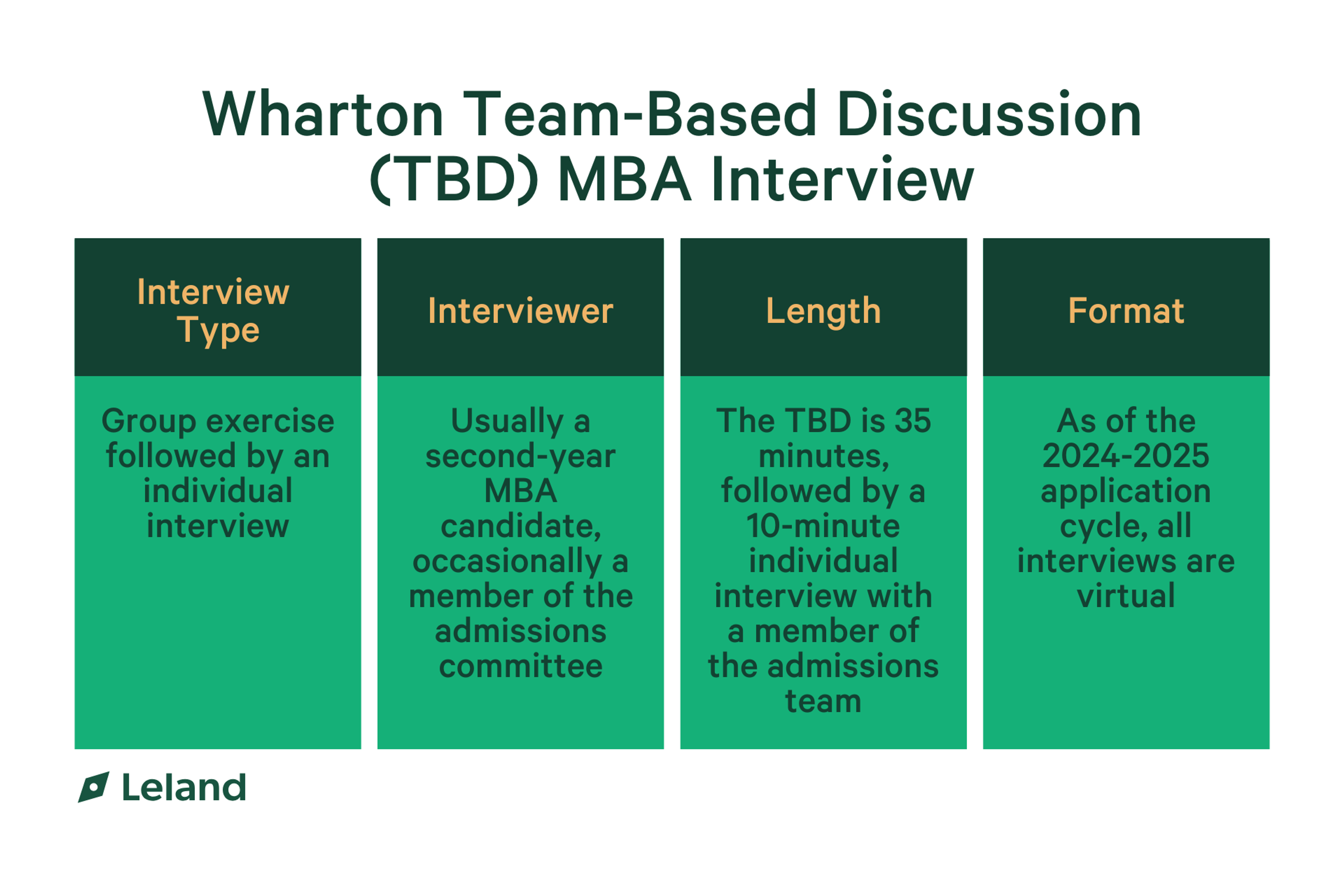
The Wharton Team-Based Discussion (TBD) is a group interview component of the Wharton MBA admissions process where applicants collaborate on a real-time business prompt to assess teamwork, communication, and leadership skills. All other top business schools use a traditional, one-on-one interview; the TBD is unique as a 35-minute group exercise where five to six applicants collaborate to develop a solution to a given prompt. Each participant prepares in advance and contributes to the discussion, showcasing their teamwork, problem-solving, and leadership skills. Following the TBD, each applicant has a 10-minute individual interview with an admissions committee (AdCom) member to discuss their interest in Wharton. Currently, both the TBD and the individual interview are conducted virtually.
- MBA Interview Type: Group exercise followed by an individual interview
- Interviewer: Usually a second-year MBA student, occasionally a member of the admissions committee
- Length: TBD is 35 minutes, followed by a 10-minute individual interview
- Format: All interviews are currently conducted virtually via Zoom
- Wharton Interview Acceptance Rate: ~40% of applicants are invited to interview, and roughly 1 in 3 interviewees are admitted
Wharton Interview Dates (2026-2027)
- Round 1: Late October (invites sent October 22, 2025)
- Round 2: Mid-February (invites sent February 20, 2026)
- Round 3: Mid-April (invites sent April 17, 2026)
- Deferred: Late May (invites sent May 27, 2026)

How Does the TBD Work?
Each TBD session is conducted virtually via Zoom and includes 5-6 randomly assigned applicants. The session follows a structured format:
- Opening Statements (60 seconds per person): Each candidate presents their individual idea or proposal in response to the prompt. This serves as a jumping-off point for group discussion.
- Group Discussion (25 minutes): The team works together to refine an idea, develop a clear and actionable solution, and ensure every member contributes meaningfully. Admissions observers assess collaboration, listening, and communication skills, not just the final idea.
- Final Presentation (5 minutes): The group presents its final proposal to the Wharton admissions observers, summarizing the outcome of the discussion.
- One-on-One Interview (10 minutes): Immediately following the TBD, each applicant has a brief one-on-one interview with a second-year student or admissions team member. This conversation focuses on your MBA goals, interest in Wharton, and personal motivations.
Wharton TBD Prompt
If you’ve been invited to interview at Wharton, congratulations! This is a strong signal that the admissions committee sees potential in your candidacy and wants to assess your interpersonal and leadership skills in a group setting.
2025-2026 Prompt
Leadership development at Wharton integrates scholarship, relationships, and experiences that connect knowledge with action. The McNulty Leadership Program serves as the hub for this work, offering an expansive portfolio of experiential learning opportunities, including MBA Leadership Ventures. Ventures facilitate self‑discovery, leadership, and character development. Participants are able to step out of their comfort zone, exceed personal limitations, and experience leadership firsthand. One key offering within the Venture Portfolio is Leadership Intensives (LI). Each LI is a consolidated, immersive, group‑based experience lasting one to two days.
Wharton invites your team to propose a new Leadership Intensive (LI) to address increasing student interest. The LI proposed should be designed for Wharton MBA students and operate within a pilot budget of $25,000. All costs – including partner fees, facilitator payments, site or equipment rentals, and materials – must stay within this total amount. Transportation logistics will be arranged by Wharton and are outside the scope of your team’s planning and budget.
The program should be structured around a central theme that articulates and reinforces fundamental leadership principles. These principles will inform the program’s design and delivery, with the goal of producing specific, demonstrable learning outcomes. Consider how progress toward these learning outcomes will be assessed to determine whether participants have internalized and applied the intended skills and insights.
As a team, you’ll be expected to:
- Identify a leadership theme or challenge that the new LI will explore
- Design a 1-2 day immersive program that promotes growth through experience
- Stay within the $25,000 pilot budget (excluding transportation)
- Clarify the program’s learning goals and how they’ll be measured
Your final presentation should clearly outline the proposed Leadership Intensive and articulate how it supports Wharton’s mission to develop self-aware, action-oriented leaders.
Analysis of the 2025-2026 TBD Prompt
Last year’s team-based discussion prompt focused on collaborative problem-solving, leadership, and strategic thinking in the context of Wharton’s Impact Communities initiative. The exercise was asking applicants to propose a new Impact Community centered on an emerging global issue, requiring them to think critically about current world challenges, institutional resources, and potential partnerships.
What Is Wharton Looking For?
Every year, the prompts are looking for roughly the same characteristics in applicants, including:
- Can you work effectively in teams? Wharton values collaboration, so they want to see how you contribute to a group setting, build on others' ideas, and help drive the discussion forward.
- Do you think strategically and structure ideas well? The exercise tests your ability to analyze a problem, propose a feasible solution, and structure a compelling pitch. Demonstrate leadership without dominating – Admissions officers will be watching to see if you take initiative, facilitate discussions, and help the team stay on track.
- Can you showcase creativity and a global perspective? Choosing an issue that is timely, impactful, and aligns with Wharton’s mission will help differentiate your team’s proposal.
- Can you leverage Wharton’s resources effectively? Your ability to identify relevant academic programs, research centers, and external partnerships shows how well you understand what Wharton has to offer.
How to Approach the Team-Based Discussion
The key to succeeding in Wharton’s interview process is balancing collaboration with structured thinking. You want to contribute meaningfully, help the team stay on track, and show that you’re someone who would thrive in Wharton’s MBA environment. Here’s how to approach this year’s prompt effectively.
1. Choose a relevant and impactful global issue.
Your team will need to propose a new Impact Community, so picking the right issue is incredibly important. Focus on emerging topics that are not only globally significant but also well-aligned with Wharton’s strengths in business, finance, and leadership. Strong examples include AI ethics in business, sustainable supply chains, global health equity, the future of work and labor policy, or climate tech innovation, among others.
Whatever issue your team selects, be ready to justify why it matters now and how an Impact Community would help drive meaningful change. It’s not just about picking a trendy topic — it’s about identifying a challenge where a Wharton-led initiative could make a real difference.
2. Identify strong partner organizations.
A well-thought-out Impact Community will need external partners that lend credibility, resources, and engagement opportunities. This could include well-known companies, nonprofits, think tanks, or government agencies that align with your topic.
For example, if your group chooses a Climate Tech Impact Community, potential partners could include the World Economic Forum, Tesla, or the UN Environment Programme (UNEP). These organizations could provide funding, mentorship, research collaborations, or networking opportunities. The key is choosing partners that make sense. They’re not just big names, but entities that would actively contribute to the community’s success.
3. Leverage Wharton’s internal resources.
Wharton has a vast ecosystem of research centers, academic initiatives, and networking opportunities, and part of the TBD challenge is showing that you understand how to tap into these resources effectively. A strong proposal will highlight specific Wharton programs that could support the Impact Community, such as:
- The Mack Institute for Innovation Management – Ideal for communities focused on technology and business innovation.
- The Wharton ESG Initiative – A great fit for sustainability and corporate responsibility topics.
- Penn Wharton Budget Model – Useful for policy-related communities, especially those focused on economic and financial issues.
- Wharton Social Impact Initiative – A strong choice for equity-driven and socially conscious communities.
A good strategy here is to connect the dots between Wharton’s existing strengths and the goals of your Impact Community. This shows that you understand the school’s ecosystem and how to maximize its resources.
4. Define learning outcomes clearly.
Every Impact Community needs to have a clear purpose and tangible benefits for Wharton students. A strong proposal won’t just describe an issue; it will explain what participants will actually gain from the experience.
For example, a Global Health Equity Impact Community might focus on policy analysis, market-based solutions for healthcare access, and social entrepreneurship in medicine. This would provide a structured way for MBA students to develop expertise, gain hands-on experience, and build connections with industry leaders.
Remember, the best proposals don’t just sound good: they have a real, practical impact. Keep the focus on what Wharton students will learn and how it will prepare them to be better leaders.
Expert Tip: The TBD is designed to mirror the collaborative, high-energy nature of Wharton’s MBA environment. While content matters, the real evaluation is on how you work with others, communicate your ideas, and contribute to a productive discussion. Make sure to be structured but flexible, encourage participation, and keep the big picture in mind. The goal is not to force your idea through; it’s to create a compelling and well-thought-out proposal as a team.
5 Tips for the TBD From MBA Admissions Experts
Your TBD and one-on-one interviews will be scheduled well ahead of time, giving you ample time to prepare. On its website, Wharton suggests several things to keep in mind:
- Show your skills and strengths. Think about what you have done to improve your past teams’ work and performance. What can you bring to this experience?
- Adaptability is key. Remember to stay adaptable and be a team player.
- Be yourself. You are not expected to fit into one specific role; be yourself and show off the strengths that you personally bring to the table.
- Relax. Getting to the interview is itself an accomplishment. Remember how far you have come and go into the interview with confidence and excitement!
In addition to these tips from Wharton, we’ve compiled a list of the best advice from MBA coach experts. If you’re currently applying for or preparing to interview for Wharton, browse all MBA consultants here.
1. Contribute, Don’t Dominate
During the TBD interview, there will usually be several members of the admissions team observing to see how the activity goes and to analyze each applicant for their fit with what Wharton is looking for. One thing they want to see is active participation without completely controlling the conversation. In other words, they want to see a team player. Don’t cut others off, make sure everyone is heard, and contribute meaningfully in areas where you can add value.
One strategy that some teams implement is defining roles ahead of time. For example, one participant would take the role of “timekeeper” and another “the facilitator” or “the presenter.” Delineating this ahead of time ensures that everyone has a job to do and often makes the team cooperate more effectively.
Expert Tip: Think about this in terms of who Wharton is trying to admit. They don’t want controlling, big ego, pushy people in their MBA cohorts; they want collaborative, helpful, and considerate students with adept personal skills. The interviewers are evaluating you as a potential future MBA classmate, so consider how your actions may be viewed in that light.
2. Show Innovation with Creative Solutions
One of the core Wharton values is innovation, and this is part of what is tested in the TBD. The interview questions are generally fairly open-ended and provide plenty of opportunities for unique solutions. Work with your team to approach the problem in a different way than others might to show this skill. You can also leverage unique problem-solving experiences from your past during your post-TBD, one-on-one interview. Give examples of the problems you’ve faced, how you approached them, what you did to find innovative solutions, and the impact they made.
3. Prepare Ahead of Time
If your pitch ends up being chosen for the final recommendation, you want to have more information on it readily available. For this reason, we recommend preparing some background knowledge in support of your idea. To the AdCom, this shows that you are prepared, and it also provides you with more time to prove your expertise and interest. However, you also want to be able to build something with your team, so you do NOT need a fully fleshed-out idea. Instead, spend the time researching and understanding the question/topic well so that you have the background to analyze the other ideas’ potential for success and viability.
It's also incredibly helpful to do a mock interview beforehand so you know what to say and how to come across as polished and genuine. This is the number one most effective interview prep tool that you can use to increase your chances of admission to business school. See upcoming mock TBD simulations here.
4. Be A Leader and Be Yourself
The name of the game with these interviews is collaboration. As you begin to interact with your fellow team members, think about what strategies might help them contribute. It is much better to be guiding the conversation and helping others contribute than to be the person who only wants their idea to be chosen. Remember, a leader doesn’t necessarily need to have the loudest voice in the room; rather, it should be someone who is able to heighten the quality of the experience for everyone by highlighting the strengths of each individual group member. The 5-6 people are chosen at random, so you could be presented with any number of various group dynamics. Be prepared for anything and remember to help others shine.
It is equally as important, if not more so, to make sure that you stay true to yourself through the TBD. Wharton is a smaller business school, and it certainly does not want all of its MBA candidates to be carbon copies of each other. Act in a way that makes your personal strengths shine through. If you’re the idea-generator, show that! Whatever your skills, show the AdCom members that you bring something entirely unique to your candidacy.
5. Be Flexible
For this interview, it’s important to remember that there is no one right answer. As such, both your and your team members’ pitches will not be a perfect solution. Be flexible as you work together to find improvements. Do not get too attached to your own ideas or those of someone else, as that will make you seem stubborn and difficult to work with. Adjust the group’s idea as you get more information and as the team discussion progresses.
Bonus: Prepare to Succeed Virtually
In some ways, virtual interviews can be much more difficult than their in-person counterparts. You don’t get the ability to interact with your team in person, and it’s harder to convey and interpret body language. To counteract this, make sure that you are making eye contact with the other team members. Look at the camera on your computer screen rather than at yourself. Also, sit somewhere with good (preferably natural) lighting and a clean background. Behave in the same manner as you would in person, namely, sit up straight, smile, and nod to show you’re listening.
The other difficulty of virtual interviews is the devices themselves. Make sure that you have silenced your phone and computer notifications. In addition, check your wifi signal and audio before the call so that the others can hear you crisp and clear throughout the activity. Charge your computer beforehand or have a charger nearby and readily accessible. Lastly, as mentioned above, join the call ten minutes early to meet the other participants and double-check your wifi and video connection.
For more advice on virtual interviews, read How to Nail Your Virtual MBA Interview

Previous Wharton Team-Based Discussion Prompts (2019–2025)
Here are some of the prompts from recent years to help you prepare and practice for the Wharton TBD. As you’ll see, each prompt centers on real Wharton programs, priorities, or values—giving applicants a chance to demonstrate collaboration, creativity, and alignment with the school’s mission.
2024-2025
The Wharton MBA program is dedicated to developing impactful, globally conscious leaders who are passionate about meaningful change. To advance this mission, Wharton has introduced two Impact Communities: Social Equity and Environment. MBA students interested in one or more of these critical issues are invited to join the associated Impact Community to discover the many resources available at Wharton. These communities will consolidate resources and opportunities in research, academics, and career growth, acting as a hub for MBA students to uncover insights, attend engaging events, and connect with peers, faculty, and organizations.
The Wharton School is exploring the addition of a new Impact Community focused on an emerging topic of global interest. For today’s discussion, you and a team of fellow MBA students have been chosen to propose a new Impact Community.
As a team, address the following aspects:
- Define the emerging global issue your proposed Impact Community will address.
- Identify one or more potential partner organizations that could collaborate with the community by offering resources, support, or engagement opportunities.
- Identify resources within The Wharton School and the University of Pennsylvania that could support the proposed Impact Community (e.g., academic programs, conferences, research initiatives).
- Outline the key learning outcomes the Impact Community aims to achieve for its members.
Your final presentation should clearly articulate the vision for the new Impact Community, emphasizing how it will provide a unique and impactful learning experience aligned with Wharton’s mission to prepare leaders for the world’s most pressing challenges. Consider discussing why your team selected this emerging global issue, as well as the relevance of the resources and partner organizations identified.
2023-2024
This year’s question tasks you and fellow TBD participants to name and design a new course on a cutting-edge business topic for Wharton’s Pre-baccalaureate Program. As part of the Wharton Global Youth Program, this opportunity for exceptional junior and senior high school students introduces them business education. The idea is to inspire talented young people to analyze the world’s complex challenges as they take their first steps toward becoming leaders who will transform the global economy.
Your team’s challenge is to develop a course on a cutting-edge topic for the generation of young business leaders coming behind you. You’ll name the course, outline the topic and themes, identify faculty to lead the course, and decide on learning outcomes and assessment methods.
2022-2023
Wharton’s commitment to global engagement prepares MBA students for any challenge in the international business environment. As of the 2022 school year, all global travel at Wharton is back to normal operations. Wharton MBAs will once again have the opportunity to participate in a Global Immersion Program (GIP), a credit-bearing elective course, which is designed to provide a high-level survey of the economic, cultural, and geo-political drivers behind regions integral to the global economy.
GIP courses consist of three components: on-campus study sessions, international travel, and a final deliverable. By attending faculty lectures and traveling abroad to meet with local business leaders, government officials, and Wharton alumni, students have the opportunity to learn from a tremendous group of professionals while also immersing themselves in another culture and building strong relationships with their GIP cohort.
For the purpose of this discussion, you’ve been invited to be part of a team of students tasked with designing a new GIP. As a team, determine the following course requirements while clearly articulating your course’s desired outcomes:
- a region of study for your GIPa recommendation for company and/or government meetings
- a recommendation for a cultural event or immersion to participate in while traveling
- a recommendation for the final deliverable/assignment that students will complete after the GIP
2021-2022
A few weeks ago Wharton announced the official launch of Wharton Interactive, a venture dedicated to transforming teaching through interactive games and simulations. Wharton Interactive has a unique team of interactive fiction writers, pedagogy experts, game designers, and programmers. This venture is the first major effort by any university to create a scalable and fully automated platform built on simulations, interactivity, and games with a foundation in the latest pedagogical research.
The current offerings through Wharton Interactive are called Alternate Reality Courses (ARCs).
For the purpose of this discussion, you’ve been asked to design a new ARC for the MBA curriculum. As a team, decide on the following:
- The name of your course and the Wharton department in which it belongs
- An overview of the business problem and/or scenario of the ARC game
- Two learning objectives (knowledge you will gain in the ARC)
- Two practice objectives (specific experiences you will encounter in the ARC, so that when you see them in the real world, you will know what to do)
2020-2021
Creating an engaged, supportive alumni network is crucial to an institution’s success. With over 99,000 Wharton graduates worldwide, alumni engagement is an important part of the lifelong Wharton journey. The Wharton Alumni Relations team creates opportunities and resources to enrich the lives of alumni and strengthen their relationship with their alma mater. The needs and expectations of alumni continue to evolve, especially with young MBA alumni. Wharton’s young alumni have unique needs and desires, such as staying connected to each other while they shift into their post-MBA lives, following Wharton updates among streams of other emails and media, considering opportunities to give back both in time and philanthropy, and developing an awareness of the numerous benefits available to them as new alumni.
For the purpose of this discussion, you and a few of your classmates have been invited by Wharton Alumni Relations to be part of a team tasked with creating a new young alumni engagement program. As a team, identify the resources and human capital you will need to create the program, devise a campaign strategy to advertise and promote the program to the global young alumni base, and choose at least two key performance indicators to measure the program’s success.
2019-2020
Entrepreneurship and innovation are at the forefront of Wharton’s focus for the future of the school. Last year, the University of Pennsylvania announced a $25 million gift that will spearhead construction of a transformative new building. Tangen Hall is the first-ever dedicated space for Penn Wharton Entrepreneurship and other student entrepreneurship programs across the University. Here students will incubate ideas to transform business. Completion of the new 70,000 square foot facility is set for fall 2020.
For the purpose of this discussion, you’ve been invited to be part of a team of students tasked with creating a one-day program that promotes the unveiling of Tangen Hall and Wharton’s focus on entrepreneurship and innovation. As a team, determine and define your target audience and invitation count. Identify and select a keynote speaker and programming for the day, including one interactive workshop and metrics for success. Provide unique experiential opportunities that highlight the depth and breadth of resources within Tangen Hall.






How to Navigate the One-on-One Portion of the TBD
The 10-minute individual interview following the TBD is brief but important. This is your chance to reinforce your candidacy, clarify your motivations, and leave a lasting impression on the admissions committee. Since time is limited, preparation and precision are key.
The questions in this portion are typically pretty straightforward:
- Why do you want to pursue an MBA?
- Why Wharton?
- What are your short- and long-term career goals?
- How did the TBD experience compare to your expectations?
Since you only have 10 minutes, your answers must be sharp, compelling, and concise. Avoid vague or generic responses – this is not the time for a long-winded career story. Instead, connect your goals directly to Wharton’s unique strengths (specific programs, faculty, or resources that align with your career trajectory). It is highly recommended that you do a mock interview with a Wharton alum/admissions expert beforehand to make sure your stories and answers are prepared (but not overly rehearsed!).
You may also be asked to reflect on your TBD experience, with questions like “How do you think the discussion went?” or “What role did you play?” What you want to do here is to show self-awareness and a growth mindset. A strong response acknowledges both your contributions and takeaways, such as helping structure the conversation, bringing in quieter voices, or synthesizing key points. If you faced challenges, frame them as learning moments rather than making excuses or deflecting.
Finally, come prepared with one or two thoughtful questions for your interviewer. This is a short conversation, so skip generic questions about the curriculum (or anything else that can be found online) and instead ask about Wharton’s culture, leadership opportunities, or how students engage with certain initiatives. A smart, well-placed question can leave a strong final impression and reinforce your genuine interest in Wharton. For more ideas, check out: Top 20 Questions to Ask During Your MBA Application Interview
Expert Tip: 10 minutes go by fast. Don’t waste time with long-winded responses or off-topic tangents. If you find yourself rambling, pause, refocus, and land your key point. If there’s a natural opportunity, close with a brief, thoughtful question about Wharton’s community, curriculum, or culture – but don’t force it if the time is tight.
How I Got Into Wharton: Admit Story
The Bottom Line
The MBA program at Wharton is one of the best in the world, and the interview is a crucial step in the process of admission. Because of the unique group interview format, the TBD can be stressful for applicants, but don’t worry! Like with any part of the application, the key is preparation and getting the right support.
Wharton’s MBA interview process is unique, but with the right approach, you can stand out for the right reasons. Remember, the TBD isn’t about proving you’re the smartest person in the room – it’s about collaborating effectively, thinking strategically, and demonstrating leadership without overpowering the group. Approach the discussion with an open mind, focus on contributing productively, and show that you’d be a great addition to Wharton’s team-oriented culture.
For the one-on-one interview, preparation is key. Your answers should be concise, compelling, and tailored to Wharton’s strengths. Reflect on your TBD performance with self-awareness and a growth mindset, and come with thoughtful questions that reinforce your genuine interest in the program.
At the end of the day, Wharton is looking for engaged, collaborative leaders. Be confident, be adaptable, let your strengths shine, and get help!
Nail Your TBD With the Help of an Expert
Preparing for the Wharton TBD is unlike prepping for any other MBA interview and working with a coach who’s been there can give you a serious edge. Whether you need help structuring your opening pitch, practicing group dynamics, or refining your answers for the one-on-one interview, a coach can offer personalized feedback and real-time strategy.
On Leland, you’ll find hundreds of MBA admissions coaches, including former Wharton interviewers, successful admits, and professional consultants with deep experience across every round. Schedule a free intro call to get matched with the right fit for your goals.
See: The 10 Best MBA Admissions Consultants
Top Coaches
Read these next:
- How to Ace Your MBA Interview: With Prep Questions and Answers
- A Guide to the Wharton Essays
- Wharton School—MBA Program and Application Overview
- Wharton MBA Application Deadlines
- Financial Aid Options for Pursuing an MBA Program
- 4 Expert Tips on Paying for Business School
- 10 Essential Tips for a Successful MBA Application
FAQs – Wharton Interview
What is the Wharton TBD?
- The Wharton Team-Based Discussion (TBD) is a 35-minute group interview where 5-6 applicants collaborate on a real-time business prompt to demonstrate teamwork, leadership, and communication skills. It’s followed by a 10-minute one-on-one interview with a second-year MBA student or admissions officer. All interviews are conducted virtually via Zoom.
What is the Wharton TBD prompt for 2026?
- For the 2025-2026 admissions cycle, Wharton asks applicants to design a new Leadership Intensive (LI) as part of the McNulty Leadership Program. The proposed program must operate within a $25,000 pilot budget, focus on a central leadership theme, and produce measurable learning outcomes for MBA students. Read the full prompt above.
What is the average salary for Wharton MBAs?
- As of the most recent data, the average Wharton MBA salary is approximately $175,000-$185,000, with total compensation (including signing bonuses and performance bonuses) often exceeding $210,000, depending on industry, function, and location. Finance, private equity, and consulting roles remain the highest-paying.
Is Wharton better than Harvard?
- Both Wharton and Harvard are elite MBA programs. Wharton stands out for its strength in finance, analytics, and leadership development, while Harvard is renowned for general management and case-based learning. The best fit depends on your career goals, preferred learning style, and cultural fit. Check out How to Choose an MBA Program: The Discerning Student's Guide to compare top schools in depth.

Written by Andrew
5.0
(29)
I’m passionate about tech, entrepreneurship, and helping people unlock their potential. I’ve spent my career operating in and helping build high-growth tech companies. At Leland, I’ve focused on growth, working to help individuals reach their career and educational goals by making expert coaching more accessible. Prior to Leland, I was part of LinkedIn’s Strategy & Analytics Rotational Program, where I worked on high-impact initiatives across BizOps and product strategy. Along the way, I got my MBA from Kellogg, which was one of the best times of my life—full of incredible classes, amazing friends, lots of basketball and golf, and some unforgettable trips. I’ve experienced the power of great mentorship in my own journey, and I’m excited to pay it forward. Whether you're breaking into tech, applying to business school, or looking for support with your career, I’d love to help you. Let’s work together!
Andrew has helped clients get into organizations like:

Chicago Booth

Columbia Business School

Kellogg School of Management (Northwestern)

Northwestern University

BYU Marriott School of Business